News
Find out all about our firm’s latest news and activities below. To learn more about any individual item, please contact us here.
 Stevenson, Wong & Co.
News
Find out all about our firm’s latest news and activities below. To learn more about any individual item, please contact us here.
We are delighted to announce that Stevenson, Wong & Co. has been shortlisted as a finalist by Asian Legal Business at the 14th annual Macallan ALB Hong Kong Law Awards in the award categories of “Arbitration Law Firm of the Year”, “Deal Firm of the Year” and “Litigation Law Firm of the Year”.

Awards will be presented on 11 September 2015.
The ALB Awards recognise the industry and excellence of people behind the great deals, tremendous projects and matters and cases that overturned landmark decisions to set an entirely new jurisprudence.
Please contact our Mr. Lui or Ms. Chui for any enquiries or further information about this article.
The UK Supreme Court delivered a decision on 29 July 2015 overturning a refusal of student loan to an overseas student for higher education. The subject overseas student came to the UK at the age of 6, attended primary and secondary schools there and recently secured a place at a UK university. She was refused a student loan under the Government backed scheme but the Supreme Court has now held that such refusal, which stops anyone apart from UK citizens and people with indefinite leave to remain status in the UK from obtaining a student loan, was disproportionate and unjustified and was thus overturned.
Background
The Contracts (Rights of Third Parties) Ordinance, Cap. 623 (hereinafter, “the Ordinance”) is expected to come into force on 1st January 2016.
There are two aspects to the doctrine of privity of contract, and it is the second aspect (that is, a party who is not a party to the contract cannot acquire and enforce rights under the contract) that the Ordinance seeks to address.
Legislative provisions
The Ordinance stipulates that a third party may enforce a term of a contract either where the contract contains an express provision that the third party may do so (section 4(1)(a)) or where the term purports to confer a benefit on the third party (section 4(1)(b)). Section 4(1)(b) will not apply if, on a proper construction of the contract, the term is not intended to be enforceable by the third party. Section 4(1) applies to a third party even if the third party was not in existence when the contract was entered into.
Section 5 provides the third party with the same remedies that would have been available to the third party in an action for breach of contract as if the third party was a contracting party.
Where the third party has assented to the term and the promisor has received notice of the assent or where the third party has relied on the term and the promisor has relied on or can reasonably be expected to have foreseen that the third party would rely on the term, then the contracting parties cannot rescind or vary the contract without the third party’s consent.
Conclusion
Whilst the likely impact of the Ordinance remains unknown, if Hong Kong follows the default commercial position of the UK (that is, to exclude the operation of the equivalent statute), then the impact may be minimal. Nonetheless, there should be careful drafting of the contracts by the contracting parties.
On 28 July 2015, SW legal executive Mr. Man Wong attended the “Global Economic Prospects and Opportunities Seminar” (环球经济展望与三大行业机遇研讨会) held by SME One of Hong Kong Productivity Council. The seminar was targeted at those who are in the retailing, import/ export trading and manufacturing industries.


At the seminar, speakers from six banks spoke about the recent developments in the global and Hong Kong economy and gave advice to the attendees on how to explore potential business opportunities under the new PRC policies, including “One Belt, One Road” (一带一路).

More than 300 representatives from the three industries attended the seminar.
Please contact our Eric Lui for any enquiries or further information about this event.
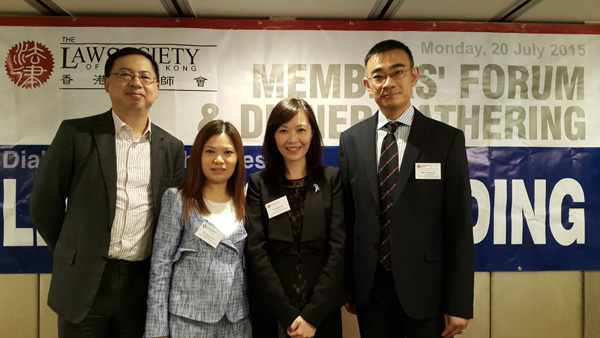
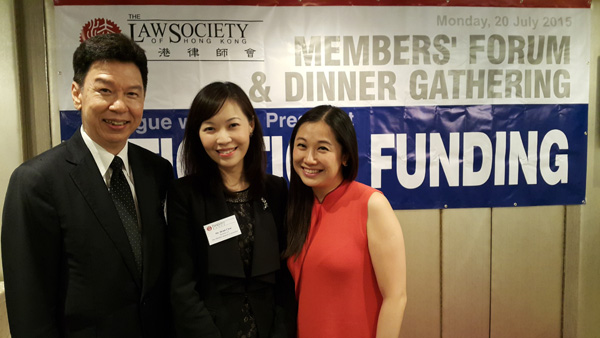
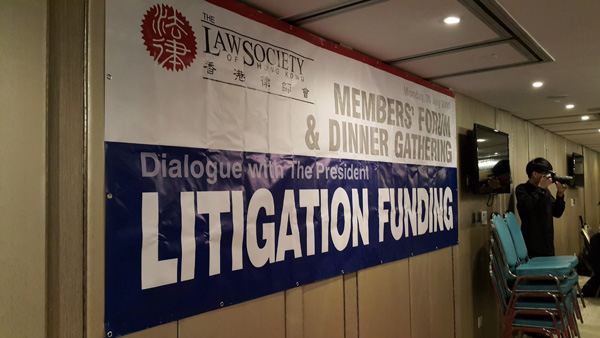
On 20 July 2015, our partners Mr. Eric Lui and Ms. Heidi Chui attended The Law Society’s Members’ Forum and Dinner Gathering. Ms. Chui acted as one of the masters of ceremony of the event whereby ideas and views were exchanged on the topic of “litigation funding” among members. Members shared their views on feasibility and desirability of litigation funding in the Hong Kong legal service market.
Please contact our Mr. Lui or Ms. Chui for any enquiries or further information about this event.
Summary:
The Court of Appeal in Citic Pacific Limited v Secretary for Justice (2015 HKEC 1263) disagreed with the narrow approach in Three Rivers (No.5) to the definition of “client”. In the context of corporations where the information may be acquired from employees in different departments or at various levels of the corporate structure, the court considered that the process of gathering information for the purpose of obtaining legal advice needs to be protected. The Court of Appeal also held that the “client” is simply the corporation, and the question is “which of its employees should be regarded as being authorized to act for it in the process of obtaining legal advice.”
Relying on the constitutionally entrenched right of legal professional privilege (hereinafter, “LPP”) (which is protected by Article 35 of the Basic Law), the Court of Appeal adopted a broader test for legal advice privilege than that previously adopted. It held that the “dominant purpose test” espoused by Tomlinson J (as he then was) in Three Rivers (No.5) sets the proper limit for legal advice privilege, i.e. an internal confidential document produced or brought into existence with the dominant purpose that it or its contents are used to obtain legal advice is privileged from production.
Conclusion
The impact of the Court of Appeal judgment is two-fold. Firstly, a broader definition of “client” has been embraced, one that is not just limited to the legal department of a corporate entity. Secondly, the “dominant purpose test” is considered more appropriate in setting the proper limit to legal advice privilege. As a result of this case, this means that documents produced by employees for the dominant purpose of obtaining legal advice are likely to be privileged.
Further, the Court of Appeal also noted the unsatisfactory nature of the procedure by which the matter had proceeded before the judge (the judge did not have the assistance he should have had from the parties in examining the documents), and urged the Department of Justice and the legal profession to consider the English experience of engaging an independent lawyer to deal with LPP material.