News
Find out all about our firm’s latest news and activities below. To learn more about any individual item, please contact us here.
 Stevenson, Wong & Co.
News
Find out all about our firm’s latest news and activities below. To learn more about any individual item, please contact us here.
In the recent case Provisional Liquidators of China Medical Technologies Inc v Samson Tsang Tak Yung [2015] HKEC 224, HCCW No.435 of 2012, the liquidators’ application to produce the “private papers” (such as bank statements and purported divorce documents) of the company’s former CFO was rejected by the Court.
Under section 221 of the Companies (Winding-up and Miscellaneous Provisions) Ordinance, Cap.32 of the Laws of Hong Kong (the “Ordinance”), the Court is empowered to order persons who have information relating to the “affairs, or property of the company” to be examined on oath (section 221 (1) and (2)) or to produce documents “relating to the company” (section 221(3)).
The liquidators in the case sought production of a wide-ranging of documents from the former CFO on the basis that he and his associates had allegedly been misappropriating the funds of the company following its IPO and issuance of bonds. In essence, the justifications for the production of the “private papers” put forward by the liquidators were that (1) the liquidators are responsible for the recovery of the company’s property and this included contingent claims on behalf of the company and (2) with reference to the similar powers in other common law jurisdictions the power of production should not be limited to documents “relating to the company” but included documents relating to the “affairs, or property” of the company”.
While granting wide orders for production against the CFO and orders for his examination, the Court refused to order production of the his private papers, considering that the power of production under section 221(3) of the Ordinance does not cover a defendant’s private papers and that “an order for production of private papers is more intrusive than an examination at which [the defendant] can be asked questions about his financial circumstances”.
It has been reported that leave to appeal against the decision has been granted. It remains to be seen whether the decision will be upheld in the appellate court.
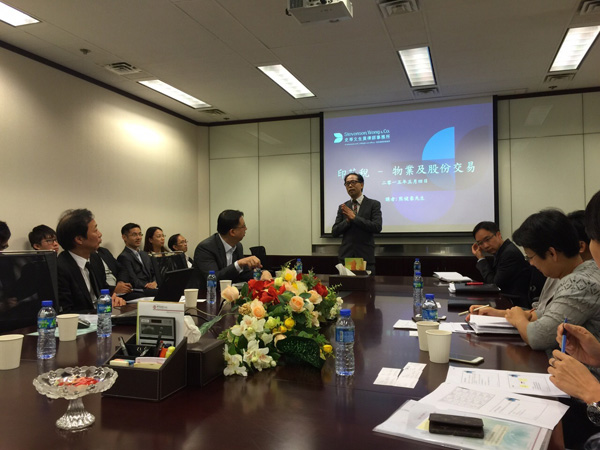
On 4 May 2015, SW partner Mr. Eric Lui, senior associate Ms. Freda Au, legal executives Mr. Stanley Hung and Mr. Man Wong delivered a presentation on stamp duty issues involving properties and share transactions at Commercial Business II – Corporate Banking and Financial Institutions of Bank of China (Hong Kong) Limited (“BCHK”). Over 50 representatives from BCHK attended the seminar.
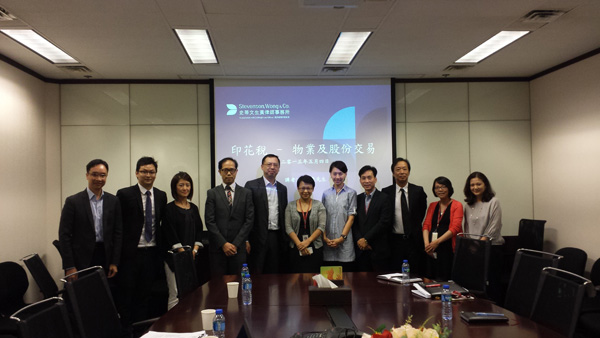
In the first part of the seminar, Mr. Lui introduced our firm to the audience and the joint venture law firm with AllBright Law Offices in Qianhai Modern Service Industry Co-operation Zone which will provide legal services to clients in both Hong Kong and Mainland China.
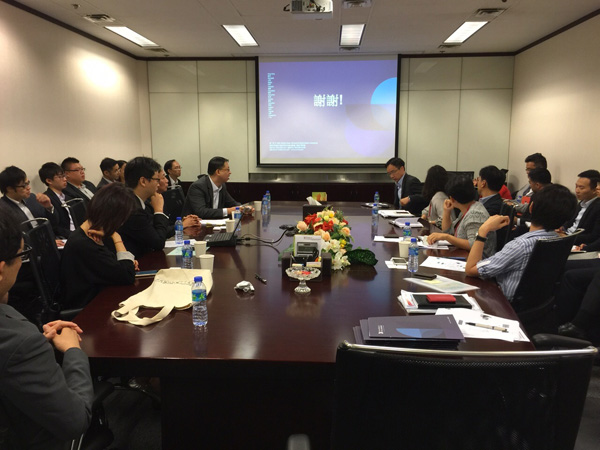
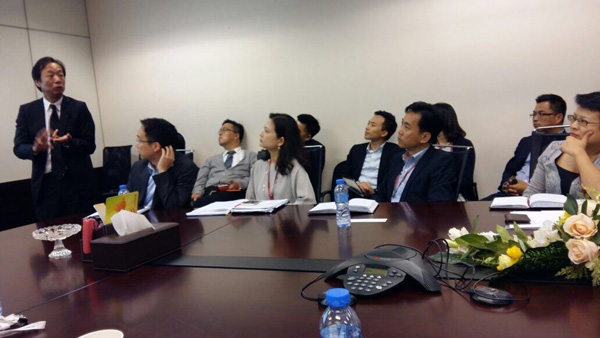
In the second part of the seminar, Mr. Wong and Mr. Hung gave practical advice to the audience on how the Stamp Duty Ordinance applies to property, and share transactions in Hong Kong and recent cases on Stamp Duty.
Please contact our Mr. Eric Lui for any enquiries or further information about this event.
On 2 May 2015, SW litigation partners Mr Eric Lui, Mr Neville Watkins, Ms Heidi Chui and associate Ms Katy Lai attended the ceremony marking the appointment of Mr Nigel Kat, Mr Martin Hui Siu-ting, Mr Hectar Pun Hei, Mr David Leung Cheuk-yin, Mr Jeremy Bartlett, Mr Douglas Lam Tak-yip, Mr Victor Dawes, Mr William Tam Yiu-ho, Mr Bernard Man and Mr Wayne Walsh as Senior Counsel of the Hong Kong Special Administrative Region at the Island Shangri-la Hotel.
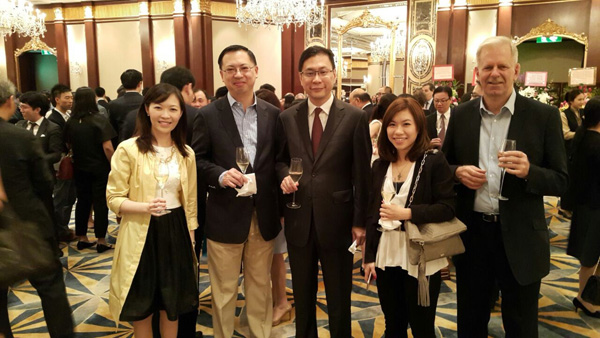
Photo taken with Mr Victor Dawes SC (Left: Ms Heidi Chui, Mr Eric Lui, Mr Victor Dawes SC, Ms Katy Lai, Mr Neville Watkins)
Please contact our Mr Lui for any enquiries or further information about this event.
Stevenson, Wong & Co. assisted Shenzhen Qianhai Financial Holdings Co., Ltd. to issue RMB1 billion credit enhanced bonds on HKEx (85714.hk)
Acting for Shenzhen Qianhai Financial Holdings Co., Ltd. (the “Issuer”) as the legal advisers as to Hong Kong laws for its CNY1,000,000,000 4.55 percent credit enhanced bonds with the benefit of an irrevocable standby letter of credit provided by China Development Bank Corporation. The joint global coordinators were Industrial and Commercial Bank of China (Asia) Limited and Hongkong and Shanghai Banking Corporation Limited. The joint lead managers and joint bookrunners were CITIC Securities International, CMB International, Guotai Junan International, Shanghai Pudong Development Bank Co., Ltd. (Hong Kong branch), Haitong International and BOC International.The net proceeds will be used by the Issuer as follows: 50 percent will be remitted into the PRC and used for equity investments in enterprises established in Qianhai Shenzhen-Hongkong Modern Service Industry Cooperation Zone of Shenzhen (“Qianhai”), and 50 percent will be injected into the Issuer’s Hong Kong subsidiary, Qianhai International Holdings Co., Ltd. The Issuer is the first financial investment service platform in Qianhai and is wholly-owned by the Authority of Qianhai Shenzhen-Hongkong Modern Service Industry Cooperation Zone of Shenzhen.
Please contact our Mr. Hank Lo for any enquiries or further information about this transaction.
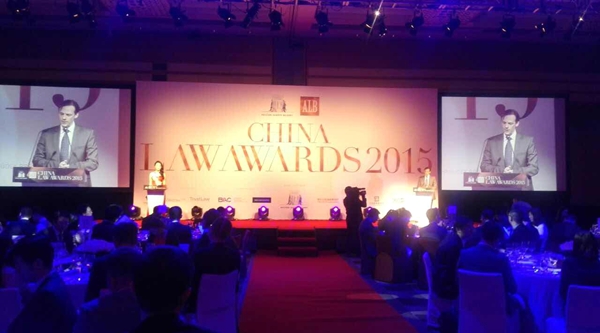
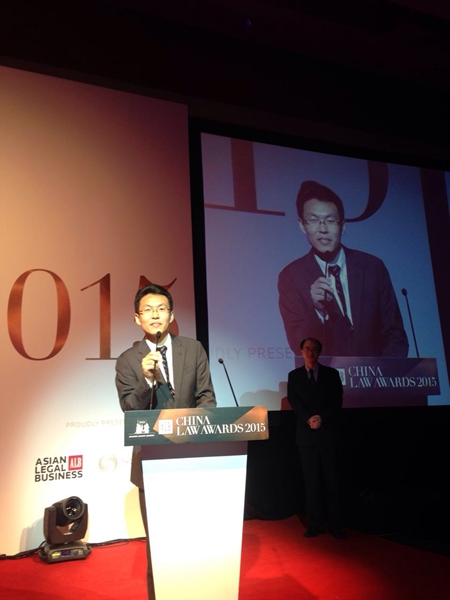
The 12th Annual Asian Legal Business (ALB) China Law Awards 2015 was held on April 23, 2015 in Beijing which recognizes the excellence and outstanding achievements of China’s leading law firms and in-house legal teams as well as the top deals and dealmakers for the past year.
The awards night on April 23, 2015 was held at The Park Hyatt Hotel in Beijing and attracted CEOs, bankers and legal luminaries from the judiciary, domestic and multinational companies, law firms, and academe in China. At the award ceremony, AllBright Law Offices which is in association with SW won the prize for the Shanghai Law Firm of the Year. AllBright’s partner, Yang Bin, received the award on behalf of the firm and gave a thank you speech. The Annual ALB China Law Awards provides unparalleled networking opportunities, live entertainment and fine gourmet food, a must go to ceremony in every lawyer’s event calendar.
Cannot Sing Along!
Gold Typhoon Entertainment Limited v Legend World Asia Group Limited (Phonographic Performance (South East Asia) Limited as Third Party) HCA1931/2012 – Court of First Instance
The plaintiff, Gold Typhoon Entertainment Limited, is the owner of the copyrights of karaoke music videos (“KMVs”) of local popular songs in Hong Kong. The defendant is operating a karaoke pub known as Vegas Club in which karaoke music videos are performed.
From 2005 and until January 2008, the plaintiff authorized Phonographic Performance (South East Asia) Limited (“PPSEAL”) to grant on its behalf both the necessary K-Server licence and the required Public Performance licence (“PP licence”) of its KMVs to karaoke establishments.
Since January 2008, the plaintiff ceased to authorize PPSEAL to grant K-Server licence but continued authorizing PPSEAL to grant PP licence. Thereafter, the plaintiff authorized other licensing bodies, namely Music Link Limited (“Music Link”) and Music and Video Copyright Management (HK) Limited (“MVCM”), to grant its K-Server licence.
At present, the plaintiff does not authorize any licensing bodies for granting its K-Server licence.
In or about September 2009, the defendant obtained the K-Server licence of the plaintiff’s KMVs through Music Link. The defendant paid quarterly to Music Link a royalty fee of $3,500 per month for the K-Server licence.
Since 1 January 2010, as MVCM has replaced Music Link as the licensing body, the defendant obtained the K-Server licence from MVCM but the royalty fee has been increased to $5,100 per month. The K-Server licence granted by MVCM expired in January 2011 and there has since then been no renewal of the K-Server licence of the plaintiff’s KMVs to the defendant.
The plaintiff claimed that the defendant played the plaintiff’s KMV in its premises through a computer system without proper licence. The plaintiff also claimed that the defendant should obtain a K-Server licence for its business because a PP licence is not enough for reproducing KMVs through a computer system.
The defendant raised the following defences:
(1) The K-Server licence granted to the defendant in respect of the plaintiff’s KMVs is a permanent licence, covering also the payment of the monthly licence for KMV’s songs;
(2) The right to play the plaintiff’s KMVs by the defendant is covered by the PP licence obtained from PPSEAL;
(3) The plaintiff is put to strict proof of its ownership and subsistence of the copyrights of the relevant KMVs; and
(4) The plaintiff’s KMVs do not constitute “work” within the meaning of the Copyright Ordinance, Cap 528 (“CO”).
For the first defence, the court found that there is no dispute that the K-Server licence would expire and it is undisputable that the defendant has had, upon the expiry of the K-Server licence previously granted to it, applied for and secured another term of the same licence. On the face of it, this is contrary to the suggestion that the K-Server licence is of a permanent nature. The argument that the fee paid by the defendant is for the downloading of new songs into the computer systems is rejected. Further, the defendant did not seek to uphold its rights under the permanent licence it has alleged, but immediately deleted all works of the plaintiff from its computer system. This conduct of the defendant is totally contradictory to what he suggested as the terms of the licence agreement.
The second defence was also rejected as whatever licence granted by PPSEAL to the defendant after 2008 should not cover the same rights as conferred under a K-Server licence.
For the third defence, the court found that as the defendant has been holding both K-Server licence and PP licence granted by the plaintiff’s licensing agents from September 2009 to January 2011, it has therefore been recognizing as the plaintiff’s intellectual property rights in the subject KMVs for many years. The defence was therefore rejected even if there were a number of technical defects in the plaintiff’s statutory declaration.
Lastly, the defendant relied on section 65 of the Copyright Ordinance, which says:-
“Notwithstanding section 23, copyright in a work is not infringed by the making of a transient and incidental copy which is technically required for the reviewing or listening of the work by a member of the public to whom a copy of the work is made available.”
Nevertheless, the defendant could not be a member of the public to whom a copy of the work is made available and therefore section 65 could not be applied.
A permanent injunction is then granted to the plaintiff. And as the conduct of the defendant does not amount to flagrant misconduct in that it has been consistently paying various royalty to licensing bodies in running its karaoke business. No additional damages was awarded to the plaintiff.
Please contact Mr. Angus Forsyth and Ms. Lai Lam for any enquiries or further information about this update.