News
Find out all about our firm’s latest news and activities below. To learn more about any individual item, please contact us here.
 Stevenson, Wong & Co.
News
Find out all about our firm’s latest news and activities below. To learn more about any individual item, please contact us here.
The essence of the privity of contract rule means that only the parties to a contract can enforce it.
In an attempt to relax certain aspects of a rule that is at times artificial, various jurisdictions have implemented statutes providing for third party rights, including Hong Kong. The Contracts (Rights of Third Parties) Ordinance, Cap.622 is expected to come into force on 1st January 2016 and will enable a third party to enforce his rights in a more straightforward manner.
A third party can enforce a contract either where it is expressly provided so (section 4(1)(a) of Cap.623) or where it purports to do so (section 4(1)(b) of Cap.623).
Section 6 of Cap.623 makes it clear that the contracting parties may not, without the third party’s consent, by agreement vary or rescind the third party’s rights so that the third party’s right is altered or extinguished.
In England, the default position in the commercial world has been to exclude such third party rights. However, there are some areas where the Contracts (Rights of Third Parties) Act 1999 has not been excluded in its entirety, such as in the context of M&A transactions.
For example, where a seller agrees not to compete but fails to abide by the restrictive covenant, this may mean that the buyer’s group of companies may suffer losses. It is therefore common for contracts governed by English law to make use of the rights under the Contracts (Rights of Third Parties) Act 1999 to directly enforce restrictive covenants.
The aforementioned example demonstrates that whilst the default commercial position in the UK is to exclude the Contracts (Rights of Third Parties) Act 1999, there should always be a careful consideration of the context and circumstances of each contract before the parties choose to adopt such default position.
Stevenson, Wong & Co. acted for Orient ZhiHui Limited (Issuer) as the legal advisers as to Hong Kong laws for its USD 150 million private placement bonds
SW acted for Orient ZhiHui Limited (Issuer) as to Hong Kong laws for its USD 150 million private placement bonds with the benefit of a Keepwell Deed provided by Orient Securities Company Limited. The interest rate of the bond was 4.09% and the joint placing agents were Nomura International (Hong Kong) Limited and Orient Securities (Hong Kong) Limited. The joint subscribers were Bank of America Singapore Branch and Industrial Bank Co., Ltd.
Background
Section 81(4) of the Ordinance states that “[t]he leave of the Court is required for any appeal from a decision of the Court under article 34 of the UNCITRAL Model Law, given effect to by subsection (1).” The “Court” refers to the Court of First Instance (hereinafter, “CFI”).
In China International Fund Ltd v Dennis Lau & Ng Chun Man Architects & Engineers (HK) Ltd (2015) HKEC 1626, the Court of Appeal (hereinafter, “CA”) considered the constitutionality of section 81(4).
The Applicant sought leave to appeal against L Chan J’s decision (the learned judge dismissed the Applicant’s application to set aside an arbitration award). The Respondent contended that the CA has no jurisdiction to grant leave because of section 81(4), whilst the Applicant contended that this section is unconstitutional because it disproportionately restricts the Court of Final Appeal’s power of final adjudication (as per Article 82 of the Basic Law)
Judgment
The CA held that notwithstanding the apparent finality of section 81(4), it possesses a residual jurisdiction to supervise the process in the CFI as a means of redress in the rare case where a lower court’s decision to refuse leave cannot be regarded as a judicial decision.
The CA also held that section 81(4) imposes finality in respect of the CFI’s decision on whether leave to appeal should be granted, but this is subject to its residual jurisdiction (as aforementioned). The CA held that if multiple rounds of applications were to be allowed, the legitimate aims of dispute resolution by arbitration (that is, finality, speed and reduction of costs) would be undermined. Further, the limitation in section 81(4) was held to be not more than what is necessary to achieve the aforesaid legitimate aims.
Robotunits Pty Ltd v Juergen Karl Mennel (2015) VSC 268 is a case from the Supreme Court of Victoria concerning disputes arising from shareholders agreements.
The Defendant sought a stay of the proceedings and referral to arbitration on the basis that the parties agreed to submit disputes between them to arbitration. He sought to rely on the arbitration agreement in Clause 15(2) of the Amended Shareholders Agreement, which stated as follows:
“Each party irrevocably and unconditionally submits to arbitration in accordance with the arbitration guidelines of the Law Institute of Victoria.”
Is there an operable arbitration agreement? Croft J held that it was undisputed that on its face the arbitration agreement was pathological because “the arbitration guidelines of the Law Institute of Victoria” referred to” do not exist and do not appear to have ever existed.” The Claimant conceded that the agreement may be rendered effective with judicial assistance. Croft J found the words in Clause 15(2) to be strong words evincing a clear intention to submit disputes, falling with the scope of the arbitration agreement, to arbitration. As such, it was held that the arbitration agreement is operable and capable of forming the basis of the orders sought by the Defendant.
Croft J held that the whole of the proceedings should be stayed, but only the issue of whether the Shareholders Agreements provided a legal or equitable basis for the Defendant to cause the Claimant to make the share payment shall be referred to arbitration. It was further held that as a result of the pathologies of the arbitration agreement, the orders should be made on the condition that the parties (within 28 days) seek to agree on the arbitral seat and the rules of the arbitration.
On August 22 2015, SW Head of Business Development (China), Ms. Connie Yeung, was invited to speak about overseas allocation and asset protection, which was organized by the FWD Hong Kong. Ms. Yeung shared techniques in overseas asset allocation and asset protection with more than 30 senior insurance financial planners and their clients. Participants found the sharing useful, practical and in particular, on how a family trust with different insurance policies can help to secure cash flows.
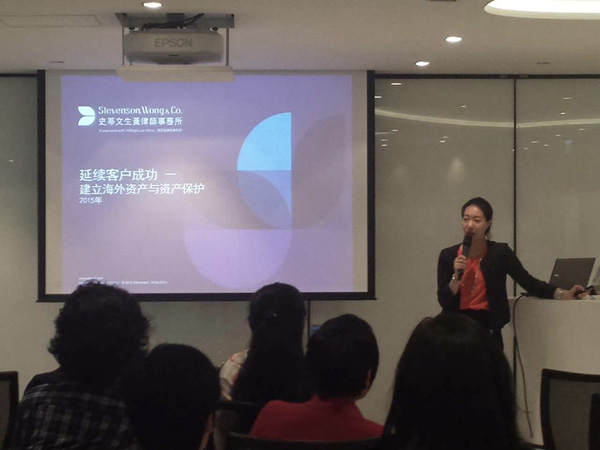
Please contact our Connie Yeung for any enquiries or further information about this event.
On August 21 2015, Head of Business Development (China), Ms. Connie Yeung, was invited to train more than 40 private bankers from the Bank of China, Harbin on asset protection and succession planning. Ms. Yeung has been invited to the same training for two consecutive years, which was held in Wu Yi Mountain and previously in Nanjing. The participants came from different provinces and included private bankers and branch managers. Ms. Yeung shared her views on the difficulties of succession and the advantages and disadvantages of different tools including the use of wills, trusts and power of attorneys.

Please contact our Connie Yeung for any queries or further information about this event.