News Updates
Find out all about our firm’s latest news updates below. To learn more about any individual item, please contact us here.
News Updates
Find out all about our firm’s latest news updates below. To learn more about any individual item, please contact us here.
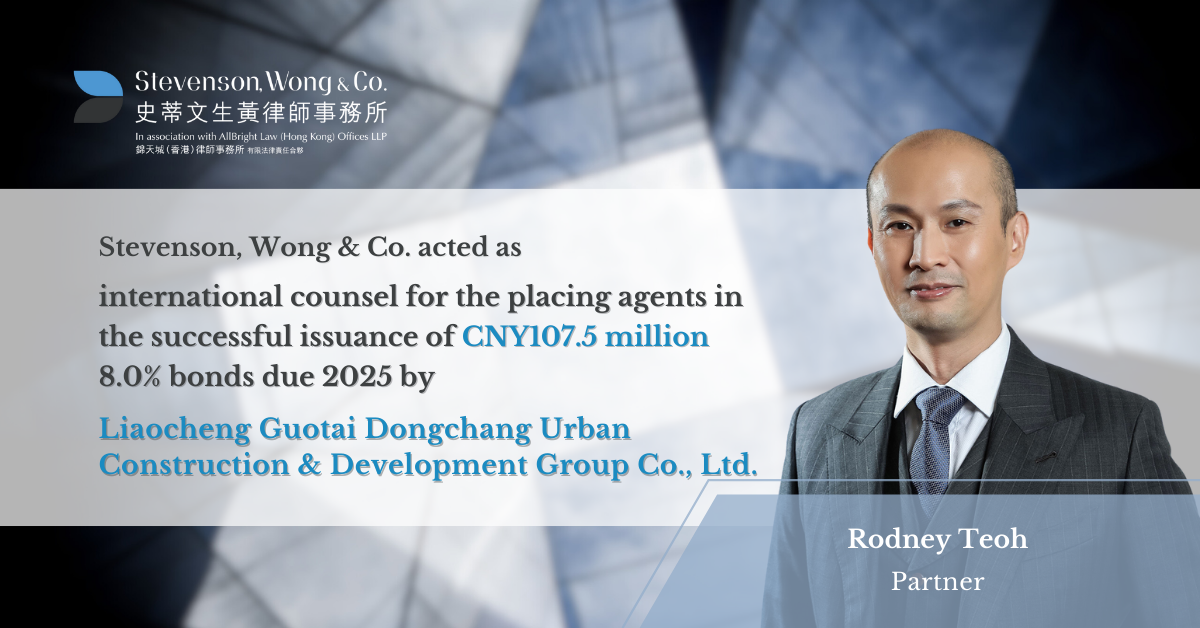
Stevenson, Wong & Co. acted as international counsel for the placing agents in the successful issuance of CNY310 million 8.0% bonds due 2024 by Weihai Nanhai Investment and Development Co., Ltd. (the “Issuer”).
…
The Issuer is a state-owned enterprise wholly-owned by the Weihai Nanhai New District Management Committee. The Issuer is one of the crucial state-owned investment and operating entities in the Weihai Nanhai New District, principally engaged in the businesses of agent construction, sales of products and water supply. Fortune Origin Securities Limited, Tung Yat Securities Limited and China Galaxy International Securities (Hong Kong) Co., Limited acted as the placing agents in this issuance.
Our team was led by Partner Mr. Rodney Teoh, supported by team members including Associates Ms. Angela Lau and Ms. Audrey Ng, Trainee Solicitor Mr. Leo Choi and Paralegal Mr. Jay Lee.
Please contact our Partner Mr. Rodney Teoh for any enquiries or further information.
Introduction
On 15 December 2023, The Stock Exchange of Hong Kong Limited (the “Hong Kong Stock Exchange”) published conclusions (the “Consultation Conclusions”) to its consultation paper on GEM Reforms (the “Consultation Paper”).
…
During the consultation period which ended on 6 November 2023, the Hong Kong Stock Exchange received 58 responses in total. After considering the comments made by the respondents, the Hong Kong Stock Exchange has adopted all the proposals in the Consultation Paper with minor adjustments and clarifications. For more details of the proposed GEM listing reforms, please refer to our news update on the Consultation Paper. The said proposals came into effect on 1 January 2024.
The Hong Kong Stock Exchange has marked several modifications and clarifications to its original proposals in Chapter 2 of the Consultation Conclusions, which the conclusions are summarised below:
Initial Listing Requirements
New Alternative Eligibility Test
The Hong Kong Stock Exchange proposed a new financial eligibility test (the “market capitalisation / revenue / R&D test”) to attract high-growth enterprises heavily involved in R&D. Concerns were raised about its effectiveness in attracting new GEM listings and favouring technology industries over traditional ones. The Hong Kong Stock Exchange clarified that the market capitalisation / revenue / R&D test is open to companies from all industries with substantial R&D investment, therefore, small and/or medium-sized enterprises (“SMEs”) in traditional industries can still list on GEM if they meet cash flow test thresholds. The Hong Kong Stock Exchange will monitor the market capitalisation / revenue / R&D test’s effectiveness and make adjustments if needed.
Reduction of Post-IPO Lock-up Period for Controlling Shareholders
Regarding the post-IPO lock-up period for controlling shareholders of GEM issuers, the proposed duration was reduced from 24 to 12 months. While there are concerns about operational instability and shell activities, the Hong Kong Stock Exchange considers them adequately addressed by emphasising existing rules and guidance on reverse takeovers and the delisting regime. As such, the 12-month lock-up period is considered sufficient to balance the interests of investors and post-IPO fundraising flexibility of the GEM issuers.
Existing Eligibility Requirements
Though not mentioned in the Consultation Paper, some respondents suggested lowering the minimum market capitalisation of HK$150 million and cash flow requirement of HK$30 million for GEM listing. However, the Hong Kong Stock Exchange decided to maintain the existing requirements, commenting that the current minimum market capitalisation is already lower comparing to peer markets and that operating activities which generate a reasonable level of cash flow are more likely to indicate business sustainability.
Continuing Obligations
Compliance Officer and Compliance Adviser
The Hong Kong Stock Exchange removed the requirement for an executive director of a GEM issuer to serve as the compliance officer, with the view that the board of directors collectively holds responsibility for compliance, making the role of compliance officer unnecessary. To ease the financial burden of GEM issuers and further align with the rules applicable to Main Board issuers, the engagement period for compliance advisers is also shortened so that it ends on the date on which the GEM issuer publishes its financial results for the first full financial year commencing after the date of its initial listing.
Periodic Reporting Requirements
As to the removal of mandatory quarterly financial reporting for GEM issuers, while some respondents preferred retaining quarterly reporting to enhance transparency, the Hong Kong Stock Exchange believed that removing the requirement (and only keeping it as a recommended practice) would reduce compliance costs for GEM issuers. Respondents unanimously supported aligning financial reporting timeframes of GEM issuers with those of the Main Board, as both markets adhere to the same accounting standards and report preparation process. A respondent suggested amending the guidance letter HKEX-GL25-11 to reflect the change in publication timeframes, which the Hong Kong Stock Exchange agreed to.
Transfers to the Main Board
New Streamlined Transfer Mechanism
In the Consultation Paper, the Hong Kong Stock Exchange planned to introduce a streamlined mechanism for qualified GEM issuers to transfer their listings to the Main Board. An overwhelming proportion of respondents supported this proposal, believing that the streamlined transfer mechanism will enhance accessibility and efficiency, eliminate the need for a redundant “prospectus-standard” listing document, and save time and costs by removing the requirement for sponsor appointment. Considering the majority support, the Hong Kong Stock Exchange has adopted this proposal.
Track Record Requirements
As part of the streamlined transfer process, applicants are required to demonstrate a minimum track record of ownership continuity and control, as well as of no significant changes in their principal business for three full financial years as a GEM listed issuer before the transfer. Some respondents considered the three-year period to be too long and proposed shortening it to one or two years. However, the Hong Kong Stock Exchange believed the three-year compliance record is necessary to justify the streamlined transfer arrangements, while decided to retain the existing transfer mechanism alongside the new streamlined transfer mechanism. The existing mechanism requires a transferee to demonstrate a one-year pre-transfer track record period after GEM listing. In other words, GEM issuers can choose the existing transfer route over the streamlined mechanism for a quicker transfer if the benefits outweigh the costs associated with sponsor due diligence and the production of a “prospectus-standard” listing document.
Liquidity and Valuation Requirements
Transfer applicants must also meet certain liquidity and valuation criteria, including the Daily Turnover Test and the Volume Weighted Average Market Capitalisation Test as described in the Consultation Paper. Supporting respondents considered that a daily turnover requirement could reflect adequate investor demand in the GEM issuer’s securities, and the minimum daily turnover threshold is set at HK$50,000. Regarding the Volume Weighted Average Market Capitalisation Test, for the purpose of assisting issuers and market practitioners, the Hong Kong Stock Exchange will further provide illustrative examples to explain how to calculate the volume weighted average market capitalisation of an issuer.
Compliance Record Requirement
The Hong Kong Stock Exchange has introduced a compliance record requirement for streamlined transfers. This means that transfer applicants must not have committed a serious breach or be the subject of an investigation or ongoing disciplinary proceedings related to a serious or potentially serious breach of the Listing Rules. Some raised concerns about the presumption of innocence and the potential disruption and costs associated with cancelling a transfer application if an applicant is only made aware of an investigation at the time of application. In response, the Hong Kong Stock Exchange again emphasised the importance of a clean compliance record to mitigate the risk of disciplinary action or serious breaches after the GEM issuer being transferred to the Main Board.
Costs for Transfers of Listing
The proposal of exempting GEM transferees from the Main Board initial listing fee received widespread support, as it reduces the cost of transferring from GEM to the Main Board and incentivise qualified companies to choose the streamlined transfer mechanism.
Analysis and takeaways
The lack of GEM listings in recent years has underscored the need for reforms to enhance its competitiveness. By reintroducing the streamlined transfer mechanism with modifications and clarifications in the Consultation Conclusions, GEM listing reforms may attract SMEs from Hong Kong and the Greater Bay Area that are seeking a listing, and reduce compliance costs for current GEM issuers while maintaining market quality and protection to investors.
Effectiveness of the reforms in restoring vitality to the GEM market is yet to unfold. Hopefully, the GEM reforms will pave the way for a more conducive environment to SMEs, new listings, and a more vibrant GEM market.
Please contact our Partner Mr. Rodney Teoh for any enquiries or further information.
This news update is for information purposes only. Its content does not constitute legal advice and should not be treated as such. Stevenson, Wong & Co. will not be liable to you in respect of any special, indirect or consequential loss or damage arising from or in connection with any decision made, action or inaction taken in reliance on the information set out herein.
On 2 November 2023, the Securities and Futures Commission of Hong Kong (the “SFC”) issued a circular (the “Circular”) regarding the tokenisation of SFC-authorised investment products for offering to the public in Hong Kong.
…
Background
Tokenisation of investment products is a process that leverages blockchain technology to represent ownership in traditional investment assets, such as real estate, stocks, bonds, or funds, through digital tokens. Please also see our news update in relation to the Guide to Digital Assets and Tokens in Hong Kong. These tokens are created on a blockchain network and serve as digital representations of the underlying assets, made available directly to individual investors, distributed by the intermediaries who are licensed by the SFC, or traded among the blockchain participants, in accordance with applicable regulations.
In Hong Kong, certain stakeholders have already initiated or are actively exploring the tokenisation of securities and other investment products in which the tokenisation is expected to be capable of enhancing product efficiency, lowering operational expenses by decreasing dependence on intermediaries, and accessing the end-investors through new channels.
To meet market demand and support the growth of the market, the SFC has been evaluating different suggestions related to the tokenisation of investment products. These proposals encompass a range of activities, including primary transactions involving tokenised products such as subscriptions and redemptions, as well as secondary trading of tokenised products on virtual asset trading platforms licensed by the SFC. The SFC believes that employing a see-through approach is suitable to permit primary dealing of tokenised SFC-authorised investment products. Nevertheless, this is contingent upon the underlying product meeting all the relevant requirements for product authorisation and the implementation of additional safeguards to address the potential risks associated with the tokenisation arrangement.
Conversely, the secondary trading of SFC-authorised investment products that have been tokenised requires greater caution and meticulous evaluation to ensure that investors receive a level of protection that is substantially equivalent to that provided for non-tokenised products. Several factors need to be considered, including maintaining accurate and immediate records of token ownership, the preparedness of trading infrastructure and market participants to facilitate liquidity, and the equitable pricing of tokenised products, among other considerations.
Guidelines pertaining to the primary dealing of tokenised SFC-authorised investment products
Product providers of tokenised SFC-authorised investment products must ensure that the underlying products comply with the applicable requirements outlined in relevant rules, regulations and product codes. These requirements encompass various aspects, including the eligibility of product providers, product structure, investment and operational criteria, disclosure obligations, and ongoing compliance responsibilities. In addition, requirements in the Circular on intermediaries engaging in tokenised securities-related activities released by the SFC on 2 November 2023 (the “Tokenised Securities Circular”) should also be satisfied (please see our news update on the Tokenised Securities Circular).
1. Tokenisation arrangement
Considering that tokenised products are publicly offered in Hong Kong and the significance of accurately reflecting investors’ ownership through proper records, product providers have a ultimate responsibility for the management and operational soundness of the tokenisation arrangement adopted, as well as the accurate record-keeping of ownership, regardless of any outsourcing arrangements. They should ensure the proper maintenance of records regarding token holders’ ownership interests in the product, while ensuring operational compatibility with the involved service providers. Further, they must also implement suitable measures to identify, manage, and mitigate cybersecurity risks, ensure data privacy, address system outages and recovery, and maintain a comprehensive and robust business continuity plan.
When utilising blockchain networks, product providers should avoid using public-permissionless networks without adequate controls. Instead, they should impose additional control by employing a permissioned token. Product Providers are required to, confirm and, when requested by the SFC, demonstrate to the satisfaction of the SFC the management and operational soundness of the tokenisation arrangement, record-keeping of ownership, and the integrity of smart contracts.
Upon request from the SFC, product providers should obtain third-party audits or verifications to assess the management and operational soundness of the tokenisation arrangement, record-keeping of ownership, and integrity of smart contracts. Furthermore, product providers should obtain satisfactory legal opinions to support their applications upon SFC’s request.
2. Disclosure
The offering documents for a tokenised SFC-authorised investment product should provide clear information on the following:
(i) the tokenisation arrangement, including explicit disclosure regarding whether off-chain or on-chain settlement is considered final;
(ii) the ownership representation of the tokens, such as details about legal and beneficial title, as well as ownership of or interests in the product; and
(iii) the risks associated with the tokenisation arrangement, for instance, cybersecurity vulnerabilities, system outages, the potential existence of undiscovered technical flaws, the evolving regulatory landscape, and potential challenges related to the application of existing laws.
For more disclosure requirements, please also refer to paragraphs 19 to 20 of the Tokenised Securities Circular.
3. Intermediaries and staff competence
Distributors of tokenised SFC-authorised investment products as well as product providers who distribute their own products must be regulated intermediaries such as SFC-licensed corporations or registered institutions. They are required to adhere to the relevant requirements outlined in existing rules, codes, and guidelines. This includes meeting obligations related to client onboarding requirements and conducting suitability assessments on their investors. Product providers are also required to provide confirmation to the SFC that they have at least one competent staff member with relevant experience and expertise to operate and/or supervise the tokenisation arrangement and to manage the new risks associated with ownership and technology in an appropriate manner.
Prior consultation and approval
For investment products with tokenisation features that intend to seek authorisation from the SFC, prior consultation with the SFC is necessary. The same applies to the tokenisation of existing SFC-authorised investment products, which may require prior approval, for instance, approval should be obtained before adding the disclosure of new tokenised unit/share class of an SFC-authorised fund in the Hong Kong offering documents and offering it to the public in Hong Kong.
Considering the dynamic nature of this field, the SFC reserves the right to provide additional guidance or impose further requirements specific to tokenised SFC-authorised investment products as deemed appropriate.
Analysis and takeaway
The Circular sets out the requirements under which the SFC would consider allowing tokenisation of SFC-authorised investment products for offering to the public in Hong Kong. The SFC’s evaluation of proposals and support for the tokenisation of investment products indicates the recognition of the market potential in Hong Kong. Tokenisation can provide opportunities for increased market efficiency, reduced costs, and expanded access to investment products for investors. Also, it may facilitate streamlining of processes and reduce reliance on intermediaries.
While the SFC recognises the potential benefits of tokenisation, it also places emphasis on investor protection and regulatory oversight. The SFC aims to strike a balance between accelerating the growth of tokenised investment products and ensuring that market participants adhere to the necessary requirements and safeguards. Ongoing communication among market participants, investors and the regulatory, and vigilance in mitigating risks, would be crucial in this evolving landscape.
Please contact our Partner Mr. Rodney Teoh for any enquiries or further information.
This news update is for information purposes only. Its content does not constitute legal advice and should not be treated as such. Stevenson, Wong & Co. will not be liable to you in respect of any special, indirect or consequential loss or damage arising from or in connection with any decision made, action or inaction taken in reliance on the information set out herein.