News
Find out all about our firm’s latest news and activities below. To learn more about any individual item, please contact us here.
 Stevenson, Wong & Co.
News
Find out all about our firm’s latest news and activities below. To learn more about any individual item, please contact us here.
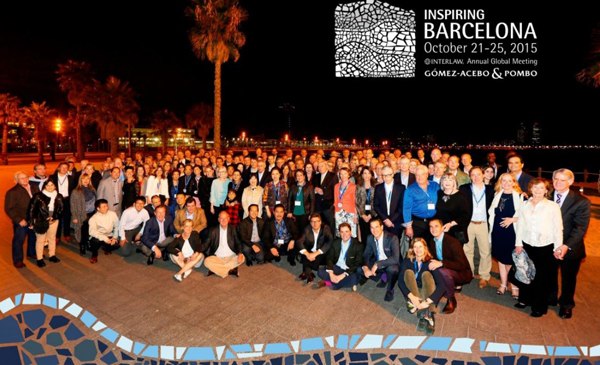
Our Willy Cheng and Lai Lam attended the Interlaw Annual Global Meeting held in Barcelona between 21-25 October 2015.
Close to 140 delegates which was a record number from almost every firm attended this annual event.
Both partners attended several Special Business Team Meetings which included Global IP/IT, Managing Partners, Next Generation and Women Lawyers of Interlaw.
Key speaker, Kevn Doolan, Managing Partner of Moller Professional Service Firms Group, University of Cambridge, and also a Harvard University Professor gave an informative talk on the pricing of legal fees and alternative fee structures. Other panel speakers included in-house counsel offering valuable insights into choice of law firms and using networks of independent law firms.
The diary for 2016 has already been planned for Regional conferences in Hanoi, Vietnam, Charlotte North Carolina, USA, Valletta, Malta and ending in with the AGM in Tokyo, Japan.
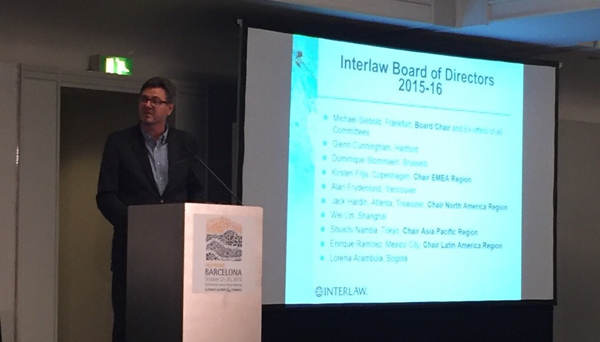
Michael Siebold, Chairman of Interlaw addressing delegates
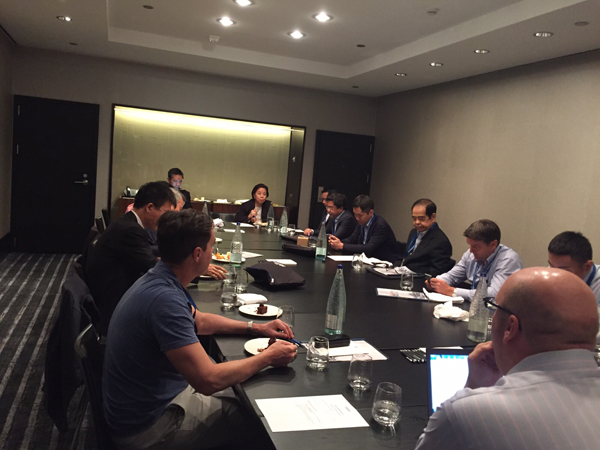
Delegates at the Asia Pacific Regional Meeting
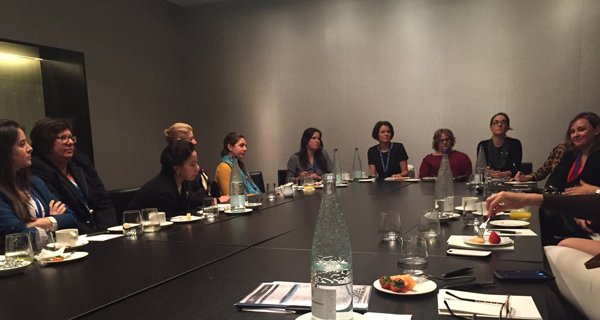
Women Lawyers of Interlaw
Please contact our Willy Cheng or Lai Lam for any enquiries or further information about this event.
The Plaintiff (“P”) and the Defendant (“D”) in Chan Sang v Chan Kwok [2015] 3 HKLRD 131 were brothers. P ran a business in a shop which P and D had equal shares as tenants in common. Their father (“F”) financed P’s purchase of the shop. P alleged that D, F and he had agreed that D would be a registered co-owner of the shop for the purpose of securing repayment of the loan to F. When the loan was fully repaid, D would deregister his name. P had repaid the loan but D refused to deregister his name.
P sought a declaration that he was the sole beneficial owner of the shop and D was holding his shares on trust for P and an order that D transfer his shares to P.
The Court decided that “common intention constructive trust” could be relevant in considering the parties’ common intention as to the beneficial ownership of a property and should not be limited to the “domestic consumer context”. However, the presumption of equality would not apply outside the “domestic consumer context”; whereas, the presumption of resulting trust would apply in a “commercial context”.
In this case, P solely purchased and paid for the shop. D was registered as a tenant in common of the shop to secure P’s repayment of the loan. The loan was already repaid by P. Thus, the Court held that P was the sole beneficial owner of the shop under either the common intention constructive trust or resulting trust principles.
(中文) 重婚,二婚,婚外恋的继承难点
改革开放后,中外交流频繁,外国人在中国重婚实际上是不难操作的。没有统一的婚姻信息联网也导致了中国境内的重婚可能。 年轻一辈为了各种原因在外国结婚的人愈来愈多,也制造了重婚的空间。
异地工作,移民热潮的太空人现象,增加了非婚生子女的风险;年长一辈丧偶再婚,年轻一辈闪婚闪离的情况都会出现同父异母或异父异母的子女。当然,如果丧偶再婚意味着二奶转正,问题就更复杂了!
这里面就出现了三个继承问题:1)中国继承法还是外国继承法适用问题2)中国继承法的子女是包含非婚生,有抚养关系和合法收养的,那就意味继承时会突然出现“素未谋面的亲戚”!3) 继承权公证时,不排除恶意受益人故意缺席会议,导致继承权没法/延误办理。
张先生离世后, 15岁的继承人发现原来自己是“二奶之子”,面对繁琐的继承流程,长辈离开的悲痛,重新适应生活,父亲美好形象破灭, 母亲意志消沉,还出现争产的情况,把他推到人生崩溃的边缘!
对张先生来讲, 家人之间感情互相伤害,争了好几年后,弱势一方妥协,资产分配也不是他的意愿;没想到几年下来,公司价值下降,证券投资亏损, 是他意料以外的!宝贝儿子从此荒废学业,前途尽毁,才是他最心疼的!
作为负责任的父母,应主动为孩子安排传承工具,保护财富并把其风险降到最低,而不应该让遗产被动地被继承。
如想了解更详细的海外信托对资产保护或继承安排的功能,请联系你的法律顾问/理财顾问/家族办公室。史蒂文生黄律师事务所成立了香港及新西兰信托公司,可为客户提供信托咨询或受托人服务。
分享资讯助人自助,谢谢关注微信公众号或浏览官方网站www.sw-hk.com。如需节录或转载,请注明资料来源为微信公众号swc_hk。
免责声明: 于此提供的资料只供参考,须以有关国家/地区法律顾问的法律意见和有关政府行政与司法机关对于适用的法例的解释和应用为准;上述资料亦受制于适用法例的任何不时的更新与修改,如因上述资料而引至任何人士或单位蒙受任何损失,该人士或单位须自行承担一切责任
On 17 October 2015,SW Head of Business Development (China) Ms. Connie Yeung was invited to speak at a client event at the head office of FWD Life Insurance Company (Bermuda) Limited (“FWD”) and delivered a presentation on “How to Protect Assets Through the Establishment of Family Trust and its Benefits. Approximately 60 financial planners and clients attended. The number of participants was double that of the same event held 2 months ago. Real cases were shared and participants all found the sharing both interesting and practical.

On 14 October 2015, SW Head of Business Development(China)Ms. Connie Yeung spoke at a forum organized by Pingan Private banking in Quanzhou. Zhongrong International Trust Co., a top 3 PRC trustee and active in family trust business was also present at the event. The focus was on how to use PRC and offshore family trust together to ring fence different types of assets.Approximately 20 HNWIs invited by Pingan private bank attended and all found the sharing not only inspiring but also useful.
The Law Society of England and Wales (“the Law Society”) has expressed concern that tightening tier 2 policies will potentially prevent international law firms in London from recruiting highly skilled and experienced foreign lawyers from around the world. It has been substantiated by statistics from the Law Society that holders of tier 2 visa in London law firms, encompassing associates, trainee solicitors and partners, have generated revenues of more than £34 million in the year of 2015-2016. Commentators are not optimistic about the draconian tier 2 policies, criticizing that such policies will preclude highly qualified legal practitioners from working for UK based law firms and hence hampering the lucrative markets of the legal sector.