13 Jul 2017

Hong Kong Legislative Council passed the Apology Bill

On 13 July 2017, the Hong Kong Legislative Council passed the Apology Bill, with the object of “promoting and encouraging the making of apologies with a view to preventing the escalation of disputes and facilitating amicable resolution.”

The Apology Bill is the first of its kind in Asian jurisdictions, consisting of 13 clauses and a schedule, and will be applicable to apologies made by a person (or those made on behalf of the person) on or after the commencement date of the Ordinance.

The Definition of an Apology and the Applicable Proceedings

Under the new law, evidence of an apology will not generally be admissible for determination of issues in any Applicable Proceedings, subject to certain exceptions. In practical terms, an apology will not be treated as admission of any fault or liability, or used against him in determining other issues (such as appropriate remedies or issues of credibility) in a defined set of Applicable Proceedings, i.e. judicial, arbitral, administrative, disciplinary, regulatory proceedings or any other proceedings conducted under an enactment.

An apology is defined as “an expression of the person’s regret, sympathy or benevolence in connection with the matter” made orally, in writing or by conduct, and typically includes an expression that “the person is sorry about the matter”. Significantly, the apology also includes any part of the expression that is an express or implied admission of the person’s fault or liability or a statement of fact in connection with the matter.

Exception

The new law would not apply to criminal proceedings, proceedings of the Legislative Council and other proceedings conducted under the Commissions of Inquiry Ordinance, the Control of Obscene and Indecent Articles Ordinance and the Coroners Ordinance.

An apology would also be admissible with the apology maker’s consent. The Court is also vested with the discretion to admit a statement of fact contained in an apology in an exceptional case, and only if it is just and equitable to do so, having regard to the public interest or the interests of the administration of justice.

Implications in other areas

An apology is precluded from constituting an acknowledgment of rights and hence would not extend the relevant limitation period of certain rights of action relating to land, personal property, debts and other claims.

Finally, in order to alleviate the concern of any adverse effect on insurance covers by apologies where some insurance contracts may contain provisions that prohibit the admission of fault by the insured without the insurer’s consent, the new law also provides that a person’s apology would not affect any insurance cover, compensation or other form of benefit under a contract of insurance or indemnity.

We anticipate that with the introduction of the Apology Ordinance, the concerns of making apologies can be alleviated and hence this would prevent escalation of disputes and encourage reaching an amicable resolution.

Should you have any enquiries to the bill, please contact our partner Ms. Heidi Chui for more details.
7 Jul 2017

Hong Kong Court Appoints Interim Receivers in Support of PRC CIETAC Arbitration

Hong Kong has long been an arbitration-friendly jurisdiction. Since the Arbitration Ordinance took effect from June 2011, as seen from various precedents, the Hong Kong Courts have been very supportive for international arbitration. The Court is willing to grant emergency/interim relief to preserve evidence, assets and the status quo as and when the situation calls for such reliefs, pending the final resolution of the dispute by the arbitral tribunal. The Court’s supportive stance is on full display in the latest case Chen Hongqing v Mi Jingtian & Others (HCMP 972/2017).

Background

The Plaintiff and the Defendants as well as other third parties entered into a series of loan and share pledge agreements, whereby the Defendants pledged their shares in China Shanshui Investment Company Limited (a Hong Kong company) to the Plaintiff. Any transfer of the shares to third parties was expressly prohibited in the agreements. The Plaintiff and the Defendants had some disputes in relation to the exercise of voting rights, and in February 2017 submitted the matter to CIETAC for determination in accordance with the agreements.

In March 2017, the Defendants agreed to sell the shares to the Asia Cement Corporation (ACC). In order to protect his interests, the Plaintiff invoked section 21M of the High Court Ordinance (Cap. 4) and section 45 of the Arbitration Ordinance (Cap. 609) to apply for interim reliefs, including the appointment of receivers over the shares in question and an injunction to restrain the Defendants from taking further steps to transfer the shares.

On 27 June 2017, the Honourable Madam Justice Mimmie Chan handed down judgment, and granted the reliefs sought.

The Requirements for s.21M and s.45 Interim Reliefs

The requirements for granting interim reliefs include:-
1. A serious question to be tried;
2. Risks of dissipation of assets;
3. Balance of convenience (e.g. any delay on the part of the Applicant, third party interests);
4. Enforceability of judgment/award in Hong Kong; and
5. Undertaking as to damages.

In respect of the 1st requirement, there is dispute between the parties as to whether the pledge agreement relied upon by the Plaintiff is effective and legally valid. Since the governing law of the pledge agreement is PRC law, the Court is of the view that it is not appropriate to make factual findings on the above issues. Such issues shall be determined by the arbitral tribunal, and the role of the Hong Kong Courts is to grant appropriate interim reliefs in support of the arbitral proceedings. As it is common ground that the pledge agreement contains an express provision restricting the transfer of the shares in question, the Court agrees that there is a serious issue to be tried.

With respect to the 2nd requirement, the Defendants have already executed the sale and purchase agreements and completed all steps in relation to the transfer, and the only remaining step is for the shares to be registered in ACC’s name. It is clear that there are risks of dissipation.

As regards the 3rd requirement, having considered and struck a balance among various factors, including any third party interests, whether the receivership is an appropriate remedy, and the most appropriate forum, the Court was inclined to grant the reliefs sought.

It is inevitable that the appointment of receivers would involve and affect the third party’s control and disposal (if any) of the shares in question, and as such in this case, ACC (being the purchaser of the shares) as an interested party, was granted leave to intervene in the proceedings to make submissions and adduce evidence. Taking into account the duties of the receivers, the Court held that the receivers had the expertise and independence to preserve the status quo and the value of the shares. The Court was also of the view that if the shares are to be transferred and registered in ACC’s name, and the Plaintiff’s claims to the shares were ultimately accepted by the arbitral tribunal to be valid and enforceable, the transfer of shares in breach of the pledge agreement would defeat the Plaintiff’s security rights and the purpose of the share pledge. Since the share transfer was almost completed but for the last step of registration, receivership should be a necessary remedy to preserve the shares.

This case also showcases the willingness of the Court to grant supplemental reliefs to fill the void of the relatively limited remedies or the lack of equivalent interim measures available in the jurisdiction of the arbitral tribunal. The Defendants submitted that since the arbitral tribunal is within PRC jurisdiction, the PRC Courts should be the most appropriate forum to grant interim reliefs. However, in the instant case the shares are those of a Hong Kong company, in which case the usual protection to share pledge under PRC law becomes inapplicable, and the PRC Courts cannot therefore grant the interim reliefs in respect of a Hong Kong company. Coupled with the fact that ACC was not a party to the arbitration, the arbitral tribunal cannot grant interim reliefs against ACC either. In the circumstances, the Court affirmed the position that the appointment of receivers by the Hong Kong Court will not usurp the jurisdiction of the PRC Courts and in this case, the Court is in a position to grant the relevant supplemental interim reliefs in support of PRC arbitration.

The Court also found that the delay on the part of the Plaintiff would not frustrate his application. With the 4th and the 5h requirements being fulfilled, the Court granted the interim reliefs sought, i.e. the appointment of interim receivers over the shares and the relevant injunctions against the Defendants.

Significance of the Case

As explained above, the Court has carefully weighed various factors in the balance of convenience in great detail. This case could serve as some guidance and set a great example of how the Court shall approach different intricate factors and strike a balance. It is also shown that if it is necessary to preserve assets for the enforcement of arbitral awards, notwithstanding that the measures may affect the interests of third parties, the Court would appoint receivers as an interim relief without hesitation in appropriate cases. The Court also exhibits the willingness to grant supplemental measures in support of international arbitration.

Further, this case also demonstrates that since the available interim measures in the PRC courts are limited, the parties may consider seeking relief from Hong Kong court in aid of PRC arbitration, to preserve assets and maintain status quo.

The litigation team of Stevenson, Wong & Co., led by Partner Ms. Heidi Chui (Head of Dispute Resolution Department), assisted by Senior Associate Ms. Katy Lai, Associate Mr. Kyle Lo, and Trainee Solicitor Mr. Benson Cheung, acted for the Plaintiff in the application and successfully obtained the interim reliefs.

Please contact our Ms. Heidi Chui (heidichui.office@sw-hk.com) for any enquiries or further information.

7 Jul 2017

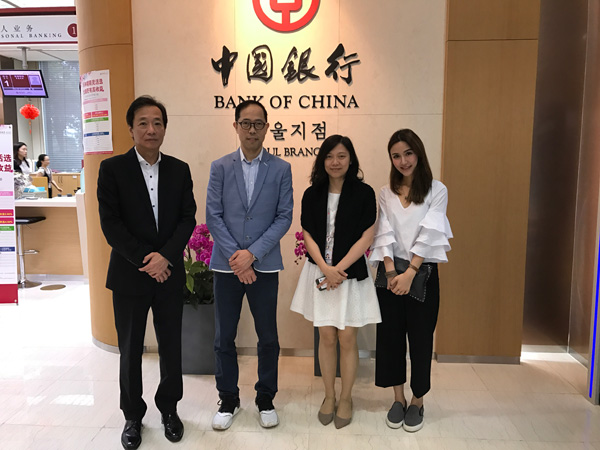
Stevenson, Wong & Co. visits Bank of China, Seoul Branch

Our legal executives Mr. Stanley Hung, Mr. Man Wong and Ms. Hebe Au were invited by Deputy Head of Corporate Banking of Bank of China, Seoul Branch Cheryl Yan to attend an exchange activity at Bank of China, Seoul Branch from 7 to 9 July 2017.

During the visit, Mr. Hung, Mr. Wong and Ms. Au introduced the services of SW and identified the typical requests for legal services which include China appointed attesting services and engaging Hong Kong lawyers to prepare Hong Kong legal opinions. This is the first meeting between SW and Bank of China, Seoul Branch, which was a success to build further communications.

Should you have any enquiry about this event, please contact our Mr. Stanley Hung and Mr. Man Wong for further information.

5 Jul 2017

HKEX unveils New Board Concept Paper to attract New Economy Companies

Introduction

An underweight of New Economy companies in the Hong Kong capital market has prompted the Hong Kong Exchanges and Clearing Limited (“HKEX”) to publish a New Board Concept Paper (《創新板框架諮詢文件》) prospecting the creation of a stand-alone New Board. This aims to broaden Hong Kong’s capital market diversity and enable companies with non-standard corporate governance structures to list, in hope that it will vitalise Hong Kong’s global listing appeal and competitiveness.

The New Board Concept Paper

The New Board Concept Paper proposes a New Board divided into two segments:

  • the New Board PREMIUM (創新主板) focuses on companies that are already meeting the Main Board’s listing requirements, but are currently ineligible to list domestically due to their non-standard governance structures, such as certain companies’ weight voting rights (“WVR”) or dual-share characteristics; and
  • the New Board PRO (創新初板) is specifically tailored for professional investors with New Economy companies which are unable to meet the financial or track record requirements of the Main Board and GEM, commonly among start-ups and technology firms.

The below table summarises the key proposals of the New Board Concept Paper:

Proposal for the New Board
Rationale
  • To broaden Hong Kong’s capital market access by opening up a more diverse range of issuers
  • To fill the gaps made by the current listing framework
  • To accommodate pre-profit companies, companies with non-standard governance features and Mainland Chinese companies that wish to secondarily list in Hong Kong
  • Enhance market reputation and quality by segregating the capital market
  • Accommodate WVR structures and increase indexation flexibility
Tentative board mechanisms
  • Accelerated delisting mechanism
  • Presumption that prevailing listing criteria will generally apply
Segments
  New Board PREMIUM New Board PRO
Main characteristics
  • Allows secondary listings by Mainland Chinese companies
  • WVR permitted
  • More stringent regulatory approach
  • Appointing a financial advisor is sufficient, rather than applying the existing sponsor regime
  • For retailers and professional investors
  • Allows secondary listings by Mainland Chinese companies
  • “Lighter touch” approach to initial listing requirements
  • No restrictions on secondary listings
  • WVR permitted (dual-class structures allowed)
  • Existing sponsor regime applies
  • For professional investors only
Listing applicants New Economy companies that meet the Main Board’s financial requirements but have non-standard governance structures For pre-profit/ early stage/ start-ups/ New Economy firms that do not meet the financial or track record criteria for the existing boards and with non-standard governance structures
Eligibility and other listing requirements
  • Financial and track record requirements same as Main Board
  • Minimum public float of 25%
  • Minimum of 300 investors
  • No track record or minimum financial requirements
  • Minimum public float of 25%
  • Minimum of 100 investors
  • Existing suitability guidance set out in Guidance Letters GL68-13 and GL68-13A will not apply
Listing Approval To be approved by the Listing Committee; same as Main Board To be approved by the Listing Department under the authority of the Listing Committee
Offer Document Need to satisfy Prospectus requirements in the Companies (Winding Up and Miscellaneous Provisions) Ordinance and current Main Board requirements No need to satisfy Prospectus requirements.  Only expected to ensure that an accurate and sufficient Listing Document is produced

Consultation Paper on Review of GEM and changes to GEM and Main Board Listing Rules

In light of the proposed framework, a Consultation Paper on Review of the Growth Enterprise Market (GEM) and Changes to the GEM and Main Board Listing Rules (《有關檢討創業板及修訂《創業板規則》及《主板規則》的諮詢文件》) was issued simultaneously to help readjust the current Hong Kong listing regime.

The Main Board will be positioned as a “premier” board, having its minimum market capitalisation requirement raised from HK$200 million to HK$500 million, and a minimum public float value from HK$50 million to HK$125 million.  The Main Board will retain its existing financial and track record criteria.

The GEM will also acquire an increased minimum market capitalisation of HK$100 million to HK$150 million, a public float value increased from HK$30 million to HK$45 million, and a minimum cash flow of HK$30 million in two fiscal years from HK$20 million.  A mandatory public offering mechanism of at least 10 % of its total offer size will also be incorporated.  The Exchange also proposes to remove the GEM’s current treatment as a “stepping stone” to the Main Board and streamline the process for any legible transfers.

Implications

With tech groups such as Alibaba Group Holding Limited and Sea Ltd. (a rebrand of Garena) choosing to list in the U.S., HKEX’s New Board proposal can be seen as its desire to open up greater diversity of issuers as well as an incentive for New Economy companies to list in Hong Kong.

However, a New Board will introduce certain difficult regulatory and administrative complications.  The proposed accelerated delisting mechanism may enable a procedural floodgate due to listing and delisting inflation.  HKEX will also have to ensure that there is sufficient investor protection.  It may also lead a possibility of an overall decrease of issuer quality affecting Hong Kong’s market reputation.

On top of that, there is also still a risk of tier ambiguity.  GEM may be made redundant due to its repositioning as a middle-tier board.  Additional attention should be given to each tier’s demographic in the fear of undesirable overlaps.

Despite the challenges, the New Board proposals, with the help of feedback from various stakeholders and market leaders, could represent an opportunity for Hong Kong to capture the future growth from the New Economy and further consolidate Hong Kong’s position as a  leading international financial centre.  The Exchange aims to finalise detailed New Board listing rules in early 2018, and to publish its conclusions on the GEM
review proposals in late 2017.

This newsletter is for information purposes only.  Its content does not constitute legal advice, and should not be treated as such.  Stevenson, Wong & Co. will not be liable to you in respect of any special, indirect or consequential loss or damage.

Please contact our Hank Lo, Eric Lui, Cornelia Chu or Rodney Teoh for any enquiries or further information.

4 Jul 2017

CFETS and HKEX launch new joint venture for Bond Connect

Introduction

In a newest attempt to further open up their capital markets, Hong Kong Exchanges and Clearing Limited (“HKEX”) collaborated with China Foreign Exchange Trade System (“CFETS”) on a joint venture company Bond Connect Company Limited (“BCCL”) to support Bond Connect.

Bond Connect

Bond Connect is a new mutual market access scheme enabling investors from Mainland China and offshore to trade mutually in each other’s bond markets through an infrastructure linkage in Hong Kong. This mimics a structure alike the stock-trading programmes between Shanghai, Hong Kong and Shenzhen’s stock exchanges in the past two years. BCCL is 60% owned by CFETS and 40% owned by HKEX.

Initial trading begins Northbound, allowing international investors direct access to the China Interbank Bond Market via the CFETS system. The launch of Southbound trading will be explored at a later stage.

Please contact our Eric Lui or Rodney Teoh for any enquiries or further information.