News
Find out all about our firm’s latest news and activities below. To learn more about any individual item, please contact us here.
News
Find out all about our firm’s latest news and activities below. To learn more about any individual item, please contact us here.
The Stock Exchange of Hong Kong Limited (“Exchange”) published the Consultation Conclusions (“Consultation Conclusions”) on the Review of Corporate Governance Code (“CG Code”) and Related Listing Rules on 19 December 2024. The Exchange received more than 260 responses from a wide variety of stakeholders, including listed issuers and market participants.
…
While the majority supported the proposals outlined in the June 2024 Consultation Paper on Corporate Governance Code (“Consultation Paper”),[1] notable divergences were observed regarding the appointment of a lead independent non-executive director (“INED”) and the limit on INED’s tenure.
Following a review of the feedback, the Exchange has set the implementation date for the suggested modifications as 1 July 2025. Transitional arrangements will apply to certain rules regarding “overboarding” and tenures of INEDs. The latest guidelines will be provided by the Exchange in the first half of 2025 to facilitate the listed companies in complying with the most updated requirements.
A. Major Revisions to the CG Code and Related Listing Rules
The following table presents the primary focuses on the fundamental changes in the CG Code and the relevant Listing Rules, namely (i) Board Effectiveness; (ii) INED’s Independence; (iii) Board and Workforce Diversity; (iv) Risk Management and Internal Controls; and (v) Dividends.
| Proposals | Final Amendments |
| Board Effectiveness | |
| Designation of a lead INED (“Lead INED”)
|
· The functional role of a Lead INED is to facilitate discussions among the INEDs on the board and provide stakeholders with greater insight into the roles and contributions of the INEDs.
· The newly introduced Recommended Best Practice C.1.8 recommends appointing a Lead INED in listed companies where the chairman is not an INED. This arrangement enables the Lead INED to act as an intermediary for the board members and shareholders, as well as providing an alternative communication channel when standard communication with the chairman or management proves insufficient. · The Exchange clarifies that the designation of an INED is not essential if the board chair is an INED and does not fall under the categories that necessitate an announcement in accordance with Main Board Listing Rules 13.51(2). Any alterations in the appointment of a Lead INED shall be promptly published via an updated list of directors and their roles and functions on both the Exchange’s and listed companies’ websites. · The listed companies are mandated to disclose the board’s interaction with the shareholders in the Corporate Governance Report (“CG Report”). · The latest Mandatory Disclosure Requirements section L(d) and Code Provision F.1.1 provide that the following details must be included in the disclosure: – The nature and number or frequency of such engagements; – The group(s) of shareholders and representatives of the issuer involved; and – The issuer’s approach to following up on the outcomes of these engagements
|
| Mandatory director training | · The Exchange emphasises the importance of maintaining director competence and expertise by mandating compulsory training, particularly for First-time Directors (“First-time Directors”).
· The First-time Directors refer to individuals who (1) do not have previous experiences in being appointed as a director of a listed company on the Exchange; or (2) not being designated as a director of a listed company on the Exchange for a minimum of three years preceding their appointment. They are required to undergo a minimum of 24 hours of training within a period of 18 months following their appointment. · For the First-time Directors who possess experience serving as directors of a listed company on the exchanges in foreign jurisdictions within the past three years before their designation, a total of 12 training hours are necessary within the initial three years of appointment. · A confirmation listing the details of the directors taking part in the continuous professional development is specified under the Mandatory Disclosure Requirements section B(i), which includes: (i) the total hours of continuous professional development accomplished; (ii) the format or mode of continuous professional development engaged in, specifying whether an external or internal provider was utilised or if the development resulted from self-study; and (iii) the total number of hours completed, the training subjects addressed, and a description of the relevant training provider(s) for each mode of continuous professional development undertaken.
Note: For the First-time Directors, a confirmation statement indicating that they have fulfilled the basic training requirement is compulsory pursuant to new Main Board Listing Rules 3.09H and GEM Listing Rules 5.02H.
|
| Board performance review | · The proposal will be implemented accordingly as Code Provision B.1.4, which mandates the issuer to perform an official review of the board’s performance a minimum of every two years.
· The Exchange clarifies that the emphasis of the review is predominantly based on the holistic performance of the board, such as whether it corresponds with the company’s overall business objectives and strategies, instead of an individual assessment of each director. · Additional guidance in the New Corporate Governance Guide (“New CG Guide”) regarding the anticipated scope and level of details required for the related disclosure will be provided.
|
| Board skills matrix | · Code Provision B.1.5. will be implemented, which will require the issuer to maintain and disclose a board skills matrix in the CG Report, including details such as the combination of skills possessed by the board at present.
· The New CG Guide will include guidance on the recommended format and requisite level of detail for the maintenance of a board skills matrix and enhancement of disclosure.
|
| Overboarding INED and director’s time commitment | · The revised Main Board Listing Rules 3.12A and GEM Listing Rules 5.07A provide that an INED must not simultaneously hold more than six directorships of listed companies listed on the Main Board or GEM.
· Listed companies with overboarding INEDs will be given a three-year transition period starting from 1 July 2025, with compliance required by the first Annual General Meeting (“AGM”) held on or after 1 July 2028. IPO applicants are obliged to ensure their INEDs adhere to the respective cap on the simultaneous directorships effective from 1 July 2025. · The nomination committee is required to adopt consistent assessment requirements to evaluate the director’s time commitment and board contribution alongside his or her capacity to fulfill obligations in an effective manner on an annual basis as stipulated in the Mandatory Disclosure Requirements section E(d)(iii). · Factors such as the directorships of the listed issuers on the Exchange and other significant external time commitments will also be taken into consideration.
|
| INED’s Independence | |
| Cap on INED’s tenure | · An INED of the issuer’s board is not allowed to serve for over nine years (“Long Serving INED”), which will be implemented in two phases over a six-year transition period to encourage board renewal, as elucidated in the revised Main Board Listing Rules 3.13A and GEM Listing Rules 5.09A.
Phase 1 Requirement: A listed company on the Exchange shall not comprise Long Serving INEDs constituting the majority of INEDs on the board.
With the three-year transition period commencing from 1 July 2025, adherence to the requirement must be completed by the first AGM carried out on or after 1 July 2028.
Phase 2 Requirement: A listed company shall not include any Long Serving INEDs on the board.
With the six-year transition period commencing from 1 July 2025, adherence to the requirement must be completed by the first AGM carried out on or after 1 July 2031.
|
| Disclosure on INED’s tenure | · The duration of the tenure and the current appointment period of each director is required to be disclosed in the CG Report as provided in the updated Mandatory Disclosure Requirements section B(a).
|
| Board and Workforce Diversity | |
| Composition of the nomination committee | · Code Provision B.3.5 will be introduced to require listed companies to designate a minimum of one director of a different gender to be part of the nomination committee to foster great diversity within the board.
|
| Workforce diversity policy | · The revised Main Board Listing Rules 13.92(1), GEM Listing Rules 17.104(1) and Mandatory Disclosure Requirements section J(b) require the listed companies to implement a workforce diversity policy alongside a board diversity policy.
|
| Annual review of board diversity policy and disclosure of gender ratio | · The updated Mandatory Disclosure Requirements section J(a) specifies that listed companies are obliged to conduct a review of the board diversity policy annually to encourage increased accountability for the measurement of progress and pursuit of diversity objectives.
· The revised Mandatory Disclosure Requirements section J(c) states that the issuers are required to disclose separately in the CG Report regarding the gender ratio of (i) senior management and (ii) the workforce (excluding senior management) to update the market and investors that enable them to perform a more sophisticated examination on the diversity and inclusion initiatives.
|
| Arrangements during temporary deviation | · The revised Main Board Listing Rules 13.92(2) and GEM Listing Rules 17.104(2) stipulate that the current guidance provided by the Exchange on temporary deviations from the requirement that issuers have listed companies consist of directors of various genders on the board will be codified.
|
| Risk Management and Internal Controls | |
| Strengthened the board’s obligations in conducting annual reviews on the risk management and internal control system (“RMIC Systems”) | · The obligation to perform annual reviews on the effectiveness of the RMIC Systems in the listed companies is stated in the revised Mandatory Disclosure Requirements section H to promote a systematic approach in identifying potential risks and vulnerabilities.
· The revised Code Provision D.2.1 has been refined to specify the scope of the review, encompassing the coverage of material controls of both the listed companies and its subsidiaries’ RMIC Systems. · A comprehensive evaluation of the RMIC Systems by the listed companies are expected to establish proper procedures and controls to mitigate business risks.
|
| Dividends | |
| Disclosure of the listed companies’ policies concerning dividends payments and the board’s dividend decisions | · The newly amended Mandatory Disclosure Requirements section M has provided that there is an enhanced disclosure requirement of the companies’ dividend policies and board’s dividend decisions to enhance transparency and accountability in financial reporting.
· Details such as the policy’s aim and objective and the primary considerations in determining whether to declare, recommend or pay any dividend; and confirm the board’s compliance with the dividend policy (or otherwise, an explanation of its departure from the policies). · For listed companies without a dividend policy, it is necessary to disclose reasons for the non-existence of such policies. · For all listed companies, it is a mandatory requirement to state clearly whether (i) there are material variations in the dividend rate compared to the prior corresponding period; and (ii) the reasons for non-declaration of the dividends and the intended measures taken by the issuer to improve investors return.
|
B. Analysis and takeaways
The Exchange has strived to review and refine the Consultation Paper based on the recommendations and opinions provided by multiple industrial stakeholders and professional bodies. This has apparently reflected the Exchange’s efforts to enhance the sound corporate governance of the listed companies in multiple essential areas. The proposed amendments to the respective rules, provisions and requirements regarding Board Effectiveness, INED’s Independence, Board and Workforce Diversity, Risk Management and Internal Controls and Dividends, reveal the Exchange’s commitment to foster a structured and robust framework within the regulatory and compliance regime. As reflected in the Consultation Conclusions, the listed companies on the Exchange are expected to adhere to the most recent guidelines and their respective timelines to ensure effective compliance.
Please contact our Partner Mr. Rodney Teoh for any enquiries or further information.
This news update is for information purposes only. Its content does not constitute legal advice and should not be treated as such. Stevenson, Wong & Co. will not be liable to you in respect of any special, indirect or consequential loss or damage arising from or in connection with any decision made, action or inaction taken in reliance on the information set out herein.”
[1] Please see our news update on the Exchange’s June 2024 Consultation Paper on Corporate Governance Code here.
On 18 December 2024, the Securities and Futures Commission (“SFC”) published a circular (the “Circular”) outlining streamlined licensing procedures for virtual asset trading platforms (“VATPs”) and revised second-phase assessment (“Second-phase Assessment”).[1] The SFC strives to continuously foster effective engagement and interactions between the SFC and the VATPs by way of becoming a “party to the engagement” in the Second-phase Assessment to be performed by VATPs.
…
The revised Second-phase Assessment emphasises on ensuring the policies, procedures, systems and controls (“P&P”) of the VATP are adequately created and executed as a direct assurance engagement.
Subsequent to the on-site inspections targeting to ensure the applicants have complied with the relevant regulatory standards, the deemed-to-be-licensed VATP applicants (“Deemed Applicants”) would have to satisfy the SFC’s further regulatory expectations for improvement. They are mandated to provide a plan detailing the rectification strategies in response to the feedback from the SFC during the inspection. Upon agreement with the plan by the SFC, a conditional license will be issued to the Deemed Applicants accordingly. To satisfy the licensing requirements, the VATP is bound to carry out the rectification measures as outlined, and conduct penetration tests and vulnerability assessments performed by independent third parties. Satisfactory results must be obtained prior to functioning under a restricted operational scope by the VATP.
The independent third-party assessor should detect any susceptible risks within the VATP’s systems by adopting a thorough binary analysis of the custody system. The assessment will primarily focus on external and internal vulnerabilities, which will be categorised in accordance with their respective risk levels.
To enhance cybersecurity resilience and identify potential security loopholes in the platforms, security enhancement assessments and penetration tests are expected to be carried out by independent third-party assessors on multitudes of systems, including network devices, services, databases and e-wallets infrastructures. Following the notification by the SFC regarding its satisfactory completion of the stipulated assessments and testing, the VATP is permitted to operate within a restricted scope of business as a licensing condition. The VATP can then proceed to involve an External Assessor (“EA”) in performing the Second-phase Assessment.
The Second-phase Assessment is conducted through a tripartite agreement that includes the SFC, the VATP and the EA. It focuses on evaluating whether the updated P&P have been properly established and implemented after the VATP completes the rectification plan in accordance with the inspection comments provided by the SFC. In the event of any material alterations in the P&P, the VATP must promptly notify both the SFC and the EA. Any contraventions or breaches detected during the Second-phase Assessment shall also be promptly notified by the VATP to the SFC for further investigation.
The process is a direct assurance engagement, requiring certification by a practicing public accountant to ensure compliance with the relevant regulatory standards established by the SFC. Additionally, the EA is required to determine whether the P&P are adequately structured and executed to adhere to the Guidelines for Virtual Asset Trading Platform Operators and the Guideline on Anti-Money Laundering and Counter-Financing of Terrorism (For Licensed Corporations and SFC-licensed Virtual Asset Service Providers). Once the Second-phase Assessment is successfully completed, the SFC will uplift the licensing conditions that limit the VATP’s scope of business.
As indicated in the Circular, the SFC has made considerable efforts to develop and refine regulatory regimes to establish the licensing requirements of VATPs. The comprehensive regulatory framework involving external parties, such as independent third-party assessors and certified accountants, intends to protect investors’ rights and reduce the risks of fraudulent activities occurring in the sector. Such an approach demonstrates the SFC’s dedication to cultivate a healthy trading environment while reinforcing its regulatory and enforcement roles in inspecting the VATPs with transparency and accountability.
Please contact our Partner Mr. Rodney Teoh for any enquiries or further information.
This news update is for information purposes only. Its content does not constitute legal advice and should not be treated as such. Stevenson, Wong & Co. will not be liable to you in respect of any special, indirect or consequential loss or damage arising from or in connection with any decision made, action or inaction taken in reliance on the information set out herein.”
[1] Please see our news update on the SFC’s latest licensing regime for VATPs here.
Stevenson, Wong & Co. acted as international counsel to the issuer in connection with the successful offering by Tai’an Financial Holdings Group Limited Company (Tai’an Financial Holdings) of CNY500,000,000 6.0 per cent. guaranteed bonds due 2028. These bonds are listed on the Chongwa (Macao) Financial Asset Exchange Co., Ltd.
…
The placing agents of the offering include Sigma Capital Management Limited, Haitong International Securities Company Limited, China Industrial Securities International Brokerage Limited, Shanxi Securities International Limited, Yuan Tong Global Securities Limited, Danehill Capital Limited, Guotai Junan Securities (Hong Kong) Limited, Shenwan Hongyuan Securities (H.K.) Limited, Emperor Securities Limited, Industrial Bank Co., Ltd. Hong Kong Branch, Huatai Financial Holdings (Hong Kong) Limited, Target Securities International Limited, CCB International Capital Limited, Donghai International Securities (Hong Kong) Limited, ICBC International Securities Limited, TFI Securities and Futures Limited, Star River Securities Limited, Gentech Capital (Hong Kong) Limited, and SunRiver International Securities Group Limited.
Tai’an Financial Holdings is a core operating entity designated to provide comprehensive financial services within Tai’an City and to implement the Tai’an Municipal Government’s blueprint for enriching and developing the local financial market and economy. The group is mainly engaged in four principal business segments: financial leasing, guarantee service, private capital investment, and supply chain trading.
Our team comprised our partners Hank Lo, Gordon Tsang and Erica Cheng, senior associate Anthony Wong and trainee solicitor Selina Tsang.
Please contact our partners Hank Lo, Gordon Tsang and Erica Cheng for any enquiries or further information about this transaction.
In addition to the successful issuance of bonds in an aggregate principal amount of US$25,000,000 by Weifang Guokong Development Group Co., Ltd. (Weifang GuoKong) in January 2025, Stevenson, Wong & Co. acted as international counsel to the issuer in connection with Weifang Guokong’s successful offering of CNY481,000,000 6.9% bonds due 2027. These bonds are listed on the Chongwa (Macao) Financial Asset Exchange Co., Ltd.
…
The placing agents of this offering include Harmonia Capital Limited, CNCB Capital, Donghai International, Excellent Tide Securities, HTF Securities, ICBC International, Pulun International, Shenwan Hongyuan Securities (H.K.), Soochow Securities (Hong Kong), Target Securities and Zhongtai International.
Weifang Guokong is mainly responsible for the construction of infrastructure and promoting the strategic economic and social development in Weifang City. The group is mainly engaged in three principal business segments: infrastructure construction, road maintenance and commodities trading.
Our team comprised our partners Hank Lo, Erica Cheng or Gordon Tsang, senior associate Anthony Wong and trainee solicitor Selina Tsang.
Please contact Hank Lo, Erica Cheng or Gordon Tsang for any enquiries or further information about this transaction.
Prior to 2015, it was popular among high net-worth individuals to invest in “immigration bonds” issued by companies listed on the Hong Kong Stock Exchange to enrol in the Capital Investment Entrant Scheme (CIES).
…
But as Warren Buffett famously said, “only when the tide goes out do you discover who’s been swimming naked”. In the economic downturn of the last few years, cashflow dwindled and the overleveraged were weeded out. Bond defaults became rampant, and so were recovery actions by gutted bondholders.
Recovery of bond debt was once thought straightforward. A more conservative claimant would choose to commence a civil action against the issuer company to obtain a summary judgment first. Others would either seek to petition for winding-up directly, or join in as supporting creditors.
The case below reveals how a recalcitrant issuer could complicate and drag the proceedings on for months on end.
Winding-up at First Instance
On 8 June 2023, a winding-up petition was presented by a CIES bondholder against China Zenith Chemical Group Ltd (“Company”) based on a summary judgment. After coming to terms with the Company, the original petitioner dropped out.
Several other CIES bondholders immediately applied to substitute as the petitioner. Stevenson, Wong & Co. represents one of the bondholders who have, up to the date of this article, tirelessly pursued their claims against the Company.
Rather than putting forward a scheme of arrangement / proposal for debt-restructuring (as is fashionable), the Company vigorously disputed all claims of bond default (currently 10+ and counting) in the winding-up proceedings.
The Company’s approach resulted in the Court exercising case management power to hear the (substituted) petition and the substitution applications at once. At the hearing on 3 June 2024, Hon Linda Chan J adjourned the petition together with the claims of 3 supporting creditors for substantive arguments. The substantive hearing took place before Recorder Suen SC on 19 September 2024.
Our client’s case is that he subscribed to a CIES bond through an intermediary. He adduced evidence of full payment of the subscription price to the intermediary, the bond certificate signed and sealed by the Company, and letters from the Company to the Immigration Department year after year confirming our client’s status as a bondholder.
The Company argued that it had only received partial payment of the subscription price from the intermediary, and that the bond was cancelled by some private agreements between the Company and the intermediary.
The Court criticized the Company for how its defence evolved over time (i.e. that our client agreed to extend the maturity, that the Company had received no payment of the subscription price at all, and then finally that it and the intermediary had agreed to cancel the bond). The absence of the intermediary from the proceedings did not lend credibility to the Company’s. As a result, the learned Recorder found no bona fide dispute as to the debt on substantial grounds on 10 October 2024.
The Company bargained for time to pay the debt before a winding-up order is pronounced, and the Learned Recorder allowed as such on 18 October 2024.
At this point, the creditors may think they were at the finishing line, but they would be sorely mistaken.
The Witching Hour
One has to admire the Company’s tenacity and ingenuity. In the next few months, the Company
All these were to seek adjournments of the winding-up petition.
Fortuitously for the Company, the Court of Appeal finally ordered an expedited appeal, and while Hon. Anthony Chan J. criticized the Company’s ploy at the hearing of the Companies Court on 2 December 2024, he reluctantly adjourned the hearing of the winding-up petition until after the disposal of the appeal.
The Court of Appeal’s decision and beyond
The appeal was heard on 20 February 2025 before Hon Kwan VP, Cheung JA, and Barma JA, and judgment was handed down on 11 March 2025.
The appeal was largely an appeal on facts. The Court of Appeal found that the Company was rehashing its arguments at the Court below, and found no palpable errors in the learned Recorder’s assessment of evidence.
At the hearing before the Companies Court on 17 March 2025, DHCJ Gary Lam made a usual winding-up order against the Company despite the Company’s submission that it was carrying out yet another round of fundraising activities. It remains to be seen what tactics will be deployed to keep the bondholders at bay even in the Company’s winding-up.
Implication to bondholders
In a typical winding-up proceedings where the original petitioner drops out, it is understandable that a supporting creditor may want to defer to other creditors to apply for substitution in order to save legal costs.
As demonstrated in the present case, however, where there is sufficient commonality among the claims (all being bond defaults), the Court may exercise its case management power to hear the petition and multiple substitution applications together. This helps to exert maximum pressure, which is particularly important in a case against a recalcitrant debtor.
Our Partner Mr. Dominic Lau, solicitor advocate, appeared in the Court of First Instance on behalf of one of the bondholders / supporting creditors as sole advocate. On appeal, Counsel Mr Jeff Yau appeared on our instruction. The team was also assisted by associate Mr. Harold Chiu and trainee solicitors Ms. Kayla Yu and Ms. Selina Tsang.
Please contact our Partner Dominic Lau for any enquiries or further information.
This news update is for information purposes only. Its content does not constitute legal advice and should not be treated as such. Stevenson, Wong & Co. will not be liable to you in respect of any special, indirect or consequential loss or damage arising from or in connection with any decision made, action or inaction taken in reliance on the information set out herein.

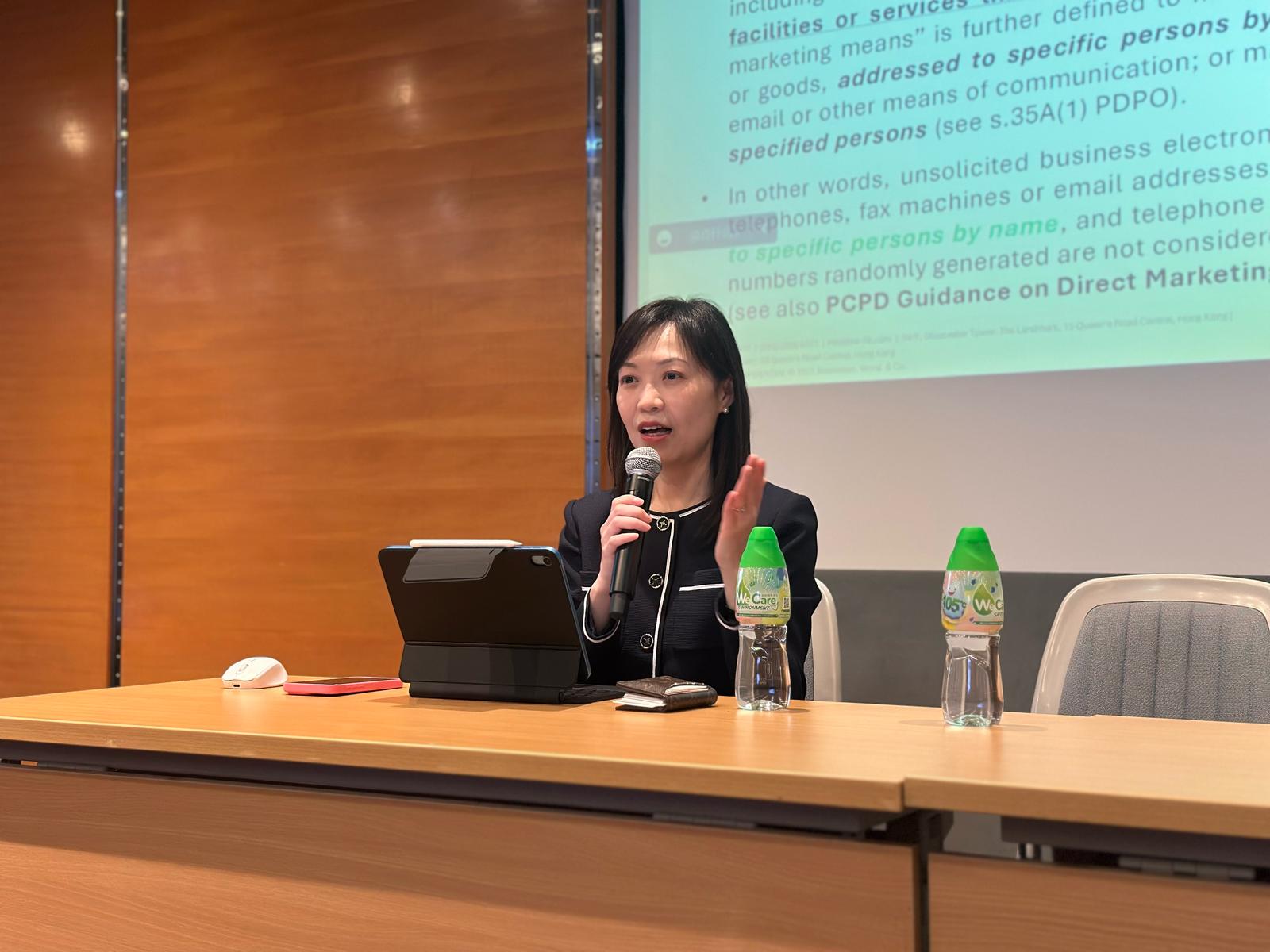
(中文) 2025 年 2 月 28 日,本所合伙人、诉讼及争议解决部主管徐凯怡律师,受邀为全国涉外仲裁人才培训班(香港)在香港律政中心进行授课,讲授国际仲裁的机遇与挑战 。

左起: 香港国际法律人才培训办公室主任杨玲博士和本所合伙人徐凯怡律师
…
此次全国涉外仲裁人才培训班(香港)由司法部与香港特别行政区律政司成立的香港国际法律人才培训学院联合举办,同时得到了中国政法大学和中国法律服务(香港)有限公司的大力支持。该培训班为期两周,吸引了众多专业人士参与,其中包括国资委推荐的内地企业法律顾问,以及各地司法局和律师协会推荐的资深法律从业者,学员总数超过 80 名。培训班特别邀请了香港国际法律人才培训专家委员会成员以及本港资深法律界人士代表授课,旨在推动两地仲裁规则相互借鉴,促进人才协同发展。

徐凯怡律师以“参与国际仲裁:机遇与挑战 (Engaging in International Arbitration: Opportunities and Challenges)”为主题展开授课,深度剖析了多个关键要点,包括中国法律从业者在国际争议市场中面临的机遇、香港国际仲裁中心 2024 年规则下的标准国际仲裁流程、国际仲裁过程中的文化与程序差异,以及国际仲裁中的不同角色等。课堂上,徐律师通过互动练习,增强了学员对课程内容的认识与理解,提升了他们在国际仲裁领域的实践能力。


如阁下有任何查询或想了解更多详情,请联络本所合伙人徐凯怡律师。