News
Find out all about our firm’s latest news and activities below. To learn more about any individual item, please contact us here.
 Stevenson, Wong & Co.
News
Find out all about our firm’s latest news and activities below. To learn more about any individual item, please contact us here.
In an interlocutory application, the Defendant and the Plaintiff reached terms on the mutual undertakings which were included as part of a Court Order. The undertakings in question were 1) the Defendant was to maintain the sum of RMB 45,000,000 at a bank account(“the First Undertaking”) and 2) the Defendant was to provide the Plaintiff weekly reports of the status of the assets at issue(“the Second Undertaking”).
The Plaintiff applied to commit the Defendant for contempt of Court for his breach of two undertakings. At the Court of First Instance, it was held that the Defendant acted in contempt. The Defendant appealed to the Court of Appeal.
The First Undertaking
The CFI judge found that the sum in the agreed amount was not properly deposited in the account as agreed by the parties. The CFI characterized the conduct of the Defendant as “deliberate and contumacious”.
Interestingly, the Court of Appeal adopted a purposive approach and rejected the CFI’s finding that the First Undertaking was intended to be the security for the Plaintiff’s claim. Moreover, there was not any evidence of the discussion between the parties to work out an agreement for the designated account. In light of these uncertainties, the First Undertaking was too unclear to be enforceable.
The Second Undertaking
The Plaintiff applied to amend the originating summons so that further alleged breaches of the Second Undertaking were to be considered by the Judge, which was opposed by the 1st Defendant. The Judge in CFI did not make a ruling at the hearing but decided the issue in his judgment to the effect that he allowed the amendment and found that the Defendant was in contempt of all of the originally pleaded and newly alleged breaches.
The Court of Appeal considered this approach “faulted”. The court stressed that contempt proceedings were of penal nature, and hence require strict proof of guilt beyond reasonable doubt. It also entails that fairness requires the person cited for contempt to be informed at the outset of all allegations made against him. The statement in support of the application was to be treated in a similar fashion as an indictment in criminal proceedings. If the CFI approach was adopted, the Defendant would be deprived of the opportunity to defending against the additional allegations.
The court also held that the elements of contempt were not merely a strict proof of breach – but also involved a question of guilty intention on the part of the Defendant. The court then leniently held that the Defendant’s breach was an “unintentional slip”. Applying such a high threshold, the Court of Appeal held that the Defendant was not in contempt.
Implications
The implications of this case are two-fold. Firstly, despite the undertakings being part of the court order, the purpose of the undertaking (and the language of the undertaking) must be clear and certain enough in order to be enforceable. Secondly, a breach of a Court undertaking does not automatically translate to contempt of Court. The Court will have to be satisfied that the Defendant acted with the guilty intention as well.
SW partner Ms Catherine Por attended the IAFL Annual Meeting 2016 held by International Academy of Family Lawyers (IAFL) in New Delhi, India on 14-18 September 2016. Founded in 1986, IAFL is a worldwide association of practicing lawyers who are recognized by their peers as the most experienced and skilled family law specialists in their respective countries. Ms Por has been a fellow of the IAFL since 2004.
The Annual Meeting was well attended by more than 120 fellows from multiple jurisdictions. Legal practitioners from all parts of the globe shared and exchanged insights and recent developments on a wide spectrum of family law issues. Topics such as cohabitation arrangement, financial remedies, surrogacy, etc. were thoroughly explored. Ms Por, together with other speakers, joined in the panel discussion on financial remedies on a case study.
Please contact our Ms Catherine Por for any enquiries or further information about this event.
On 9 September 2016, our partner Ms. Heidi Chui and Public Relations Manager Ms. Yo Yo Fang attended the 15th annual Macallan ALB Hong Kong Law Awards gala dinner held at the Conrad Hotel, Hong Kong. Stevenson, Wong & Co. had been shortlisted as a finalist in the award categories of“Arbitration Law Firm of the Year”, “BDO Limited Award Matrimonial Law Firm of the Year”, “Deal Firm of the Year”, “Insolvency and Restructuring Law Firm of the Year”, “Real Estate Law Firm of the Year” and “Litigation Law Firm of the Year”. Meanwhile, AllBright Law Offices was nominated for “PRC Firm, Hong Kong Office of the Year”.

Members of the legal profession gathered to salute the best deals and legal practitioners in Hong Kong.
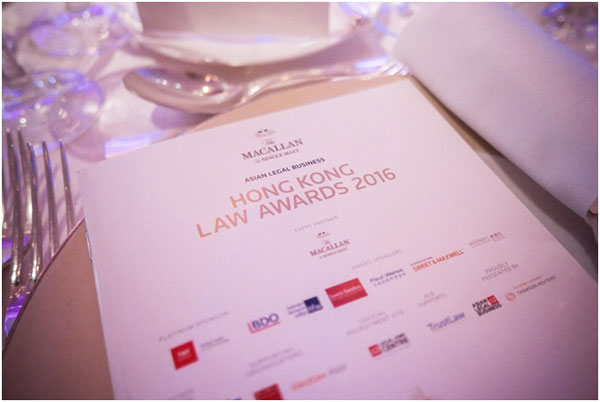
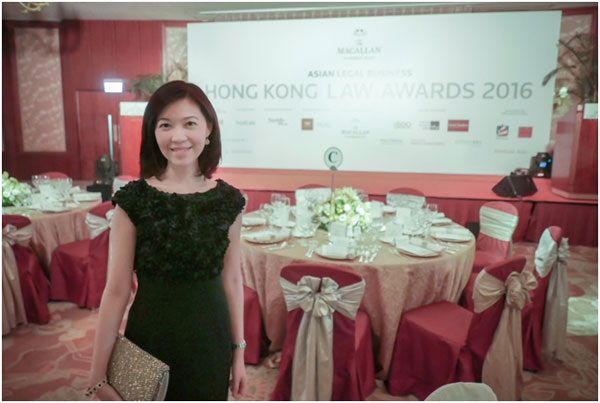

Photographs of Ms. Heidi Chui
Please contact our Ms. Heidi Chui for any enquiries or further information about this event.
We are pleased to announce that one of our recently recruited trainee solicitors, Mr Tommy Lau, was selected by the Board of Examiners in Laws in the University of Hong Kong to receive “The Oldham, Li & Nie Prize in Matrimonial Practice and Procedure”. The Prize is awarded to the candidate who achieved the highest mark in the course “Matrimonial Practice and Procedure” in the HKU P.C.LL. programme for the academic year 2015-2016. Tommy is currently in our Family Law Department and trained in, amongst other disciplines, matrimonial law.
Please contact our Ms. Catherine Por for any enquiries or further information.
The defendant filed an application to stay the action pursuant to section 20 of the Arbitration Ordinance, Cap. 609 based on the ground that there existed a binding arbitration agreement which required the matter to be referred to arbitration.
In the contract between the parties, the dispute resolution clause stated that in the event of disputes, the matter “may” be referred to arbitration. The defendant’s argument was two-fold: 1) The clause constitutes an arbitration agreement as it demonstrates the parties’ clear intention both to arbitrate and for relief to be obtained from arbitration as opposed to litigation. 2) Where the clause gives an option for the parties to elect arbitration and one party does so, then it becomes mandatory for the other party to be bound by this and it cannot insist on carrying on with litigation which has already commenced. The defendant relied on the Privy Council case of Anzen Ltd v Hermes One [2016] UKPC 1. However, the learned judge held that the relevant clauses were “substantially different” from one another.
If the learned judge found that there existed an arbitration agreement in the present case, then the action ought to be stayed.
In deciding whether there was an “arbitration agreement”, the determining factor is whether the parties are compelled to have the dispute resolved by arbitration or whether they are given a choice. The learned judge made 3 observations: 1) The answer is based on the proper construction of the relevant clause by applying established contractual principles. 2) Where permissive words such as “may” or “can” appears in an arbitration provision, some cases have been interpreted so that these words are given their literal meaning such that the parties have a choice. However, there have been cases where the word “may” should really be construed as “shall”, such that the parties are compelled to submit to arbitration. Deputy Judge Winnie Tsui maintained however that the approach of the courts in the construction exercise remains consistent as the conclusions were reached based on the relevant “factual matrix” of each case. 3) Where the parties have agreed on specific provisions providing for a mechanism as to how to arbitrate, an assumption may arise (and can only be displaced by clear words to the contrary) that the parties do not intend to have a choice between litigation and arbitration when a dispute subsequently arises.
It was held that applying the aforementioned principles, the present clause does not compel or require the parties to submit any dispute arising out of the contract to arbitration. The present case was therefore a case where the word “may” should simply mean “may” and it should be given its literal meaning. As the parties are not compelled to arbitrate, the present clause is not an arbitration agreement for the purposes of the Arbitration Ordinance, Cap. 609, such that the plaintiff ought to continue with the present action. The defendant’s stay application was therefore dismissed.
The implication of this case is that parties should be careful when drafting their respective dispute resolution clauses and should ensure that the said clause accurately reflects the actual intention of the parties should any disputes arise between them. This case also reminds parties that even when the word “may” appears in an arbitration provision, it is not clear whether the parties will be compelled to arbitrate or are given a choice to do so as each case will depend on its own “factual matrix”.
The plaintiff, the defendant, another company (of which the defendant was the founder and director of) and other subsidiaries of the company entered into a subscription agreement whereby the company would issue convertible notes to the plaintiff. The defendant also issued a guarantee in favour of the plaintiff. The subscription agreement, the convertible notes and the conditions of the convertible notes all contained arbitration clauses, whereas the said guarantee contained a clause which stated the following: “irrevocably submits to the non-exclusive jurisdiction of the Hong Kong courts”.
The plaintiff commenced legal proceedings under the guarantee, whilst the defendant relied on section 20 of the Ordinance to apply for a stay of the legal proceedings commenced by the plaintiff and for the dispute to be referred to arbitration.
At issue was whether the action is “in the matter which is the subject of an arbitration agreement” as set out under section 20 of the Ordinance. If it did fulfil the requirements under section 20, it would be mandatory for the court to order a stay of the proceedings.
The judge held that no clause in the guarantee clearly excluded or displaced the mandatory arbitration clause contained in the subscription agreement as the dispute resolution method. It was also held that it is arguable that the non-exclusive jurisdiction clause contained in the guarantee can operate in parallel with the arbitration provisions found in the other agreements. The judge held that as the proceeding brought by the plaintiff is “in the matter which is the subject of an arbitration agreement”, a stay of the proceedings was ordered. The plaintiff was also ordered to pay the defendant’s costs of the summons on an indemnity basis.
The implications of the aforementioned case are twofold. Firstly, it reinforces the pro-arbitration stance of the Hong Kong judiciary. Secondly, contracting parties involved in transactions concerning multiple contracts should be mindful of the contractual inconsistencies that may be brought to light in the event of disputes arising, which in turn leads to parties incurring further time and costs. In order to resolve disputes as effectively as possible, parties should therefore think carefully how they wish disputes to be resolved during the drafting stages of multiple contracts.