News Updates
Find out all about our firm’s latest news updates below. To learn more about any individual item, please contact us here.
 Stevenson, Wong & Co.
News Updates
Find out all about our firm’s latest news updates below. To learn more about any individual item, please contact us here.
Stevenson, Wong & Co. is honoured to announce that we have once again been ranked in Benchmark Litigation Asia-Pacific, a guide to the market’s leading litigation firms and lawyers.
This year, we are ranked in 5 categories:
In addition, our partner and Head of SW Private Client, Ms. Catherine Por, has been named as a “Litigation Star” in Family and Matrimonial for 4 consecutive years.
Please contact Ms. Catherine Por, Ms. Heidi Chui, or Ms. Milly Hung for any enquiries or further information.
To view the full list of awards, please click here.
(中文) 简介
如果一名银行客户因为一名银行雇员的欺诈行为而遭受损失,银行需要负上法律责任吗?被欺诈的客户针对银行又可以寻求哪些救济方式呢?在最近的陆颖恩对招商永隆银行有限公司 [2021] HKCFI 279一案中,香港法院原讼法庭裁定被告人招商永隆银行不需要对其雇员欺诈客户所造成的损失负上法律责任。法庭在判决中详细讨论及审视了转承责任及Quincecare责任方面的法律,并确立了重要的法律原则。
背景事实
原告人为被告人银行 (下称「银行」) 的客户,涉事的银行雇员(下称「该雇员」)当时于北角分行任职证券经理。原告人是该雇员欺诈投资计划的其中一名受害者。
该雇员向原告人提出可让原告人参与只提供给银行雇员的「内部」投资,而该等「内部」投资将产生极高的回报 (大约是一般银行定期存款回报的100倍)。
原告人信以为真,并于2010年至2013年间将约3,500万港元转到该雇员的私人银行帐户用作「内部」投资。该雇员伪造收据、结单及其他记录,并前后向原告人支付约1,130万港元的「回报」,令原告人相信她转给该雇员的3,500万港元全部用作「内部」投资。

该雇员的欺诈行为于 2014 年 3 月曝光。该雇员继而受到刑事检控,被判定三项欺诈罪,并判处监禁 10 年。在整个欺诈投资计划中,原告人损失了约2,380万港元。
原告人其后向银行提起诉讼,要求银行赔偿她的损失。就此,法庭需要处理的议题是,银行是否需要对原告人因其雇员的欺诈行为而遭受的损失负上法律责任。
转承责任
首先,原告人依赖转承责任的原则向银行申索。该原则下雇主在某些情况下需要为其雇员的侵权行为 (tort) 负上法律责任。
在雇佣关系的情况下,香港终审法院于Ming An Insurance Co (HK) Ltd v Ritz-Carlton Ltd 一案中就转承责任的认定确立了「密切联系」测试 (“close connection” test)。该测试的准则是,雇员的未经授权侵权行为与其受雇工作的联系是否如此密切,以致于法庭裁定雇主须负上转承责任是公平公正 (fair and just) 的?

在本案中,法庭认为,由于侵权行为可能出现的情况是无限 (infinite) 的,「密切联系」测试无可避免地缺乏精确性 (lack of precision),因此并非在所有情况下都适用。 法院认为,在涉及雇员欺诈行为的案件中,认定转承责任的法律测试应该是雇员的欺诈行为是否属于雇主实际或表见代理 (apparent authority) 的范围。 一般而言,表见代理成立的条件是:-
(1) 委托人 (principal) 以言语或行为向第三方表示 (represent),代理人 (agent) 有权从事有关交易;
(2) 第三方依赖该陈述 (representation) 进行交易; 及
(3) 该等依赖是合理的。
就此,法庭接纳银行的说法认为银行不可能打算或授权其雇员代表银行向外部人员提供内部投资计划。法庭更指出,认为银行的雇员出售证券产品的表见代理权限会扩大至销售任何类型产品的权限,包括外部人员明确知道是银行无法提供给外部人员的投资产品,这样的想法是不合逻辑的。因此,法庭裁定银行没有表示或向外宣称 (hold out) 该雇员有权向原告人提供该等内部投资计划,而原告人亦不会有任何实际依赖 (actual reliance),因此转承责任不成立。
Quincecare责任
除了转承责任外,原告人亦依赖Quincecare 责任向银行提出申索,该责任指当银行应当知道 (put on inquiry) 某授权代理人 (authorised agent) 发出的交易指令是为了欺骗 (attempt to defraud) 该客户时,银行有责任避免执行该代理人发出的交易指令。

然而,法庭指出,Quincecare 责任一般只有在银行收到代表客户作出的命令或指示,即从客户的授权代理人收到的命令或指示,而不是直接从客户收到指令或指示才适用。在本案中,由于付款指示是由原告人直接发出,且原告是有意向收款人支付款项的,因此Quincecare责任并不适用。法庭认为,原告人的损失不是由银行的任何疏忽或失职造成的,而是由「她自己的贪婪及轻信」 (her own greed and gullibility) 所造成的。
同时,法庭拒绝将Quincecare责任的范围扩大至银行需判断付款指示是否是任何人以任何方式欺骗客户的任何计划的一部分 (a duty arising whenever a bank has reasonable grounds for believing that the instructed payment is part of any scheme perpetrated by any person to defraud the customer in any way)。这种扩大的责任范围无疑会让银行执行客户指示的效率变低,且严重阻碍银行的首要责任。

评论及要点
毋庸置疑,银行界会欢迎陆颖恩案的裁决,特别是法庭确认了Quincecare责任的有限适用范围,并且拒绝将银行的责任范围扩大。然而,随着银行在人工智能以及金融科技领域的进一步发展,银行可能需要考虑制定并采取适当的监管措施,合法监管银行职员的行为,保障银行客户的利益。同时,在所有涉及客户代理人发出的交易指令或指示时,银行应该额外保持警惕,以确保完善履行Quincecare责任。
本文由本所合伙人﹑银行及金融部和诉讼及争议解决部主管徐凯怡律师和黄晊晄律师撰写。若阁下想了解更多详情,请联络本所徐凯怡律师 (heidi.chui@sw-hk.com)。
于本文中提供的一切资料仅供参考,不构成任何法律意见,资料亦受制于适用规定及法例不时的更新与修改。若需取得相关法律意见,须咨询法律顾问。
In such an international and cosmopolitan city as Hong Kong, it is not unusual for a spouse to seek to commence divorce proceedings against his / her partner who is overseas. This article illustrates how we may serve divorce petitions out of Hong Kong to commence the proceedings.

Laws on the Service of Divorce Petitions Overseas
Service of a writ out of the jurisdiction of Hong Kong is permissible with the leave of the court generally. However, service out of jurisdiction for divorce petitions is an exception and the Hong Kong Matrimonial Causes Rules specifically provides that no leave is required.
Whilst it is not necessary to seek prior permission to serve the divorce petitions, the mode of service in the laws of the jurisdiction in which the papers have to be served must be followed.

Examples on Serving Divorce Petitions Overseas
Here are some of the examples we have come across.
In the U.K., the U.S.A. and Australia, the service of process can be effected directly by post, through a local lawyer, the judicial authority, or even a private investigator.
In mainland China, Germany and India, service can only be effected through their respective central authorities.
In the Philippines, we can only effect such service on nationals of the originating state.
Some jurisdictions may require that the translation of the documents to their corresponding official languages be appended. For documents to be served on a spouse in mainland China, generally, the documents should be in Chinese, or else a translation in Chinese should be attached. For documents to be served on a spouse in Germany, the German translation of the documents has to be served.
If it cannot be proved to the satisfaction of the Hong Kong court that the documents have been properly served, the proceedings cannot move forward. It is therefore essential that proper legal advice is sought so as to avoid frustration and disappointment.
This article is co-authored by our experienced Private Client Team – our Partners Catherine Por and Wendy Lam, and our Senior Associates Karl Wong and Calvin Lo. Please contact our Ms Catherine Por or Ms Wendy Lam for any further enquiries or information.
This newsletter is for information purposes only. Its content does not constitute legal advice and should not be treated as such. Stevenson, Wong & Co. will not be liable to you in respect of any special, indirect or consequential loss or damage arising from or in connection with any decision made, action or inaction taken in reliance on the information set out herein.
The HKSAR Government announced in November last year (2020) that the annual quota of the Quality Migrant Admission Scheme (“QMAS”) has been increased from 1,000 to 2,000 with a view to enlarging Hong Kong’s talent pool and strengthening its role as Asia’s World City. It is expected that more QMAS applicants will benefit from such increase in quota.
QMAS is an admission scheme for global talents (including those from Mainland China) to settle in Hong Kong. Applicants may obtain a visa to settle in Hong Kong through the scoring mechanism and the subsequent selection process under QMAS. Successful applicants are not required to secure a job offer before coming to settle in Hong Kong with the QMAS visa granted. QMAS visa holders may work or establish a business in Hong Kong and after continuous residence in Hong Kong for 7 years, may be eligible to apply for permanent residency in Hong Kong.
If you wish to know more or would like to consult us about visa or immigration matters, please contact us at samsonwong.office@sw-hk.com or +852 2533 2520.
This newsletter is for information purposes only. Its content does not constitute legal advice and should not be treated as such. Stevenson, Wong & Co. will not be liable to you in respect of any special, indirect or consequential loss or damage arising from or in connection with any decision made, action or inaction taken in reliance on the information set out herein.
(中文) 一、SPAC在香港的最新动态
SPAC(即Special Purpose Acquisition Company特殊目的收购公司)虽然多年来只盛行于美国资本市场,但经过近几年上市数量及集资金额的爆发性增长后,全球市场都开始更加关注SPAC。截至今年3月31日,仅3个月的时间,美国SPAC上市数量已达298家,募资额约971.26亿美元,上市数量和募资额已经双双超越2020年全年的数字。据报,香港企业家如长和系创办人李嘉诚及新世界发展行政总裁郑志刚等也计划或正在于美国筹组SPAC上市,个别集资额高达4亿美元。
为了提高香港作为国际金融中心的竞争力,香港特区政府已于上月初正式要求港交所及证监会认真研究在香港引入SPAC的上市制度,且有望在年底前在香港落实SPAC上市制度,并在全球的SPAC资本市场中分一杯羹。然而,美国在过去两年爆发性增长后,很多SPAC亦面临未能在限期前完成并购的问题,因此政策制定者也应提防SPAC泡沫爆破的可能性。
同时,虽然不少欧亚国家已容许SPAC上市,单计亚洲区也有南韩及马来西亚,但暂未见如美国般的热潮。香港在这个时期引入SPAC,应参考其他国家在SPAC监管及管治方面的经验,在对投资者的吸引力及保障之间取得好的平衡。
二、SPAC是什么?
SPAC简单来说,是一家上市时只有筹集的资金,只为并购其他公司而成立,没有任何其他业务的「空壳公司」。从投资者的角度来说,则是集上市、并购、私募投资等金融产品特征及目的于一体的金融工具,深受资金充足和客户资源广泛的基金、投行的青睐。
SPAC一般由发起人(如基金管理机构)发起成立,进行首次公开募股(IPO – Initial Public Offering),由券商从机构投资者和散户投资者中筹集资金,经批准后,该只有资金而没有营运业务的公司在证券交易所上市交易。通常,IPO中筹集的现金100%放置在监管帐户中,直到SPAC完成业务合并时才释放。

SPAC的唯一目的就是寻找欲上市的目标企业并洽谈并购,使目标企业获得融资,并代替SPAC成为上市公司,这个过程称为de-SPAC(即「去SPAC化」)。如果SPAC在24个月内未能完成de-SPAC,则该SPAC将面临清盘,并应将其为投资者托管的资金连本带利归还投资者。
在de-SPAC的过程中,SPAC的发起人(Sponsor)会物色合适的目标企业。若双方达成共识,则会签署合作协议并草拟合并文件,交由监管机构审批。获批后,仍须由SPAC的股东在股东大会上投票,通过的话则继续并购的过程。完成合并当天,目标企业既获得资金,又登陆证券交易所成为上市公司。
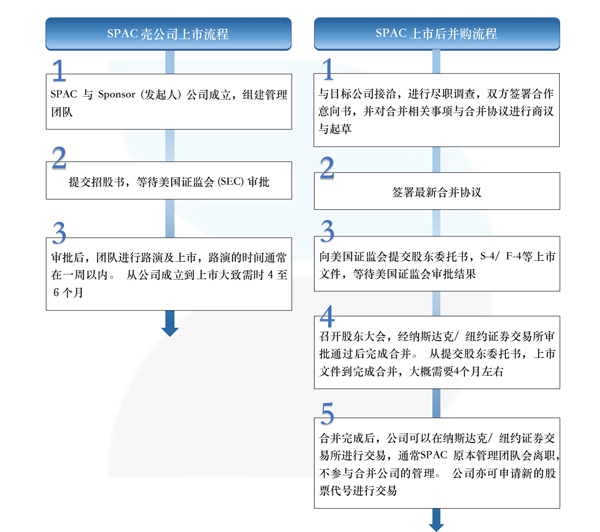
根据美国SPAC的实践,其上市及de-SPAC流程如下图所示。
三、SPAC与传统IPO的区别
与传统IPO不同,SPAC是先有上市公司和资金,再并购合适的公司。对目标公司来说,这就有了可在主板市场上市的确定性,避免了传统IPO申请不获批准,导致上市失败或延迟的风险,同时上市的成本也较低。对投资者来说,若并购对象或未如理想或最终未能成功并购,也有赎回股票的退场机制。
但是SPAC的劣势也不容忽视。首先,SPAC收购目标存在较大不确定性,SPAC的投资者无法得知最终将投资什么公司,亦无任何业绩纪录可作参考,更不保证一定能够完成并购,只能相信发起人团队的眼光及能力。其次。虽然SPAC合并交易需经证监会和交易所审核,但这种审核远不如IPO审核严格,同时也不会充分披露信息。如果SPAC管理团队的尽职调查不到位,可能发生造假上市。由此对于公众投资者而言,SPAC模式仍具有一定投资风险。

四、SPAC的监管重点
1、SPAC是否等同于借壳上市?
SPAC与香港监管机构多年来决心打击的借壳上市(买壳)行为看似相似,两者均是私人企业透过与壳公司进行并购取得上市地位,但两者在过程、披露及投资者保障方面有根本上的分别。
借壳上市(又称反收购Reverse Takeover)一般发生在一家规模较小或业务无以为继的上市公司,与一家规模相对较大的私人企业之间,名义上是上市公司收购私人企业以扩展业务,实质为把私人业务及资产上市,又能规避新上市规定的一种方法。壳公司的价值曾经达到数亿港元,导致不少人巧立名目造壳以图利。但这种手法一般枉顾其他投资者的利益,擅自改变上市公司的业务及处置资产,也大大损害市场的诚信、稳健及质素,影响投资者的信心,因此成为港交所的重点打击对象。
为针对并遏止借壳上市的做法,港交所在2019年修订《上市规则》第14章及刊发三封指引信等,以对市场上的借壳上市行为作出定义及纳入规管,赋予港交所较大空间去行使停牌及除牌等监管权力,提高借壳上市的门槛至类似IPO的披露要求,并限制控制权转手后的资产处置等。在现行的监管制度下,在香港借壳上市变得相当困难。
SPAC的分别在于其「成立壳公司」以「并购私人企业」的目的是透明公开的,无论是壳公司的成立、集资、并购私人公司的变相上市都是由发起人主导,并在监管机构的监视下按游戏规则进行,而过程中股东有权离场及对并购进行表决。在这个开诚布公的前题下,就没有了过往借壳上市会影响市场运作,造成虚假市场的弊病。
2、如何确保SPAC的发起人尽其职责?
一般来说,在设立SPAC时,SPAC的发起人可获得创始人股份,约占SPAC总股本的20%,这是其承担在合并交易完成之前,SPAC的设立和维护费用(约500万美元)的对价。除此之外,发起人不能从SPAC集资资金中提取薪酬或收取任何管理费。发起人的股份通常在SPAC合并完成后的一年内禁售。另外,若SPAC在限期内未能成功de-SPAC,其20%股份并不会获退还,因其对价(即设立和维护费用)已对外支付。
在这样的前提下,发起人有很大的诱因去完成de-SPAC,防止其努力付诸流水;同时,发起人也要小心挑选并购的业务,并努力运用发起人的影响力使之成功,才能确保其股份能转化为有价值的投资。在此之上,发起人(包括SPAC的董事会成员和管理层)与被并购对象的董事高管不可以有任何关系或拥有任何利益。

相对而言,传统IPO的保荐人为受证监会监管的机构,为了本身的业务理应尽其保荐人责任,有更大的诱因确保整个IPO过程都合规合法。但由于其报酬并不受上市公司的股价表现影响,所以即使对过往业绩做过充份的调查,但对业务日后的成功与否,则未必是其首要任务。
为加强SPAC发起人努力的诱因及防止发起人匆忙进行de-SPAC,监管机构可以考虑加入发起人出资的要求,以及延长禁售期。同时,若要加强对发起人的监管,也可以考虑在de-SPAC的中介团队中加入类似传统IPO保荐人的持牌人角色,去确保de-SPAC团队工作的合规性及提高对证监会的问责性。
3、关于被并购对象的资料,披露是否充份?
通常在SPAC与并购对象签署合并意向书后,会花大约三至五个月完成被并购方的审计、重组(如需要)、法律尽调、投资银行进行的价格评估,并由律师起草合并文件。在一般SPAC的并购过程中,对目标公司的监管及审查不及传统IPO,中介进行的调查也相对有限。
尽职调查的意义在于减低目标公司在重要事项上欺瞒投资者及监管机构的风险。发起人无论在管理或投资方面有多少经验及知名度,都不能取代实质、到位的尽调工作。
然而,若按《上市规则》第14章有关反收购的门槛去处理,要求de-SPAC达到IPO的标准,则令SPAC失去其让私人企业快速上市的优势。香港的监管机构在制定相关尽调要求时,适宜在中间着墨,在保留市场竞争力之余,提升对投资者的保障。

4、退场机制是否能保障投资者?
美国在经历SPAC的热潮后,有很多SPAC正面对在限期内找不到收购对象的问题。即使给予发起人充足的诱因,也不能解决市场上有可能出现的SPAC资金供过于求的情况。因此,能保障投资者(包括退出的投资者,以及留下的投资者)的退场机制至为重要。
一般SPAC的退场机制有两种。首先,如果SPAC未能在成立后的二十四个月内完成合并交易,则监管账户中的募集资金(包括发起人的出资和投资者的出资)将全额原路退回。其次,在SPAC完成de-SPAC之前,投资者可以于任何时候要求SPAC回购股份,取回自己的投资。这对于投资者可能不满意发起人或并购对象时,可以终止对项目的投资。
唯投资者的中途退场,意味着SPAC用于并购的资金减少,影响并购最后的成功与否。要保障留下来的投资者,可以考虑限制退场的时间在SPAC提出并购目标前,以及在股东投票后(只限投反对票的投资者),以免并购过程因投资者时机不当的退场而失败。

五、总结
正如前文所述,香港正在积极考虑引入SPAC制度。作为较迟加入SPAC市场的一方,香港有着前车可鉴的优势,同时也面对新加坡同一时期加入SPAC的竞争。若特区政府希望SPAC在香港能够取得成功,必须从香港的实际情况出发,在提升香港作为SPAC上市平台的吸引力的同时,加强对投资者,尤其是散户投资者的保障。
本文由本所曾浩贤高级律师、陈正斌律师,及中国执业律师沈佳颖共同合著。如有任何疑问或需要进一步的信息,请联系本所曾浩贤高级律师。
本新闻简讯仅供参考之用。其内容不构成亦不应被视为法律意见。史蒂文生黄律师事务所对于任何因根据或倚赖本文件所载资料所作决定,行动或不行动而引致的损失或损害,史蒂文生黄律师事务所概不负责。
On 31 March 2021, The Stock Exchange of Hong Kong Limited (the “Exchange”) published a consultation paper (the “Consultation Paper”) on a proposed streamlined listing regime for overseas issuers. According to the Exchange, this is contextual to its Strategic Plan 2019-2021 announced in February 2019, which contained an initiative to continue to develop Hong Kong as a listing and capital raising hub for major global and regional companies on either a primary or secondary basis, thereby attracting global investments seeking exposure to Asia Pacific companies and Mainland investors seeking international exposure.
The Exchange considered the current regime is affected by issues such as complexity of requirements for overseas issuers, inconsistent shareholder protection standards for recognised jurisdictions and acceptable jurisdictions, co-existence of two secondary listing regimes and more restrictive secondary listing requirements for issuers with a centre of gravity in Greater China. In view of these and other issues set out in the Consultation paper, the Exchange set out its proposals, for comment, on amendments to the Listing Rules to streamline the existing regime for overseas issuers (including those with a centre of gravity in Greater China), and also make consequential amendments to the requirements for all issuers (including Hong Kong issuers and PRC issuers).
Summary of proposals
The proposals of the Exchange are at the following dimensions. Comparison is made with the existing regime for illustrative purpose. Capitalised terms shall have the same meaning as defined in the Consultation Paper.
|
Existing Regime |
Proposed Regime |
| 1. Recognised Jurisdictions and Acceptable Jurisdictions | |
|
a. Three “Recognised Jurisdictions” – Bermuda, the Cayman Islands and the PRC b. 28 “Acceptable Jurisdictions”, i.e. jurisdictions (other than Hong Kong, the Cayman Islands, Bermuda and the PRC) that the Exchange has accepted as an issuer’s place of incorporation eligible for listing in Hong Kong |
a. No more distinction between Recognised Jurisdictions and Acceptable Jurisdictions |
| 2. Shareholder protection standards | |
|
a. All issuers must comply with Appendix 3 to the Listing Rules b. Overseas Issuers incorporated in Recognised Jurisdictions must comply with the applicable part of Appendix 13 to the Listing Rules c. Overseas Issuers incorporated in Acceptable Jurisdictions must demonstrate they can comply with the Equivalence Requirement (i.e. the Listing Rules requirement that an Overseas Issuer must be incorporated or otherwise established in a jurisdiction where the standards of shareholder protection are at least equivalent to those provided in Hong Kong) by meeting the JPS Key Shareholder Protection Standards set out in the Country Guides d. However, “Grandfathered Greater China Issuers” (i.e. Greater China issuers primary listed on a Qualifying Exchange, namely, the New York Stock Exchange LLC, NASDAQ Stock Market or the Main Market of the London Stock Exchange plc (and belonging to the UK Financial Conduct Authority’s “Premium Listing” segment) on or before 15 December 2017) and Non-Greater China Issuers (i.e. issuers primary listed on a Qualifying Exchange, which are not issuers with centre of gravity in Greater China) are subject to another set of requirements in Chapter 19C |
a. The shareholder protection standards in Chapter 19C of and Appendices 3 and 13 to the Listing Rules and the JPS will be replaced by one common set of Core Standards applicable to all issuers to establish a baseline level of investor protection for all issuers regardless of their places of incorporation b.The Core Standards cover the most fundamental shareholders’ rights relating to the notice and conduct of shareholders’ meetings, approval of important matters, members’ right to requisition a meeting, remove directors, vote, speak and appoint proxies/corporate representatives, auditors, appointment of directors to fill casual vacancies and inspection of shareholders’ register, etc. which are based on standards set out in the HKCO or already required under the Listing Rules. c.The Equivalence Requirement will be repealed as a result |
| 3. Dual primary listings | |
|
a. Grandfathered Greater China Issuers with Non-compliant WVR and/ or VIE Structures cannot retain such structures while applying for dual primary listing directly, but may become dual primary listed on the Exchange with such structures if they secondary list in Hong Kong first, and subsequently there is significant demand for their shares such that the Trading Migration Requirement (i.e. the requirement under Listing Rule 19C.13 that if the majority of trading in Greater China Issuer’s listed shares migrates to the Exchange’s markets on a permanent basis, the Exchange will regard the issuer as having a dual primary listing and consequently the Automatic Waivers will no longer apply to such issuer) is triggered b. Common Waivers available to primary and dual-primary listed Overseas Issuers are set out in the JPS |
a. Grandfathered Greater China Issuers and Non-Greater China Issuers with non-compliant WVR and/ or VIE Structures may apply directly for a dual primary listing and retain the non-compliant structures, as long as they meet the eligibility and suitability requirements of Chapter 19C for Qualifying Issuers with a WVR structure b. Codification of some conditional Common Waivers for dual-primary listed issuers and the principles for granting Common Waivers |
| 4. Secondary listings | |
|
a. Two routes: the JPS (only available to Overseas Issuers that do not have a centre of gravity in Greater China) and Chapter 19C of the Listing Rules b. Common Waivers available to secondary listed Overseas Issuers are only set out in the JPS c. Automatic Waivers are (a) set out in the JPS for JPS Secondary Issuers; and (b) codified in Chapter 19C of the Listing Rules for issuers with, or seeking, a secondary listing under that chapter d. Greater China Issuers with or without a WVR structure must (i) demonstrate that they are “Innovative Companies”; and (ii) have a minimum market capitalisation at listing of HK$40 billion (or HK$10 billion with revenue of HK$1 billion in the most recent audited financial year) e. Only Greater China Issuers are subject to the Trading Migration Requirement f. JPS Automatic Waivers eligibility requirements: (i) Listing on a Recognised Stock Exchange (as set out in JPS); (ii) Five years’ good compliance record; (iii) Market capitalisation of US$400 million (approximately HK$3.1 billion) or more g. Listing Rules are silent on the application of Automatic Waivers for a secondary listed issuer that de-lists from the stock exchange on which it is primary listed h. Listing Rules are silent on whether a Grandfathered Greater China Issuer or a Non-Greater China Issuer can retain its Non-compliant WVR and/ or VIE Structures if it delists from the overseas exchange on which it was primary listed |
a. Codification and consolidation of requirements of the two routes to secondary listing b. Codification of all secondary listing related JPS provisions (including Common Waivers and Automatic Waivers for JPS Secondary Issuers) into Chapter 19C of the Listing Rules c. Non-WVR Greater China Issuers seeking a secondary listing (i) are no longer required to demonstrate that they are “Innovative Companies”; and (ii) have the option of meeting a minimum market capitalisation at listing of either HK$3 billion (with a track record of good regulatory compliance of at least five full financial years on a Qualifying Exchange or on any Recognised Stock Exchange, as the case may be) or HK$10 billion (with a track record of good regulatory compliance of at least two full financial years on a Qualifying Exchange) d. All secondary listed issuers are subject to the Trading Migration Requirement e. Codification of JPS Automatic Waiver eligibility requirements with minor modifications: (a) the compliance record requirement changed from “five years” to “five full financial years”; and (b) the minimum expected market capitalisation requirement changed from US$400 million to HK$3 billion f. An issuer will be regarded as having a primary listing on the Exchange upon its de-listing from the stock exchange on which it is primary listed. The issuer shall notify the Exchange in advance of any anticipated de-listing (voluntary or involuntary) from the stock exchange on which it is primary listed and, among other things, details of any proposed waivers or continued relief/ grace period for full compliance with any Listing Rules requirements (including the bases for requesting such waivers/ relief/ grace period) g. The Exchange may, on a case-by-case basis, exercise its discretion to grant a time-relief waiver, suspend trading of the issuer’s shares or impose other measures as it considers necessary for the protection of investors and the maintenance of an orderly market. The Exchange will issue relevant guidance. h. A Grandfathered Greater China Issuer or a Non-Greater China Issuer is allowed to retain its Non-compliant WVR and/ or VIE Structures (subsisting at the time of its secondary listing in Hong Kong) if it de-lists from the Qualifying Exchange on which it is primary listed |

Analysis and Takeaways
The Consultation Paper represents an attempt of the Exchange to unify the existing regimes relating to the application for dual primary and secondary listings of overseas issuers. As the Exchange observed, the market feedback was that the rules are “fragmented, complex and difficult to navigate”, and as a result, the complexity of these requirements may not be conducive to compliance.
The proposed changes are expected to enhance comprehensibility of the rules and the regulatory regime as a whole, resulting in higher regulatory certainty. It is expected that this may create incentives for overseas issuers which are already primary listed in other exchanges, to explore possibilities of applying for dual primary listing or secondary listing on the Exchange.
It should also be noted that the proposed changes have removed certain more restrictive requirements for issuers with a centre of gravity in Greater China. This may well encourage and facilitate further “homecoming” secondary listing attempts of these issuers.
Please contact our Partner Mr. Rodney Teoh for any enquiries or further information.
This newsletter is for information purposes only. Its content does not constitute legal advice and should not be treated as such. Stevenson, Wong & Co. will not be liable to you in respect of any special, indirect or consequential loss or damage arising from or in connection with any decision made, action or inaction taken in reliance on the information set out herein.