News
Find out all about our firm’s latest news and activities below. To learn more about any individual item, please contact us here.
 Stevenson, Wong & Co.
News
Find out all about our firm’s latest news and activities below. To learn more about any individual item, please contact us here.
Background
On 7 August 2020, The Stock Exchange of Hong Kong Limited (the “Exchange”) published a consultation paper as to its proposal to review the Rules Governnig the Listing of Securities on the Exchange (the “Listing Rules”) relating to disciplinary powers and sanctions (the “Disciplinary Regime”). On 20 May 2021, the Exchange issued the Consultation Conclusions to the consultation exercise (the “Consultation Conclusions”). The new amendments aim at augmenting the range of reputational sanctions available and ensuring that disciplinary action can be brought against a broader range of individuals, including members of senior management, if they cause or knowingly participate in a contravention of the Listing Rules. The revised Listing Rules have taken effect from 3 July 2021. Set out below are some of the major changes to the Listing Rules.
Identifying New Relevant Parties and Defining Senior Management
The Exchange has added new classes of the relevant parties who may be subject to disciplinary actions and sanctions under Rule 2A.09 of the Listing Rules and Rule 3.10 of the GEM Listing Rules (the “Relevant Parties”). A definition of “Senior Management” has also been added to bring clarity.
| New Classes of
“Relevant Parties” |
The following new classes have been included as Relevant Parties:
(a) employees of professional advisers of listed issuers and their subsidiaries as a Relevant Party under the Listing Rules; (b) guarantors of structured products; (c) guarantors for an issue of debt securities; and (d) parties who give an undertaking to, or enter into an agreement with, the Exchange as Relevant Parties under the Listing Rules. |
| Definition of “Senior Management” | The new Rule 2A.09(2)(c) of the Listing Rules (Rule 3.10(2)(b) for GEM Listing Rules) defines “senior management” to include any person:
(a) occupying the position of chief executive, supervisor, company secretary, chief operating officer or chief financial officer, by whatever name called; (b) performing managerial functions under the directors’ immediate authority; or (c) referred to as senior management in the listed issuer’s corporate communication or any other publications on the Exchange’s website or on the listed issuer’s website. |
Amendments relating to a PII Statement
One of the existing sanctions under the previous Listing Rules is to issue a public statement that the retention of office by the director is prejudicial to the interests of investors (a “PII Statement”).
The new amendments extend the Exchange’s power to issue PII Statements by abolishing the high threshold of establishing “wilful” or “persistent” failure by a director to discharge his responsibilities under the Listing Rules. Under the new Listing Rules, a PII Statement can be made where the Exchange is satisfied that the individual’s occupying of office “may cause prejudice” to the interests of investors. With the removal of the “wilful” or “persistent” threshold, the Exchange is afforded greater flexibility to attach appropriate sanction to the misconduct.
PII Statement can now be issued against wider classes of individuals. With the new amendments, not only the directors of a listed issuer but also the senior management of the relevant listed issuer and even the director or senior management of any of its subsidiaries can be the subjects of a PII Statement. Further, the Exchange clarifies that a PII Statement can be made whether or not the individual continues in office at the time the PII Statement is made.
Enhancingfollow-on actions after making of a PII Statement
In case of more serious misconduct, the Exchange may direct follow-on actions at the same time a PII Statement is made. To further the effectiveness of a PII Statement, where an individual continues to be a director or senior management of the named listed issuer after a PII Statement has been made against him, the Exchange can order denial of facilities of the market to that listed issuer for a specified period. If there are significant problems in a listed issuer’s internal controls, this sanction may be imposed until the completion of an internal control review from a external professional adviser and the implementation of adequate and effective internal controls to ensure the compliance of the Listing Rules. The “wilful” or “persistent” threshold for ordering the denial of facilities of the market is also removed.
In addition, the Exchange requires named listed issuer to include a reference to the PII Statement in all its announcements and corporate communications unless and until the individual subject to a PII Statement with follow-on action is no longer its director or senior management member.

Extending Disclosure in Listing Documents and Annual Reports
The scope of disclosure on public sanctions towards senior management and directors is extended to the listing applicants’ listing documents and listed issuers’ annual reports to include full particulars of any public sanctions made against their directors or members of senior management (current and/or proposed) by statutory or regulatory authorities. The new scope of disclosure increases market transparency and makes the information more readily available to the public.
Introducing the Director Unsuitability Statement
Director Unsuitability Statement is introduced for the most egregious or severe cases of misconduct. Where a director fails to discharge his responsibility under the Listing Rules in a serious manner or repeatedly, the Exchange has the power to publicly state that the director is unsuitable to occupy a position as director or within senior management of a named listed issuer or its subsidiaries. The rules on follow-on actions, disclosure, and publication requirements apply equally to the Director Unsuitability Statement.
Imposing Secondary Liability
The rule changes allow the Exchange to impose sanctions on the Relevant Parties which have caused by action or omission or knowingly participated in a contravention of the Listing Rules. In particular, company secretaries, who are considered members of senior management, as well as professional advisers to the listed issuers, are also subject to secondary liability. The Exchange, however, made a note to clarify two matters. First, the imposition of secondary liability on solicitors and certified public accountants in private practice only covers circumstances that are agreed between the Exchange and the professional regulatory bodies. Second, the Exchange will take into account whether the party has knowingly or recklessly facilitated or participated in a breach of the Listing Rules or any undertaking given or any agreement with the Exchange when determining the secondary liability of the “Relevant Parties”.

Obligation to provide complete, accurate and up-to-date information
The rule binds a party which is providing information to the Exchange regarding a matter or interacting with the Exchange, whether proactively or in response to an enquiry. It obligates the party to provide information that is as complete, accurate and up-to-date as possible.
Minor Rule Amendments
Other minor rule amendments have also been introduced:
1. Extending the ban on professional advisers to cover banning of representation of any or a specified party;
2. Placing an obligation on professional advisers to use all reasonable efforts to ensure that their clients understand and are advised as to the scope of and their obligations under the Listing Rules when acting in connection with Listing Rules matters on which they are instructed to advise. Professional advisers should also refrain from knowingly provide information to the Exchange which is false or misleading in a material particular;
3. Using “business day” as the benchmark for counting the periods for filing review applications, and for requesting or providing written reasons for decisions;
4. Requiring all review applications to be served on the Secretary to the Listing Committee or the Secretary to the Listing Review Committee;
5. Counting the period for filing review applications from the date of issue of the decision or the written reasons;
6. Counting the period for requesting written reasons from the date of issue of the decision; and
7. Counting the period for providing written reasons from the date of receipt of the request.
Please contact our Partner Mr. Rodney Teoh for any enquiries or further information.
This newsletter is for information purposes only. Its content does not constitute legal advice and should not be treated as such. Stevenson, Wong & Co. will not be liable to you in respect of any special, indirect or consequential loss or damage arising from or in connection with any decision made, action or inaction taken in reliance on the information set out herein.
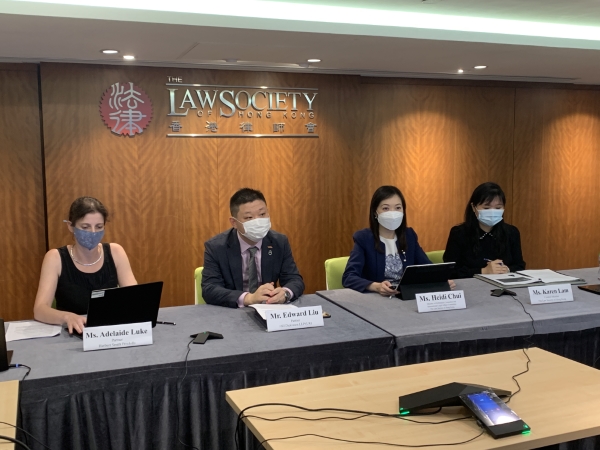
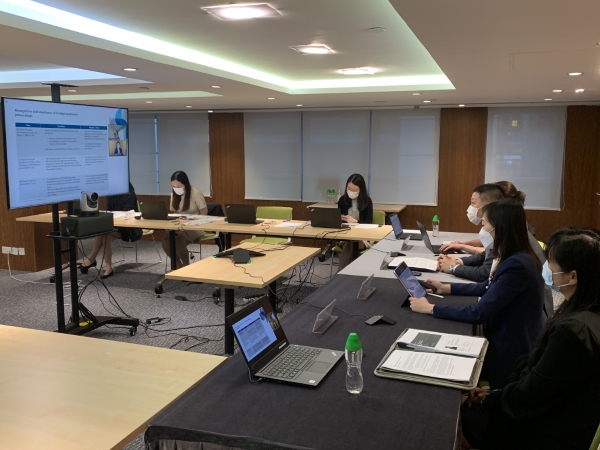
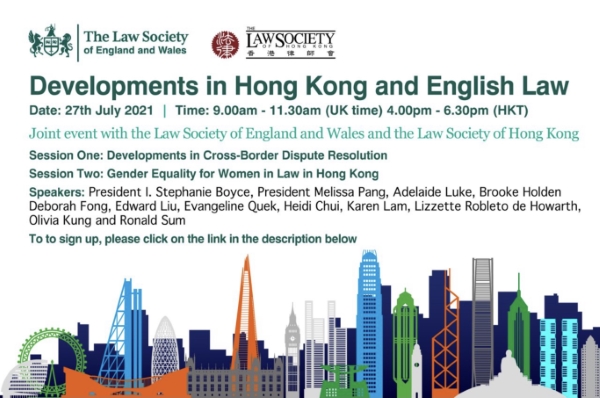
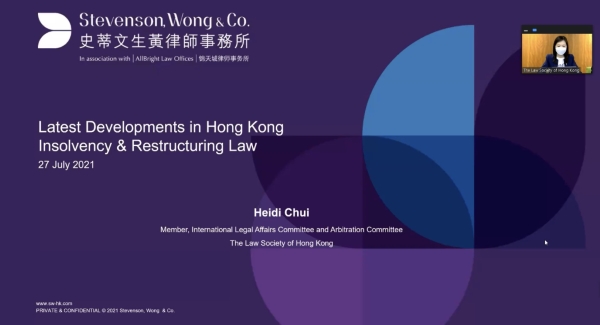
On 27 July 2021, our Partner and Head of Litigation and Dispute Resolution department, Ms. Heidi Chui, was invited to be one of the panel speakers of “Developments in Cross-border Dispute Resolution”. The webinar was jointly organised by The Law Society of England and Wales and The Law Society of Hong Kong.
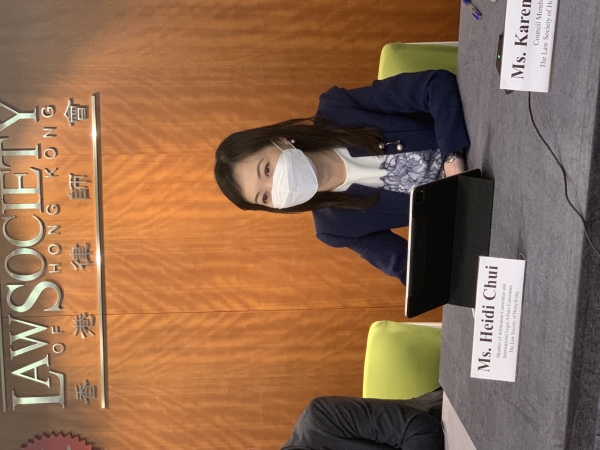
At the webinar, Ms. Chui shared and explained the latest developments in Hong Kong’s insolvency and restructuring law, including the recognition and assistance of foreign insolvency, “soft-touch” provisional liquidation, and corporate rescue bill by analysing the key facts and significant impacts of the recent landmark cases. The webinar was well-received by over 100 participants.
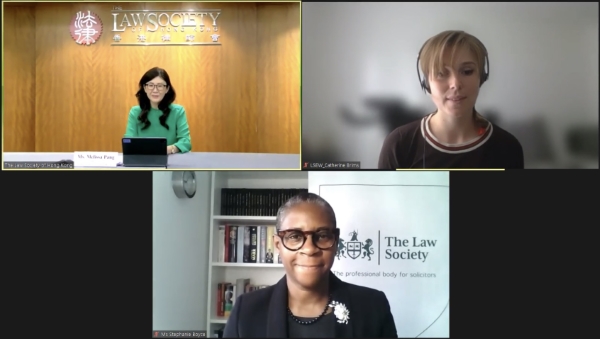
Top left: Ms. Melissa Pang, President of The Law Society of Hong Kong; Top right: Ms. Catherine Brims, International Policy Adviser of The Law Society of England and Wales
Bottom: Ms. Stephanie Boyce, President of The Law Society of England and Wales
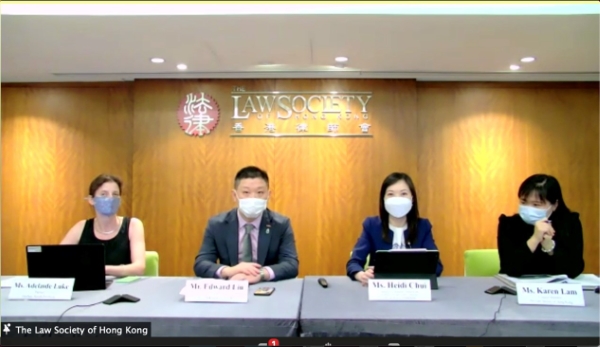
For more information, please contact our Partner Ms. Heidi Chui (heidichui.office@sw-hk.com).
(中文) 近年来,随着网络技术的进一步普及和使用,网络骗案也在不断增加,甚至逐步形成产业化的趋势。许多犯罪分子利用跨区域的网络技术,对境内外的受害人实施诈骗,并要求受害人将款项转至香港的银行账户。如此,一旦骗案曝光,受害人除了向香港执法机构求助冻结相关银行账户外,亦需要循民事程序向香港法院申请披露相关银行账户的资料,以追讨被骗取的资产,保障自身的权益。
然而,在寻求披露银行账户资料的过程中,一个无法避免的环节便是银行的收费。通常情况下,受害人需要向银行支付与披露申请相关的手续费用,而银行会按照各自的内部指引进行收费。当中,不排除有些银行会收取较高额的费用,而且不同的银行的收费可能会有较大的差异。
近日,香港法庭在Hwang Joon Sang & Ors v G.E.I & Ors [2021] HKCFI 544一案中,就银行的收费进行了讨论。在该案中,涉案银行要求收取的费用包括 (1) 每个账户港币3,000元的处理费用,及 (2) 以每页港币200元收取提供文件的额外费用。原告人律师就此提出了反对,认为每页收取港币200元的费用完全过高,与另外一单于2021年4月涉及相同银行的披露申请的协定费用 (每页港币25元) 相差甚远。
针对银行的收费,高等法院原讼法庭高浩文法官认为目前的情况与法庭的基本目标 (即高等法院规则 (第4A章) 第1A号命令第1条规则的基本目标) 包括提高法庭程序的成本效益的目标相违背。高法官特别指出,银行需要自己考虑是否减少使用纸张,并通过使用电子数据库的形式提供披露资料会更加节约及环保 (more economical and environmentally friendly)。高法官进一步指出,银行亦需要考虑避免耗费不必要的时间及行政资源 (expenditure of time and administrative resources),或至少应该最小化该等支出。

同时,高法官亦提出,「法庭认为,银行遵从披露命令并非为了牟利,银行遵从披露命令收费而采用的基数不应大过实际而且合理的费用基数。事实上,命令申请人按弥偿基准支付披露文件的费用,完全是为了确保银行收取的金额完全足够补偿 (但不能多于) 为遵从命令而引致的成本。」(“I do not think it is part of the profit making of a bank to charge for compliance with orders for disclosure on a basis greater than the actual reasonable costs of compliance. Indeed, the whole point of ordering the costs of providing disclosure to be paid on an indemnity basis, against the applicant’s undertaking to do so, is to ensure full (but no more than full) compensation for the costs of complying with the order.”)
由于在本案中银行并未就收取的费用作出解释,高法官暂时无法确定涉案银行本次提出的收费是否是合理的。虽然如此,高法官表示,「将来如果没有一套合理的方法可用,法庭可能在一些情况下会被迫考虑透过讼费评定或其他方法,找出按银行弥偿基准遵从命令而引致的成本。」(“[F]ailing a justified approach in future, it may be that the court will on some occasion be forced to consider identifying the reasonable indemnity costs for compliance with an order in any particular case, through a process of taxation or otherwise. ”)

本案中,虽然法庭并未就银行遵从披露命令而收取费用进行严格的规定及上限,但法庭明确表达了对于该等收费的态度。正如高法官所言,申请人支付银行遵从披露命令的费用是为了补偿银行的成本,而非让银行牟利。银行可能需要重新审视内部的收费指引,并且准备就其在披露申请案件中的收费向法庭提供合理理由 (如所有银行客户皆适用的收费标准、涉及的人工成本等),以符合法庭提高法庭程序的成本效益的目标。
本文由本所合伙人,诉讼及争议解决部主管徐凯怡律师、黎嘉钿高级律师和黄晊晄律师撰写。若阁下想了解更多详情,请联络本所徐凯怡律师 (heidi.chui@sw-hk.com)。
于本文中提供的一切资料仅供参考,不构成任何法律意见,资料亦受制于适用规定及法例不时的更新与修改。若需取得相关法律意见,须咨询法律顾问。
In the past two decades, the Hong Kong court has gradually increased its scrutiny on the appointment of provisional liquidators for the purpose of corporate rescue and as a means to resist winding-up petitions.
In the 2003 Court of First Instance decision of Re Seapower[1], the court granted the provisional liquidators powers to facilitate a restructuring as a part of a scheme of arrangement and dismissed the winding-up petition subject to conditions.
Then in 2006, the Court of Appeal commented in Re Legend[2] that, “……the power of the court……is to appoint a liquidator or liquidators for the purposes of the winding-up, not for the purposes of avoiding the winding-up…… Restructuring is an alternative to a winding-up”.
Re Legend and subsequent cases adopting it[3] clarified that section 193 of the Companies (Winding Up and Miscellaneous Provisions) Ordinance does not allow provisional liquidators to be appointed solely for the purpose of corporate restructuring or rescue. Rather, provisional liquidators may be allowed additional powers to restructure the subject companies if they are insolvent and their assets are in jeopardy, but the purpose of the appointment should not depart from the objective of winding-up.
An arrangement was eventually developed in response to the above clarification. Considered in detail in Re Z-Obee Holdings Limited[4], this arrangement was coined the Z-Obee technique:
In gist, a foreign company facing a winding-up petition in Hong Kong would procure the appointment of soft-touch provisional liquidators in its place of incorporation (commonly the British Virgin Islands or the Cayman Islands) to facilitate a restructuring, whereupon it would
(1) seek the Hong Kong court’s recognition of the appointment; and/or
(2) request the Hong Kong court to provide assistance to the provisional liquidators with the force of a letter of request issued by a court of its place of incorporation.
Cases leading up to Re China Bozza
In Re Lamtex[5] and Re Ping An[6], the Hong Kong court was asked to recognize foreign appointments of soft-touch provisional liquidators and provide assistance to them.
In Re Lamtex, the court refused to recognize an appointment as there was insufficient evidence of a credible restructuring plan. The subject company was wound up.
In Re Ping An, the court granted an order of recognition and assistance upon being satisfied that there was tangible prospect of restructuring. The winding-up petition was adjourned for two months. The court commented that, “the power of assistance which the court normally grants foreign soft-touch provisional liquidators is simply a consequence of recognition”[7].
One can sense a heightening caution where the Z-Obee technique was used, as the court observed in these decisions that the subject companies “were to engineer a de facto moratorium”, that it was “a questionable use of soft-touch provisional liquidation”[8], and that it had “the intention of frustrating a winding up petition issued in the company’s centre of main interest (COMI)”.
The court further commented that insolvency processes in a company’s COMI could be more efficient and effective than that in its place of incorporation where it has no connection with[9], and a more stringent approach may be adopted in similar applications for recognition and assistance in the future.[10]
The Re China Bozza decision
In the recent decision of Re China Bozza[11], the court recognized the appointment of offshore provisional liquidators “as a matter of private international law”, but in respect of the liquidators’ request for assistance, the court merely gave a general direction of “liberty to apply””: The court would not provide assistance as a matter of course. A separate application should be made with justifications.[12]
Further, the court’s recognition of an appointment of offshore provisional liquidators does not automatically entail the adjournment of the winding up petition[13].
The court will adjourn the petition only upon being satisfied that the prospect of a successful restructuring during the adjournment is justifiably strong,
“If the reality is, for example, that a company is (a) hopelessly insolvent, (b) there is no prospect of realising value from sale of its indirectly owned assets in the Mainland as they will be seized by Mainland creditors and (c) the only hope of achieving other than a de minimis return to off-shore creditors is the sale of the company to an investor, who may wish to acquire it to use as a listed vehicle for a different type of business; this should be explained and justified. Simply referring to a possible “debt restructuring” and treating the expression as a kind of magical incantation, the recitation of which will conjure up an adjournment of the petition is as inadequate as it is facile.”[14]
The court also highlighted that, to restructure a company’s debt,
(1) the appointment of a soft-touch provisional liquidator was not necessarily required;
(2) insolvency practitioners can be engaged to advise the company on restructuring and persuade the petitioning and supporting creditors and the court to adjourn the winding up petition.[15]
Creditors’ Interest is Paramount
In Re China Bozza, the court emphasized that once a company became insolvent, it had a paramount duty to consider the creditors’ interests, and the company’s directors fiduciary duties would be owed to the general body of creditors instead.[16]
Soft-touch provisional liquidators may be appointed with an intention to salvage the current shareholders’ investments in the company, often by procuring “white knight” to acquire the company’s assets[17]. In so doing, if the provisional liquidators do not appear to prioritise creditors’ interests, this may contribute to the Court’s refusal to provide assistance.[18]
The court was wary that no proper regard had been given to creditors’ interest in some recent cases. Typically, the companies would have issued low interest corporate bonds to Mainland residents. These bonds may be unattractive in terms of return, but the subscribers’ real objective would be to circumvent PRC’s exchange restrictions[19] or to apply for residency status in Hong Kong. The subscribers may not fully understood their rights and may have limited means to seek recovery.[20] In these circumstances, a soft-touch restructuring may not provide sufficient protection to the subscribers.
As such, the court will closely supervise whether the Z-Obee technique is used with sufficient regard to creditors’ interests.
Conclusion
Companies and those advising them should take heed of the court’s clear preference for the commercial approach of negotiation to the Z-Obee technique.
Procedurally, it is important to note that the court’s recognition of an appointment of offshore provisional liquidators does not automatically entail an adjournment of a winding-up petition. Instead, a strong prospect of success of restructuring needs to be demonstrated to the court to persuade it to adjourn a winding-up petition.
Please contact our Partners Mr. Osbert Hui or Mr. Dominic Lau for any enquiries or further information.
This newsletter is for information purposes only. Its content does not constitute legal advice and should not be treated as such. Stevenson, Wong & Co. will not be liable to you in respect of any special, indirect or consequential loss or damage arising from or in connection with any decision made, action or inaction taken in reliance on the information set out herein.
References:
Re China Bozza Development Holdings Limited (HCMP 172/2021, Hearing Date: 15 April 2021; Date of Decision: 11 May 2021)
Re China Greenfresh Group Co Ltd (HCCW 187/2020, Hearing Date: 29 April 2021; Date of Decision: 29 April 2021)
Re China Solar Energy Holdings Ltd (HCCW 108/2015, Hearing Date: 18 August 2017; Date of Handing Down of Decision: 20 March 2018)
Re Lamtex Holdings Limited (HCCW 263/2020, Hearing Date: 28 January 2021; Date of Decision: 11 March 2021)
Re Legend International Resorts Ltd (CACV 207/2005, Hearing Date: 7-9 February 2006; Date of Handing Down Judgement: 1 March 2006)
Re Ping An Securities Group (Holdings) Limited (HCCW 217/2020 & HCMP 1810/2020, Hearing Date: 5 March 2021; Date of Decision: 12 March 2021)
Re Plus Holdings Ltd (HCCW 612/2006, Hearing Date: 17 May 2007; Date of Decision 17 May 2007)
Re Seapower Resources International Ltd (HCMP 2977/2003, Hearing Date: 14 November 2003; Date of Judgment: 14 November 2003)
Re Z-Obee Holdings Limited (HCMP 1563/2017, Date of Hearing: 31 October 2017; Date of Decision: 31 October 2017)
We are delighted to announce that our Partner, Mr. Calvin Lo (TEP), has won the STEP Excellence Award in the STEP Diploma- International Trust Management. The award recognises the top-scoring student at distinction level in the STEP exams worldwide.
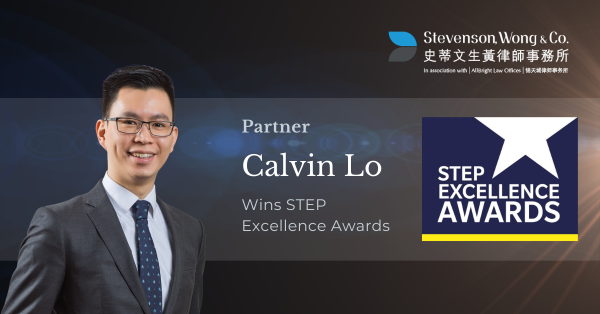
The STEP Excellence Awards celebrate exceptional achievement, recognising the highest achievers across all STEP qualifications globally. The Awards align with STEP’s core focus on promoting high standards and professional excellence.
According to STEP, winners of the STEP Excellence Awards “represent the best and the brightest practitioners – many of whom will be names to watch out for in the years ahead.”
About STEP Qualifications
STEP qualifications are widely recognised as the benchmark for the private client and wealth planning industry and are taken by accountants, lawyers, trustees, bankers and others to demonstrate their specialist knowledge and expertise.
For more information, please visit the listing here or contact our partner Mr. Calvin Lo.
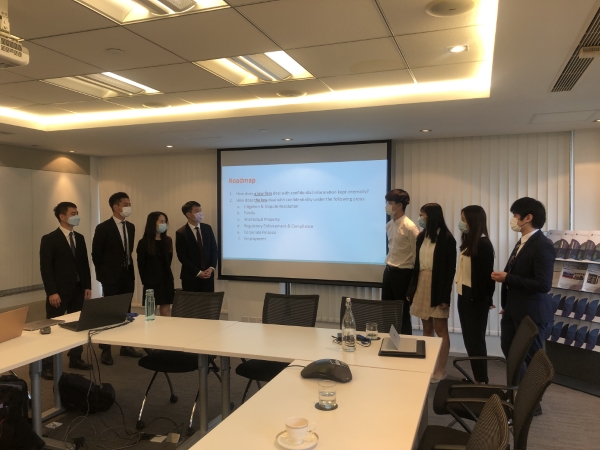
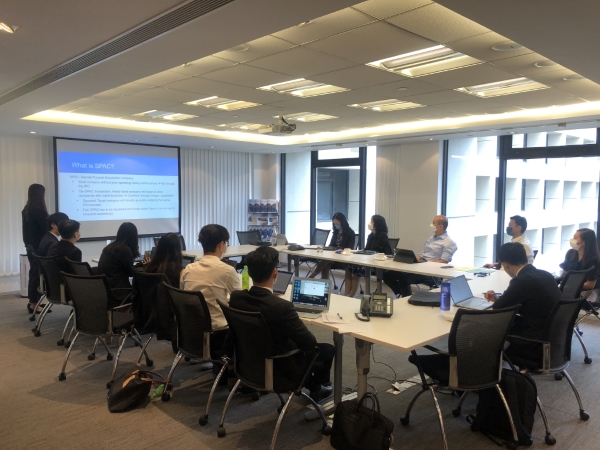
In July 2021, 8 law students joined and completed a two-week summer internship programme at Stevenson, Wong & Co..
The programme is designed for law students to have a glimpse of working at a full-service law firm and gain an insight into their future career path. During our programme, the interns attended various practice areas talks and performed legal tasks. On their last day, we were impressed by the vibrant and lively individual and group presentations given by our interns.
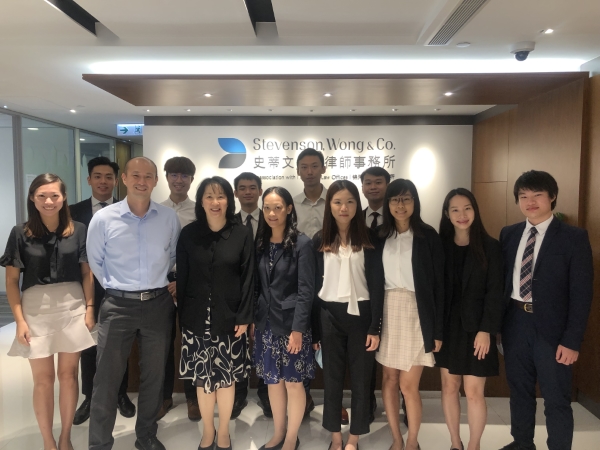
Front row from the left: Associate Ms. Karlie Cheung, Partner Mr. Rodney Teoh, Partner Ms. Lai Lam, Partner Ms. Milly Hung, Intern Ms. Bertha Wu, Intern Ms. Liz Tang, Intern Ms. Jacqueline Poon, Intern Mr. Griffin Tung
Second row from the left, Intern Mr. Winson Chu, Intern Mr. Kayson Hui, Intern Mr. Tim Cheung, Trainee Mr. Calvin Lo, Intern Mr. Leo Choi
We wish our interns great success in their future endeavours!
For more information about our internship programme, please contact Ms. Lai Lam, Mr. Rodney Teoh, or Ms. Milly Hung.