News
Find out all about our firm’s latest news and activities below. To learn more about any individual item, please contact us here.
 Stevenson, Wong & Co.
News
Find out all about our firm’s latest news and activities below. To learn more about any individual item, please contact us here.
On 14 September 2020, Wendy Lam, partner and head of SW Private Client Department, was invited to speak at a 2-day virtual conference titled “Supporting, Healing, Reconstructing – The New Landscape” by The Law Society of Singapore.
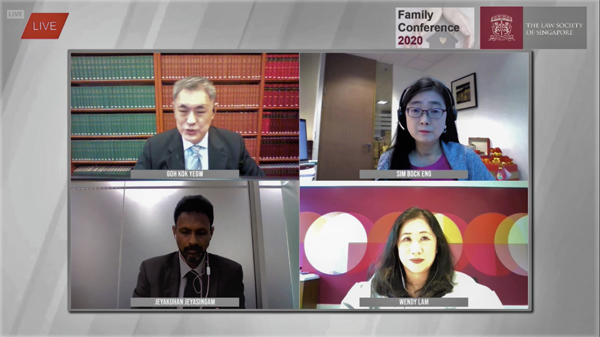
The 3rd annual Family Conference aimed to benefit practitioners in the field with updates of the multifaceted developments in family law. Different expert panels with prominent local and foreign judges, practitioners and academics covered different perspectives on topics that are central to the practice of family law. Wendy discussed the multiplicity of proceedings in family and probate matters from a Hong Kong perspective, and explored with the co-panellists from Singapore and Malaysia the challenges faced in different jurisdictions.

The conference was a huge success which was widely covered in the local press and attracted more than 400 participants.
Please contact Ms. Wendy Lam for more information or further enquiries.
In most Hong Kong divorce proceedings, an application for maintenance pending suit (“MPS”) is one of the crucial matters for consideration. It often takes a year for a divorce and even longer when there are disputes in the main suit, custody and welfare of children of the family, and/or ancillary relief and division of the matrimonial assets. Can a party to the divorce proceedings receive maintenance in any kind if he/she does not have sufficient financial resources pending suit?
According to section 3 of the Matrimonial Proceedings and Property Ordinance (Cap. 192) (“MPPO”), Hong Kong Court has the discretion to order a party to the divorce proceedings to pay MPS to the other party. If the financially weaker spouse and/or the children do not have sufficient financial resources to sustain their expenses, the spouse can apply to the Court for MPS. If granted, the Court normally orders payments for MPS to commence immediately, which lasts until the final ancillary relief order or further order of the Court. In making such order, the Court is required to balance the reasonable needs of the applicant spouse and/or the children against the paying spouse’s ability to pay by adopting a broad brush approach.

However, after the MPS Order has been awarded, either party can apply for variation of the said Order due to any change in his/her financial circumstances such as income, assets and/or liabilities. Since the variation will have great impact on the party receiving the MPS, the Court will take extra care in considering any variation application.
In this article, we will share and explain the legal issues in KCMA v ABC and others [2020] HKCFI 1078 in relation to an application to vary the MPS Order.
Background
We acted for the Wife who successfully defended against the Husband’s application to adjust the MPS Order downward at the High Court on an urgent basis during the General Adjourned Period enforced by the Judiciary during the COVID-19 crisis. Pursuant to the previous MPS Order made by consent, the Husband was to pay, amongst others, MPS for the Wife at HK$26,450 per month and MPS for the 3 children at HK$79,350 per month (HK$26,450 for each child).
The Husband sought to reduce the MPS to HK$13,600 per month for the Wife and HK$13,600 per month for each child on the basis that there had been a material decrease in his income.
Legal Principles
Section 11(1) of MPPO empowers the Court to vary or discharge the order of financial provision; section 11(7) of MPPO stipulates that in exercising the power under section 11(1), the Court is required to have regard to all the circumstances of the case and any changes on matter to which the Court was required to have regard when making the MPS Order.

In addition, the Court cited the principles from a Court of Appeal judgment AEM and VFM [2008] 3 HKLRD 36, CACV 261/2006:
Court’s Decision
The husband’s application was refused based on the abovementioned statutory and common law principles. The Court had taken into consideration the following factors:
After considering all the factors, the Court decided that the Husband was able to afford the MPS, and that even after paying the MPS, he would still have the funds to cover his daily expenditures.
Although the Husband claimed that the duration of the MPS Order was unexpectedly long, the Court pointed out that the MPS Order had been made by consent, and was based on the Husband’s average income for at least 3 years. There was no evidence that the parties had intended that such agreement was to be re-visited or varied annually.

Commentary
MPS is an important matter to be considered in the divorce proceedings. The Court is required to balance the reasonable needs of the applicant spouse and/or the children against the paying spouse’s ability to pay by adopting a broad brush approach.
When either party subsequently seeks to vary a MPS Order, the Court will carefully scrutinise the application. As the Court of Appeal principle cited by the judge in the present case, “the basis and intended effect of the original order are relevant factors to which the Court on variation should pay regard, and there should not be a radical departure from the approach taken by the parties themselves when they had entered into an agreement embodied in a consent order”.
This article is co-authored by our experienced Private Client Team – our Partners Catherine Por and Wendy Lam, and our Senior Associates Karl Wong and Calvin Lo. Please contact our Catherine Por or Wendy Lam for any further enquiries or information.
This newsletter is for information purposes only. Its content does not constitute legal advice and should not be treated as such. Stevenson, Wong & Co. will not be liable to you in respect of any special, indirect or consequential loss or damage.
The Cayman Islands have long been the pre-eminent jurisdiction for investment funds which typically take the form of a segregated portfolio company (“SPC”) or a limited partnership despite its high formation and maintenance cost. It is mainly due to the fact that the Cayman Islands have no direct taxes of any kind. However, its tax efficiency has been largely discoloured by legislation in relation to economic substance.
In an attempt to attract investment funds to establish and operate in Hong Kong and lead Hong Kong into becoming a premier international asset and wealth management centre, the Hong Kong Government has made great effort to further enhance Hong Kong’s position in asset and wealth management by diversifying Hong Kong’s fund structures and offering tax relief. Further to the introduction of the new open-ended fund company regime in July 2018, the Limited Partnership Fund Ordinance (Cap. 637) (the “Ordinance”) came into effect on 31 August 2020, under which a new fund structure named limited partnership fund (“LPF”) is now available within the international financial hub.

A LPF is a private fund that is structured in the form of a limited partnership. LPFs established under the Ordinance will not only enjoy the necessary contractual flexibility and flexibility in capital contribution and distribution of profits, but it also provides tax exemptions as well as simplified registration process and dissolution mechanism.
The table below makes a brief comparison of the major elements of the most popular investment vehicles in Cayman Islands, i.e. SPC and exempted limited partnership (“ELP”), with the forthcoming LPF regime in Hong Kong :-
|
|
Cayman SPC |
Cayman ELP |
Hong Kong LPF |
|
Formation & Registration |
A SPC requires 3 separate registrations:
1) Incorporation of an exempted company; 2) Registration of the exempted Company as an SPC; and 3) Separate registration with the Cayman Islands Monetary Authority. Both open-ended and close-ended fund are required to be registered with the Cayman Islands Monetary Authority |
ELP requires only 1 registration after constitution of an ELP by way of a written limited partnership agreement
Registration is made with the Registrar of Exempted Limited Partnerships |
LPF requires only 1 registration after constitution of a LPF by way of a written limited partnership agreement
Registration is made with the Companies Registry (*Note: A business registration certificate for the LPF must be applied for from the Inland Revenue Department within one month after the registration date) |
|
Ownership |
Can be owned by foreigners or foreign entities
|
||
|
Privacy |
Owners’ (shareholders’ and members’) names are required to be filed with the Companies Registrar, but are not part of any public records | No requirement under the Exempted Limited Partnership Law (2018 Revision) for reporting particulars of the limited partner(s) in an ELP to the ELP Registrar | No requirement under the Ordinance for reporting particulars of the limited partner(s) in a LPF to the Companies Registry |
|
Flexibility |
SPC can be divided into separate portfolios which operate independently from each other |
Do not offer mechanism for segregation of assets and liabilities
|
|
|
Costs |
1) Incorporation of an exempted company and registration as an SPC: ~US$5,000 – $8,000 (depending on the size of registered capital) 2) Annual fee: |
1) Registration fee: ~US$5,500 2) Annual fee: |
1) Registration with the Companies Registry: ~US$390 (inclusive of lodgment fee and registration fee)
2) Business registration fee and levy: ~US$32 (1-year certificate) or US$508 (3-year certificate) |
|
Tax |
Foreign owned SPCs conducting business outside of the Cayman Islands are not liable to pay any tax (but note, this exemption does not apply to those SPCs conducting business inside the Cayman Island)
Moreover, dividends are not subject to taxation and there is no withholding requirement for any tax However, it is mandatory for companies established on or after 1 January 2019 to comply with the substance requirements from the time they commence the relevant activities |
Neither an ELP nor any partner is subject to any form of direct taxation in the Cayman Islands
ELPs are not affected by the economic substance requirements. |
A LPF can generally enjoy profits tax exemption in Hong Kong (no matter whether the investments made by the LPF are conducted inside or outside Hong Kong).
No stamp duty is payable when an interest in a LPF is contributed, transferred, or withdrawn |
|
Exchange Control |
No exchange control or currency restriction
|
||
|
Management/ Regulation |
Can be managed by an individual or management entity located anywhere in the world, but note that the individual or management entity providing services to the SPC outside the Cayman Islands are subject to their local regulations | Ultimate responsibility for the management and control of the fund lie with the general partner(s), at least one of whom must be :-
1) an individual resident in the Cayman Islands; 2) a Cayman exempted company; 3) a registered foreign company; or 4) an ELP or a registered foreign limited partnership |
Ultimate responsibility for the management and control of the fund lie with the general partner(s), who can be :-
|
|
Registered Agent |
Every Company in the Cayman Islands is required to appoint a local registered agent |
No requirement for registered agent
|
|
|
Governance |
Both open-ended and close-ended SPCs are regulated by the Cayman Islands Monetary Authority | Regulated by the Cayman Islands Monetary Authority | The LPF regime is a registration scheme administered by the Companies Registry
A LPF would not require authorization from the Securities and Futures Commission at the fund level unless it is offered to the public |
|
Termination/ Dissolution |
A SPC may be wound up by making a petition to the Court in Cayman Island
A segregated portfolio which has no assets or liabilities attributable to it may be terminated by resolution of its directors (or such other authority as may be provided for in, and subject to the provisions of, its articles of association) |
An ELP may be dissolved in accordance with the provisions of the partnership agreement | A LPF may be: (1) dissolved in accordance with the limited partnership agreement of the fund, or by a court order; and (2) deregistered by application to the Registrar of Companies. |
While SPC, ELP and LPF all feature high privacy and tax exemption, and are free from exchange control, Hong Kong LPF is relatively cost-effective by way of its one-off registration fee and relatively low sustaining fee, and unlike running a segregated portfolio company, the LPF has streamlined management which further reduces the administrative costs. Moreover, its simplified registration procedures allow the investors and fund managers to manage and operate the investment vehicles more easily.
Subsequent to the implementation of the economic substance requirements in the Cayman Islands in January 2019, unless there are special needs for mechanism of segregated portfolios (e.g. investors wishing to switch their investments and/or assets between segregated portfolios at some point during the term), the Hong Kong based LPF would be a favourable option for investors from Hong Kong and all over the world.
For more information or advice on the Hong Kong Limited Partnership regime please contact Hank Lo, Osbert Hui or Ann Chan.
This newsletter is for information purpose only. Its content does not constitute legal advice and shall not be treated as such. Stevenson, Wong & Co. will not be liable to you in respect of any special, indirect or consequential loss or damage.
Our firm’s Partner Ms. Lai Lam has been recognized as Trade Mark Stars 2020/21 by IP stars.
The research is conducted by an experienced team of research analysts from Hong Kong, London and New York. The aspects assessed for the firm rankings include expertise, workload, market reputation, track record, outcomes achieved for clients, and unique strengths in a given practice area. For a practitioner to be ranked by IP Stars, one must be highly regarded by their peers and/or clients or those that are integral to their firm’s success or reputation.

Lai was admitted to practise as a solicitor in Hong Kong in 1989, in England and Wales in 1993 and in Singapore in 1995. Lai joined the firm in 2002.
Lai’s practice covers all areas of intellectual property. She frequently advises on the selection and suitability of trade marks for use and registration; the proper use of trade marks; opposition and rectification proceedings; the drafting and registration of trade mark licences; and user agreements and the assignment of trade mark rights.
Lai has handled large trade mark portfolios for clients regionally and internationally, in both the private and public sectors and in various fields, including acting for leading international companies operating in fashion and luxury goods.
In addition, Lai is qualified as a member of the Asian Patent Attorneys Association and a former Board Member of Interlaw and Vice Chair for the Asia Pacific Region. She is currently the vice Chair for the Interlaw Diversity, Inclusion and Community Special Business Team for Asia Pacific. She has also been appointed as a Civil Celebrant of Marriages.
About IP Stars
IP Stars is the leading resource for companies or individuals looking for experienced legal practitioners for contentious and non-contentious IP advice. The Managing IP’s legal directory has been covering IP law and practice since 1990 and rebranded in 2013 as IP Stars.
In August 2020, The Stock Exchange of Hong Kong Limited (the “Exchange”) published “Guidance on Disclosures in Listing Documents and Continuing Obligations under Chapter 37 – Debt Issues to Professional Investors Only” (the “Guidance”), supplementing the consultation conclusions on “Review of Chapter 37 – Debt Issuers to Professional Investors Only” (the “Consultation Conclusions”). The Guidance and Consultation Conclusions relate to the listing regime for debt issues to professional investors only (the “Professional Debt Regime”) under Chapter 37 of the Rules Governing the Listing of Securities on Main Board of The Stock Exchange of Hong Kong Limited (the “Listing Rules”). For the updates on the Professional Debt Regime, please see our news update on the Consultation Conclusions here.
This update centres upon the guidance provided by the Guidance on debt issues to professional investors only under Chapter 37 of the Listing Rules (“Chapter 37 Debts”), which consists of (1) general guidance on disclosure to be included in listing documents for the Chapter 37 Debts, (2) specific guidance in relation to the disclosure requirement of particular types of debts with special features (the “DSSFs”), as well as (3) general guidance on issuers’ continuing obligations. The Guidance applies to the Professional Debt Regime under both Chapter 37 of the Listing Rules and Chapter 30 of the Rules Governing the Listing of Securities on the Growth Enterprise Market of the Exchange.
1. Disclosure for Chapter 37 Debts and DSSFs
1.1. What are DSSFs?
DSSFs are debts with the special features that render debt securities “complex”[1]. The Guidance provided a non-exhaustive list of special features including:
(a) perpetual or subordinated debt securities;
(b) variable or deferred interest payment terms;
(c) extendable maturity dates;
(d) convertible or exchangeable;
(e) have contingent write down or loss absorption features; and
(f) with multiple credit support providers and structures.

1.2. General Disclosure Guidance
Disclosures in a Chapter 37 Debt listing document should be commensurate with the customary expectation of professional investors, especially when such investors also include high net worth individuals. Customarily expected disclosures for Chapter 37 Debts would usually include:
(a) a summary of key terms and conditions.
(b) financial information on the obligors, considering what level of financial disclosure would be required for investors to make an investment decision, including any credit assessment of the debt security.
(c) risk factors relating to the obligors, their businesses, and the Chapter 37 Debts, which may include:
(i) structural or other risks associated with the Chapter 37 Debts such as subordination, security and credit support;
(ii) for state corporations, prominent disclosure on the relationship with the government and level of financial support from the state; and in case the latter is no longer available, state that the repayment obligations of the Chapter 37 Debts remain solely on the issuer;
(iii) highlighting the risks that where the trustee or a prescribed proportion of holders of the Chapter 37 Debts can modify, waive or make other decision which may adversely affect the interests of individual or its minority holders, and that their recourse may be limited;
(iv) the full terms and conditions of the Chapter 37 Debts;
(v) a description of the use of proceeds of the Chapter 37 Debts;
(vi) business disclosure on the obligors, for example where an individual obligor has a fundamental role in fulfilling payment obligations of the debt securities, information on the business of this obligor, which the investors might not otherwise require or expect in the disclosure;
(vii) a summary of key taxation consequences associated with dealings in the Chapter 37 Debts;
(viii) any restrictions on the subscription and sale of the Chapter 37 Debts; and
(ix) any other material information that may be necessary to facilitate investors in making an informed investment decision.
(d) Issuers should consider the particular features of the Chapter 37 Debts which investors would expect to be drawn to their attention, particularly those of DSSFs that affect the investors’ rights (“Product Features”).
(e) Issuers should avoid misleading terminology when describing Chapter 37 Debts, which should have a title or description of the obligors that reflects the type of credit support being provided.
(f) Issuer should consider prominent disclosure of the key terms and structure of Chapter 37 Debts, highlighting any Product Features and risks. It may be appropriate to include a disclaimer or cautionary statement on the front cover of the listing documents, highlighting the key Product Features of DSSFs which could have an impact on investors’ rights.
(g) Issuers should include in the listing document:
(i) on the front or inside cover of the listing document, a disclaimer statement under Listing Rules 37.27 stating that Hong Kong Exchanges and Clearing Limited and the Exchange take no responsibility for the contents of the document, make no representation as to its accuracy or completeness, and expressly disclaim any liability;
(ii) a responsibility statement under Listing Rules 37.28 stating that the issuer accepts full responsibility for the accuracy of the information contained in the document and that there is no omission of other facts that would make any statement therein misleading; and
(iii) on the front cover of the listing document a caution statement stating that the Exchange has not reviewed the contents of the listing document, other than to ensure that certain prescribed form disclaimer or statements have been reproduced in the listing document, and that the listing is not to be taken as an indication of commercial merits, credit quality of the bonds or the issuer or guarantor, or quality of disclosure in the listing document.
(h) Issuers should clearly indicate the intended investors for the Chapter 37 Debts.

1.3. Specific Disclosure Guidance for DSSFs
The table below sets out the specific guidance on each type of DSSFs. Issuers should consider the type of disclosure that investors would customarily expect in a listing document in order to understand the particular type of DSSF, its Product Features and risks associated with investing in such.
|
Description or Definition adopted in the Guidance |
Guidance on disclosure |
| I. Perpetual debt securities | |
| Debt securities with no fixed maturity date or with variable or deferred payment terms. | (a) The ability of the issuer to defer or cancel distribution payments and the details and means of such, whether such deferral or cancellation can be exercised for an unlimited number of times and whether any deferred or cancelled distributions are cumulative or forfeited;
(b) The impact of any “pushers” or “stoppers” in relation to distributions, and their impact on investors; (c) The perpetual nature of the securities and the nature of any redemption rights by the issuer; (d) If the debt securities are subordinated, the status of such debt securities and how they rank relative to the issuer’s existing and future indebtedness; (e) The circumstances where the rate of distribution can be reset or adjusted and the consequential impact on investors, while where there is no reset or adjustment to the distribution rate, a more robust risk factor emphasising the perpetual nature of the debt securities may be appropriate; (f) The limited remedies for default or non-payment; and (g) Issuers may also consider highlighting any legal and/or commercial drivers behind the issuance of the debt securities, if this would be helpful for investors to evaluate the issuer and the nature of the debt. |
| II. Debt securities with extendable maturity dates (also known as “EMT Securities”) | |
| Debt securities where the maturity dates of the debt securities (“Original Maturity Dates”) can be extended to later dates (the “Extended Maturity Dates”) at the option of the issuers. | (a) The possible delay in receipt of payment of the final redemption amount, including the fact that such delay will not result in any right of holders to accelerate payments or take action against the obligors;
(b) Where the rate of interest or calculation of such is different during the period from the Original Maturity Date to the Extended Maturity Date, a description of the new rate of interest or the new calculation method; and (c) (If applicable) Any restrictions imposed on the issuer under the terms and conditions where it has elected to extend the Original Maturity Date. |
| III. Convertible bonds and exchangeable bonds (also known as “EQL Securities”) | |
| Debt securities:
(1) convertible into or exchangeable for equity securities (“Underlying Shares”) or other property (“Exchange Property”); and (2) with non-detachable rights to subscribe or purchase equity securities or other property attached. |
(a) The nature of the Underlying Shares and dividends payable;
(b) The description of the Exchange Property, stating any risks associated with it; (c) The conversion price or exchange ratio, with a description of the conversion or exchange right and the process for exercising the conversion or exchange right; (d) The nature of any adjustments to (i) the conversion price or (ii) the Exchange Property, and other anti-dilutive investor protection; (e) Any ability on the part of the issuer to elect to pay cash in lieu of delivering shares upon any exercise of the conversion or exchange right; (f) The nature of any redemption rights by the issuer and/or investors; (g) The nature of any lock up imposed on the issuer and/or major shareholders around future dealings in the EQL Security and/or the Underlying Shares; (h) Any key risks relating to the Underlying Shares; (i) The nature of any related party transactions; and (j) Information on substantial shareholders of the issuer. |
| IV. Debt securities with contingent write down or loss absorption features (also known as “CWD Securities”) | |
| Debt securities with a provision requiring a principal amount of the instrument to be written down, or converted into ordinary shares, upon the occurrence of a triggering event. | (a) The ability of the issuer to cancel distributions;
(b) The impact of any “stoppers” in relation to distributions, and their consequential impact on investors; (c) If the CWD Securities have no maturity date, the perpetual nature and the nature of any redemption rights by the issuer; and where investors have no right to require redemption, issuers should consider highlighting such a risk; (d) The ability of the issuer to require a principal amount of the instrument to be written down, or converted into ordinary shares, the consequence of such, and its impact on the investor’s rights; (e) For subordinated CWD Securities, the status of such and how they rank relative to other existing and future indebtedness; (f) The circumstances in which the rate of distribution could be reset or adjusted and the impact on investors; (g) The limited remedies for default or non-payment; and (h) To the extent the CWD Securities qualify for regulatory capital treatment, disclosure of such treatment together with disclosure on the key regulatory capital requirements, current regulatory capital ratios and any applicable resolution regime. |
| V. Debt securities with multiple credit support providers and structures (also known as “MCS Securities”) | |
| Debt securities which have the benefit of security or other types of credit support and/or contains more than one obligor (which may include the issuer, guarantor, keepwell provider, letter of comfort provider, and standby letter of credit provider). | (a) A summary of the key terms of the credit support, which may include the form of document evidencing the terms of the credit support, such as the form of letter of comfort or standby letter of credit, and the ranking and status of the credit support;
(b) Clear identification of each credit support provider, including any subsidiary guarantor (if applicable); (c) The business and risk on each credit support provider, credit support structure, identity and nature of the credit support provider, the relationship between the credit support provider and the issuer, the regulatory regime governing the performance of the credit support and the nature of the credit support, including the level of protection afforded to holders of such; and (d) For a standby letter of credit, where the MCS Security involves complex arrangements regarding pre-funding, notifications and drawings, a description of such arrangements, and the consequences of and risks associated with any failure in the operation of such arrangements. |
| VI. Other types of complex debt securities | |
|
– |
Other features, structures or terms of Chapter 37 Debts not described above that warrant additional disclosure due to their complexity, unusual nature, level of risk posed to investors or otherwise. |
The Exchange will maintain its current approach in relation to disclosure requirements and vetting for Chapter 37 Debts. It is the issuers’ responsibility to ensure that their listing documents contain information that is customarily expected by the investors in a listing document for making informed investment decisions. Issuers should also consider any Product Features and the associated risks of investing in the debt securities with such features.

2. Post-Listing Continuing Obligations
General Guidance in relation to Continuing Obligations for Chapter 37 Debts
The Guidance also reminds the issuers of Chapter 37 Debts of their continuing obligations, particularly:
(a) Issuers and guarantors should consider at all times whether they would be required to disclose information, pursuant to the continuing disclosure obligations under Listing Rules 37.47(b), 37.47A and 37.47B(a);
(b) Issuers must comply with the Listing Rules in force from time to time under Listing Rules 37.46, failing which the issuers may be subject to disciplinary action including cancellation or suspension of the Chapter 37 Debts and public or private sanctions against the issuers, and/or other appropriate actions under Listing Rules 2A.09; and
(c) Issuers and guarantors may be required to provide the Exchange with their annual accounts or any interim reports when they are issued, or to notify the Exchange when such accounts or reports are published on a website under Listing Rules 37.53.
Implications and Conclusion
This Guidance promotes disclosure consistency and quality of listing documents and reminds issuers of their post-listing continuing obligations. Having been issued along with the Consultation Conclusions, the duo clarifies and strengthens the Professional Debt Regime amid rapid debt capital market development. Particularly, the Guidance has provided specific examples of disclosable contents according to the type of DSSFs, which can better accommodate and regulate the complex debt issues nowadays. The review and guidance regarding the Professional Debt Regime further fortify Hong Kong as an international finance centre and promise greater certainty and predictability for the bond market.
This article is authored by Rodney Teoh (Partner, Corporate Finance). Please contact our Rodney Teoh for any enquiries or further information.
This newsletter is for information purpose only. Its content does not constitute legal advice and shall not be treated as such. Stevenson, Wong & Co. will not be liable to you in respect of any special, indirect or consequential loss or damage.
In August 2020, The Stock Exchange of Hong Kong Limited (“HKEx”) issued a consultation conclusion on “Review of Chapter 37 – Debt Issues to Professional Investors Only” (the “Consultation Conclusions”). It followed the publication of “Consultation Paper on Review of Chapter 37 – Debt Issues to Professional Investors Only” (the “Consultation Paper”) in December 2019. HKEx also published a guidance (the “Guidance”) on disclosures in listing documents of debt issues and issuers’ continuing obligations under Chapter 37 of the Rules Governing the Listing of Securities on Main Board of The Stock Exchange of Hong Kong Limited (the “Listing Rules”).
Chapter 37 of the Listing Rules stipulates the listing regime of debt issues (i.e. bond issuances) to professional investors only (the “Professional Debt Regime”). Such regime has been in operation for eight years, pursuant to which there is no prescribed disclosure requirement, and vetting by HKEx is limited to the fulfilment of eligibility requirements and the inclusion of the prescribed disclaimers and certain statements in the listing documents. HKEx considers that it is now appropriate to ensure that the rules and the regulatory approach continue to be supported by the market and to explore measures to enhance market quality.
For this update, we will focus on the proposals and implementation as discussed in the Consultation Conclusions.
The New Professional Debt Regime
HKEx set out in the Consultation Conclusions a summary of proposals being adopted or otherwise, their way forward. Any amendments to the Listing Rules or The Rules Governing the Listing of Securities on GEM are set out in Appendix III and Appendix IV of the Consultation Conclusions, respectively, and will come into effect on 1 November 2020.
The table below summarises the key responses from HKEx of the Professional Debt Regime:
| Area of Comments | Key Response from HKEx |
| Eligibility requirements | ● The net assets value requirement of an issuer will increase from HK$100 million to HK$1 billion.
● Corporations controlled or majority owned by central government (such as, in the case of PRC, PRC central ministries and the State-owned Assets Supervision and Administration Commission of State Council) will continue to be exempted from observing the eligibility requirements under the Professional Debt Regime (the “Eligibility Requirements”). ● A minimum issue size of HK$100 million (or equivalent in other currencies) will be introduced, other than tap issues (i.e. issues of debt securities where the subscription thereof may continue or further tranches thereof may be issued after listing has been granted). |
| Issuer statement on the intended investor market | The issuer should state explicitly on the front cover of the listing document that the intended investor market are professional investors only. |
| Publication of listing documents | ● Listing documents are required to be published on the listing date on HKEx’ website.
● Redaction of information in any published listing document is not allowed. |
| Disclosure and vetting of listing documents | ● The current disclosure and vetting approaches will continue.
● The Guidance is also issued to cover bond issuances with specified special features (which render such bonds “complex” as posted on the SFC’s website[1]) and other disclosure-related matters. ● There should not be any difference in the standards applied to high net worth investors and institutional investors in respect of debt issues to professional investors only under Chapter 37 of the Listing Rules (“Chapter 37 Debts”). Nevertheless, issuers should consider the type of information which investors would customarily expect when drafting the listing document of the Chapter 37 Debts. |
| Definition of professional investors | The definition of professional investors will include high net worth individuals, such that the definition will align with that under the Securities and Futures Ordinance (Cap 571 of Laws of Hong Kong). |
| Issuer’s or guarantor’s eligibility concerning issuance by real estate investment trust (“REIT”) | ● The eligibility of a REIT issuer or REIT guarantor will be assessed by reference to the assets and audited financials of a REIT, respectively, provided that the issuer or guarantor has recourse to the assets of the REIT to satisfy the obligations under the Professional Debt Regime.
● REIT issuers or REIT guarantors are exempted from Eligibility Requirements if the relevant REITs are listed on HKEx. |
| Enhancement of continuing obligations of issuers and guarantors under Chapter 37 | ● Issuers and guarantors should:
(1) respond to enquiries made by HKEx promptly; (2) make announcement of default or matters leading to or involving winding up and/or liquidation, which should cover contractually-appointed receivers or managers, in case they undertake any “equivalent actions” in relation to matters set out in Rules 37.47E(b) and 37.47E(c); (3) make announcement on developments after trading suspension of Chapter 37 Debts; (4) make announcement of information to avoid a false market or information having material effect on a guarantor’s ability to meet its obligations under debt securities “as soon as reasonably practicable” (as opposed to “immediately”); and (5) announce information having a material effect on their ability to meet their obligations under listed debt securities. ● Guarantors should continue to comply with the continuing obligations set out in Rule 37.44 to 37.53 of Listing Rules as a matter of existing practice. |
| Streamlining the listing application process | ● The existing requirements to submit copies of constitutional documents and resolutions as part of the listing application documents will be replaced with a requirement to provide written confirmation by the issuer (or guarantor, as the case may be) in relation to its due incorporation, capacity and authorisation, except that the issuer (or guarantor, as the case may be) remains required to submit copy of the approvals authorising the issue and listing of shares under Rule 37.35(j) of the Listing Rules, if an issue is convertible into shares.
● The existing requirement to submit last published financial statements will be replaced with a new requirement for an issuer (or the guarantor that an issuer relies in fulfilling the Issuer Eligibility Requirements) to submit its audited financial statements to evidence its fulfilment of the issuer’s Eligibility Requirements. |
| Clarify the scope of supplementary listing document | Supplementary listing document should include a pricing supplement. |
| Minor housekeeping modifications | Minor housekeeping modifications are adopted to improve clarity of the rules and correct certain typographical errors. |

Implications and Conclusion
The previous review on Chapter 37 of the Listing Rules took place eight years ago. Since then, there has been significant development in the market, with concerns on retail investors protection, and the appropriateness of disclosure of certain Chapter 37 Debts. The current review responds to the need to safeguard investors whilst maintaining an effective and appropriate listing platform for the continued development of the bond market in Hong Kong.
Some aspects of the reform, such as the enhancement of continuing obligations and other disclosure requirements, can certainly increase the compliance costs on issuers. The new Eligibility Requirements may also pose difficulty to some asset-light issuers or special purpose vehicles to list their debt securities under the Professional Debt Regime.
Having said the above, the significant market growth and expansion also reflect the attractiveness of this streamlined process of debt issuance. The current review can further strengthen public confidence and boost demand for the Chapter 37 Debts and promote overall quality of the Hong Kong debt capital market.
This article is authored by Rodney Teoh (Partner, Corporate Finance). Please contact our Rodney Teoh for any enquiries or further information.
This newsletter is for information purpose only. Its content does not constitute legal advice and shall not be treated as such. Stevenson, Wong & Co. will not be liable to you in respect of any special, indirect or consequential loss or damage.