News Updates
Find out all about our firm’s latest news updates below. To learn more about any individual item, please contact us here.
News Updates
Find out all about our firm’s latest news updates below. To learn more about any individual item, please contact us here.
Background
On 19 November 2021, The Stock Exchange of Hong Kong Limited (the “Exchange”) published its consultation conclusions (the “Consultation Conclusions”) as to its proposal to enhance and streamline the listing regime for overseas issuers. The amended Rules Governing the Listing of Securities on the Exchange (the “Listing Rules”) and the new guidance materials become effective from 1 January 2022.
The said proposals received large support from the public. As such, the Exchange has concluded to adopt all the proposals outlined in its consultation paper on enhancing and streamlining the listing regime for overseas issuers on 31 March 2021 (the “Consultation Paper”) with minor modifications. This article follows up with our news update in April 2021 on the Exchange’s Consultation Paper. The capitalised terms used herein shall have the same meaning as defined in the Consultation Conclusions and Consultation Paper.
In summary, the revised listing regime will be based on the following:
Key Summary of the Revised Listing Regime
The key points of the revised listing regime of Overseas Issuers are set out as follows.
Core Shareholder Protection Standards
Dual Primary Listing
Secondary Listing Requirements
Criteria A
Criteria B
Secondary listed issuers’ conversion to primary listing status
Analysis and Takeaways
The revised listing regime enhances and streamlines the Exchange’s approach to Overseas Issuer listings as a whole. It clarifies the applicable requirements, thereby creating incentives for overseas issuers primary listed elsewhere to explore possibilities of applying for dual primary listing or secondary listing on the Exchange. Some of the more restrictive requirements for issuers with a centre of gravity in Greater China have been removed, and it is expected to attract more US-listed Greater China Issuers to seek “homecoming” secondary listing attempts on the Exchange.
Please contact our Partner Mr. Rodney Teoh for any enquiries or further information.
This newsletter is for information purposes only. Its content does not constitute legal advice and should not be treated as such. Stevenson, Wong & Co. will not be liable to you in respect of any special, indirect or consequential loss or damage arising from or in connection with any decision made, action or inaction taken in reliance on the information set out herein.
[1] the requirement that shareholders of non-Hong Kong issuers shall be afforded shareholder protection at least “equivalent to” that provided in Hong Kong.
[2] Joint policy statement regarding the listing of overseas companies” first published jointly by the Exchange and the Securities and Futures Commission in 2007, updated on 27 September 2013, and last amended on 30 April 2018
[3] the requirement under Rule 19C.13 of the Listing Rules that if the majority of trading in a Greater China Issuer’s listed shares migrates to the Exchange’s markets on a permanent basis, the Exchange will regard the issuer as having a dual primary listing and consequently the Automatic Waivers will no longer apply to such issuer
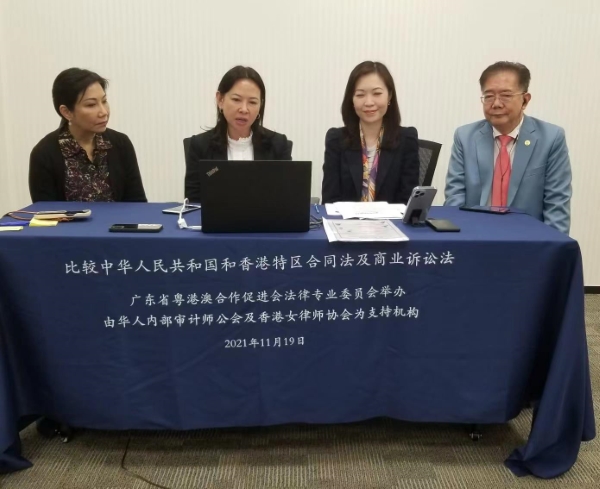
(中文) 2021年11月19日, 本所合伙人,诉讼及争议解决部主管兼广东省粤港澳合作促进会第一届法律专业委员会副秘书长、香港女律师协会现任理事- 徐凯怡律师,受邀为「比较中华人民共和国和香港特区合同法及商业仲裁法」担任主持及演讲嘉宾。
本次在线座谈会由广东省粤港澳合作促进会法律专业委员香港区主办, ACIA华人内部审计师公会和香港女律师协会共同协办,并吸引了超过1200名人士报名参加。
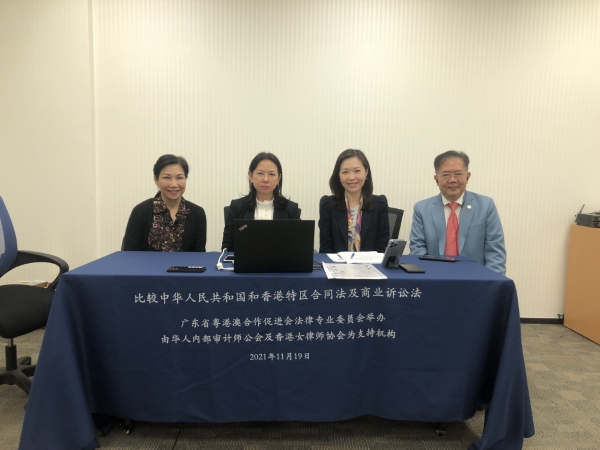
左起:香港女律师协会主席曾妙儿律师、广东省粤港澳合作促进会法律专业委员会委员何文琪律师、本所合伙人,诉讼及争议解决部主管徐凯怡律师和华人内部审计师公会会长徐惠祥博士
随着400多名香港律师取得在粤港澳大湾区内地九市执业资格,香港律师及大湾区企业需特别注意内地合同法及商业仲裁法有别于香港普通法。徐律师在会上阐释了香港的仲裁司法体系以及香港法院在其担当之角色, 并就内地与香港签订的司法互助安排之《两地仲裁保全安排》之要点进行了分享与讨论。
本次座谈会成果丰硕,本所期待日后与华人内部审计师公会和香港女律师协会在不同领域中合作。
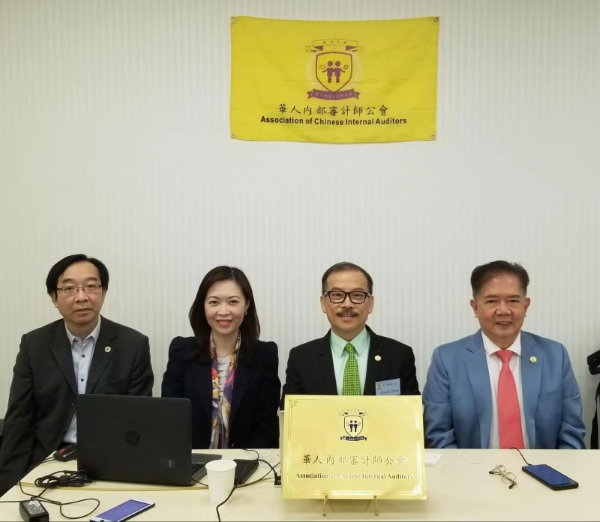
左起: 华人内部审计师公会副会长刘嘉明先生、本所合伙人徐凯怡律师、华人内部审计师公会荣誉顾问周荣生先生和华人内部审计师公会会长徐惠祥博士
若阁下想了解更多详情,请联络本所合伙人徐凯怡律师(heidichui.office@sw-hk.com)。
Asian Legal Business (ALB) published their recent findings of Asia’s Top 50 Law Firms on 18 November 2021. We are pleased to announce that our firm has been listed as the top 5th largest Hong Kong domestic law firm for 6 consecutive years.
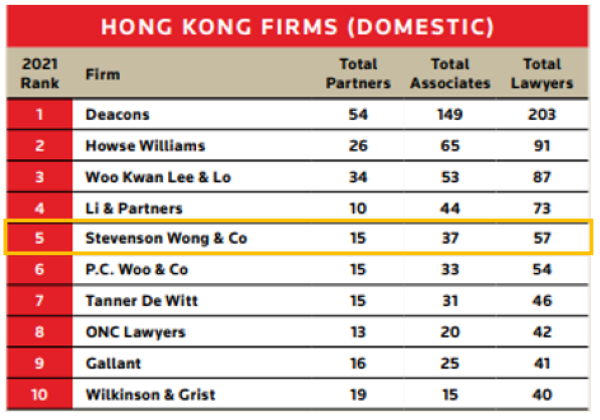
Established in 1978, Stevenson, Wong & Co. has more than 170 experienced lawyers and staff. Our aim is to provide clients with innovative and effective solutions for their personal or commercial problems with our local and international expertise.
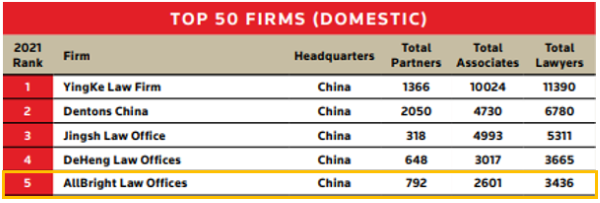
We would also like to take this opportunity to congratulate our association firm, AllBright Law Offices, for being ranked as the top 5th largest domestic law firm across Asia.
About ALB and Asia Top 50
ALB is a leading law journal published by Thomson Reuters and is considered as one of the most influential legal media in Asia. ALB’s Asia Top 50 aims to identify and rank the largest law firms across Asia by their size and number of lawyers.
For the full ranking, please click here.
Please contact us for any enquiries or further information.
Introduction
On 29 October 2021, The Stock Exchange of Hong Kong Limited (the “Exchange”) published a consultation paper (the “Consultation Paper”) on Proposed Amendments to Listing Rules relating to Share Schemes of Listed Issuers. In particular, since Chapter 17 of the Listing Rules currently only governs share option schemes, the Exchange seeks to amend Chapter 17 to also include share award schemes by issue of new shares, taking into consideration of the increasing adoption thereof by issuers and their subsidiaries. The Exchange is seeking market feedback on its proposals by 31 December 2021.

Background
Traditionally, listed issuers use share option schemes and share award schemes (collectively, the “Share Schemes”) as equity-based awards to attract, retain and motivate employees and service providers. They are used to align the interests of the participants with those of issuers and shareholders. Generally speaking, share option schemes are funded by issuance of new shares by the issuers and share award schemes can be funded by new shares or existing shares of the issuers purchased on-market. A vast majority of issuers on the Exchange have adopted Share Schemes.
Currently, Chapter 17 of the Listing Rules, which was last amended in 2000, governs share option schemes of the listed issuers and their subsidiaries. On the other hand, there is no existing Listing Rules that specifically govern share award schemes. Instead, they are subject to Chapter 13 of the Listing Rules, which governs the issuance of securities in general, as well as Chapter 14A of the Listing Rules if the grants of new shares are to connected persons. In fact, if the share award schemes are funded by existing shares of the listed issuers, shareholders’ approval is not required as it would not have any dilution effects on the existing shareholders of the issuers.
In the Consultation Paper, the Exchange is taking the opportunity to review Chapter 17 of the Listing Rules to include share award schemes. The proposals place more importance on the role of the remuneration committee in reviewing, supervising, overseeing the operation of Share Schemes.

Key Proposals relating to Share Schemes of Listed Issuers
The below table sets out a comparison between the current requirement under the Listing Rules and the key proposals to establish the framework for the Share Schemes set out in the Consultation Paper:
| Current Rules | Proposals | |
| Share Schemes funded by issuance of new shares of listed issuers | ||
| Chapter 17 of the Listing Rules |
|
|
| Eligible participants of Share Schemes |
|
(a) Employee Participants: directors and employees of the issuer or any of its subsidiaries; (b) Related Entity Participants: directors and employees of related entities (i.e. the holding companies, fellow subsidiaries or associated companies of the issuer); and (c) Service Providers: other persons who provide services to the issuer group in its ordinary and usual course of business which are material to its long-term growth and on a continuing and recurring basis (e.g. independent contractors, consultants and advisors to biotech companies).
|
| Scheme mandate | Limit on scheme mandate | |
|
|
|
| Minimum vesting period | ||
|
|
|
| Performance targets and clawback mechanism | ||
|
|
|
| Exercise price or share grant price | ||
|
|
|
| Restrictions on large share grants to individual participants and share grants to connected persons | ||
Share option schemes
Share award schemes
|
For all Share Schemes
|
|
| Share Schemes funded by existing shares of listed issuers | ||
| Disclosure in grant announcements and financial reports |
|
|
| Share Schemes of subsidiaries of listed issuers | ||
| Share award schemes of subsidiaries |
|
|

Analysis and Takeaways
In the Consultation Paper, the Exchange proposes to extend Chapter 17 of the Listing Rules to include share award schemes, in view of the issuers’ increasing adoption of share awards and options. We note that there is an existing inconsistency of Listing Rule treatments as to share option schemes and share award schemes. It is a therefore welcoming move for the Exchange to align the Listing Rules requirements in respect of the Share Schemes. Since the regime of share option schemes has remained unchanged for over two decades, the proposals can help to address the market developments and be in conformity with the international standards, which will maintain investor confidence.
Please contact our Partner Mr. Rodney Teoh for any enquiries or further information.
This newsletter is for information purposes only. Its content does not constitute legal advice and should not be treated as such. Stevenson, Wong & Co. will not be liable to you in respect of any special, indirect or consequential loss or damage arising from or in connection with any decision made, action or inaction taken in reliance on the information set out herein.
In Re HNA Group Co., Limited (in Reorganization in the Mainland of the People’s Republic China) [2021] HKCFI 2897 (“Decision”), the Hong Kong Court has for the first time granted order for recognition of and assistance to the reorganization proceedings in the mainland China (“Mainland”).
This Decision is yet another significant milestone for cross-border restructuring cases spanning Hong Kong and the Mainland. In addition to the earlier judgements in Re CEFC Shanghai International Group Limited [2020] 1 HKLRD 676 and Re Shenzhen Everich Supply Chain Co, Ltd [2020] HKCFI 965, this recent Decision further demonstrates the Hong Kong Court’s readiness to support, recognize and assist cross-border insolvency, liquidation and reorganization proceedings.

Brief Facts
Incorporated in the Mainland and headquartered in Hainan province, HNA Group Co., Limited (the “Company”) is a conglomerate with diverse business and investments but has become debt-laden in recent years. Pursuant to Article 22(i) and Article 24(i) of the PRC Enterprise Bankruptcy Law, the Hainan Province Higher People’s Court commenced reorganization proceedings against the Company (“Reorganization”) and appointed a group of administrators (“Administrators”), who was tasked with managing the assets and business affairs of the 64 member companies in Shanghai, Shenzhen and Hong Kong under the Company’s group.
Upon the Administrators’ application, the Hainan Province Higher People’s Court (the “Hainan Court”) issued a letter of request addressed to the High Court of Hong Kong (the “Hong Kong Court”) to seek recognition of the Reorganization in the Mainland and assistance to representatives of the Administrators in Hong Kong.

The Hong Kong Court’s Decision
In deciding whether it was a proper case to make an order for recognition and assistance, the Hong Kong Court considered the following three issues:
1. Whether the Reorganization, assessed by Hong Kong legal principles, constitutes a collective insolvency process?
2. Whether the Reorganization takes place in the Company’s country of incorporation or where the Company has its centre of main interests?
3. Whether the fact that the Hainan Court may not recognize Hong Kong insolvency proceedings and liquidators bars the Hong Kong Court from granting recognition and assistance in aid of the Reorganization?
As to the first issue, the Hong Kong Court is satisfied that the Reorganization, being a process specifically prescribed by Chapter 8 of the PRC Enterprise Bankruptcy Law, concerns all the Company’s creditors, and its character is considered as a collective insolvency procedure under Hong Kong law.
As to the second question, the Hong Kong Court takes no issue because HNA is incorporated in the Mainland where the Reorganization takes place.
As to the third issue regarding reciprocity, the Hong Kong Court referred to the Cooperation Agreement signed by the Secretary for Justice and the Supreme People’s Court on 14 May 2021 (“Cooperation Agreement”), which provides for a procedure for the recognition of and assistance to insolvency and reorganization proceedings between Hong Kong and three Intermediate People’s Courts in Shenzhen, Shanghai and Xiamen. The Hong Kong Court acknowledges that the Cooperation Agreement does not extend to Hainan.
That said, although the Hainan Court does not fall within the scope of the Cooperation Agreement, and there is a possibility that the Hainan Court may not recognize Hong Kong insolvency and liquidation proceedings, this is not of itself a bar to Hong Kong Court granting an order for recognition, as reciprocity is not a requirement for such recognition under Hong Kong’s common law regime.
For the reasons above, the Hong Kong Court has granted an order for recognition of and assistance to the Reorganization in Mainland at the request of the Hainan Court.

Commentary
This Decision exemplifies the willingness of the Hong Kong Court to recognize the reorganization proceedings in the Mainland and thereby provide recognition and assistance to cross-border insolvency cases. From a macro perspective, this Decision is an important development, in line with the trend of closer cross-border insolvency cooperation between Hong Kong and the Mainland over the past two years:
|
Date of Judgement/ |
Development |
Relevant Case |
| 13 January 2020 | Hong Kong Court recognized and assisted Mainland liquidators for the first time | Re CEFC Shanghai International Group Ltd [2020] HKCFI 167; [2020] HKCLC 1 |
| 14 May 2021 | The Cooperation Agreement came into effect | N/A |
| 4 June 2020 | Hong Kong Court recognized and assisted Mainland liquidators for the second time | Re Shenzhen Everich Supply Chain Co Ltd [2020] HKCFI 965; [2020] HKCLC 891 |
| 20 July 2021 | Hong Kong Court requested the Mainland Court to recognize and assist Hong Kong liquidators pursuant to the Cooperation Agreement for the first time | Re Samson Paper Co Ltd [2021] HKCFI 2151; [2021] HKCLC 1053 |
| 16 September 2021 | Hong Kong Court recognizes reorganization proceedings in the Mainland for the first time | Re HNA Group Co., Limited [2021] HKCFI 2897 |
With a more open-minded and welcoming attitude of the Courts in the two jurisdictions towards mutual recognition of insolvency, liquidation and reorganization proceedings, Hong Kong cross-border insolvency law is expected to continue to develop and mature, which would reinforce Hong Kong’s position as Asia’s leading financial and debt restructuring hub.
This article is co-authored by our Partner and Head of Litigation and Dispute Resolution Department, Ms. Heidi Chui, Senior Associate, Mr. Kyle Lo, and Trainee Solicitor, Mr. Charles Luk. Please contact Ms. Heidi Chui [heidi.chui@sw-hk.com] for any further enquiries or information.
This newsletter is for information purposes only. Its content does not constitute legal advice and should not be treated as such. Stevenson, Wong & Co. will not be liable to you in respect of any special, indirect or consequential loss or damage.
Introduction
On 17 September 2021, The Stock Exchange of Hong Kong Limited (the “Exchange”) published a consultation paper (the “Consultation Paper”) introducing its proposal to create a listing regime for special purpose acquisition companies (the “SPACs”) in Hong Kong and the proposed accompanying Listing Rules. The Exchange is seeking market feedback on its SPAC proposals by 31 October 2021.

Reasons for and Potential Benefits of a SPAC Listing Regime
The introduction of a SPAC listing regime in Hong Kong will enhance Hong Kong’s competitiveness as an international finance centre and a fundraising hub. De-SPAC targets consider listing by way of SPACs to be a more attractive option than a traditional IPO. It is because listing via SPACs can potentially result in a shorter listing time, greater price certainty and greater flexibility in structuring a De-SPAC transaction.
That said, the cornerstone of Hong Kong in maintaining its status as an international finance centre is its reputation for high quality listings and stable secondary trading. It is therefore important that the safeguards for the SPAC listing regime would not only maintain but enhance the Exchange’s reputation for attracting quality investors.
Key Proposals to Establish a SPAC Listing Regime
The summary of the key proposals to establish a SPAC listing regime set out in the Consultation Paper is as follows:
Pre De-SPAC Transaction
• Investor Suitability:
1. Only professional investors (as defined under the Securities and Futures (Professional Investor) Rules (Chapter 571D of the Laws of Hong Kong), i.e. (i) an individual having a portfolio of not less than HK$8 million; (ii) a trust corporation with total assets of not less than HK$40 million; and (iii) corporation or partnership which have a portfolio of not less than HK$8 million or total assets of not less than HK$40 million) can subscribe for and trade the securities of SPACs (i.e. prior to the De-SPAC transaction). This restriction, however, would not apply to the trading of the shares of the listed issuer following the completion of a De-SPAC transaction (the “Successor Company”);
2. At its initial offering, a SPAC must distribute each of its SPAC shares and SPAC warrants to at least 75 professional investors and at least 30 of which shall be institutional professional investors; and
3. At its initial offering, at least 75% of each of its SPAC shares and SPAC warrants must be distributed to institutional professional investors by a SPAC;
• Trading Arrangements: there should be separate trading of SPAC shares and SPAC warrants from the initial offering date and with additional mechanisms to mitigate the risks of volatility in the trading of SPAC warrants;
• Dilution Cap:
1. Professional managers who establish and manage the SPAC (the “Promoters”) are entitled to up to a maximum of 20% of the total number of all shares in issue as at the initial offering date with further issuances of up to 10% subject to the Successor Company meeting set performance targets (i.e. earn-outs); and
2. Prohibition from issuing warrants in aggregate that, if exercised, would result in more than 30% of the number of shares in issue at the time such warrants are issued is also proposed;
• SPAC Promoters: SPAC Promoters (typically formed by professional managers who have private equity, corporate finance and/or relevant industry experience) must meet suitability and eligibility requirements including at least one of the SPAC Promoters must be a firm holding: (a) a Type 6 (advising on corporate finance) and/or Type 9 (asset management) licence issued by Securities and Futures Commission; and (b) at least 10% of the Promoter Shares (i.e. shares of a SPAC typically issued at a nominal price to SPAC Promoters at the initial offering, which will convert into SPAC Shares at the time of the De-SPAC transaction);
• Fund Raising Size: the fund-raising size expected by a SPAC from its initial offering must be at least HK$1 billion;
• Funds Held in Trust: 100% of the gross proceeds raised from the SPAC’s initial offering are held in a ring-fenced trust account in Hong Kong until a De-SPAC transaction takes place or the SPAC is liquidated; and
• Issue Price: SPACs are required to issue their SPAC shares at an issue price of HK$10 or above.

De-SPAC Transaction
• Application of New Listing Requirements in full: a Successor Company must fulfil all the new listing requirements (including due diligence by Sponsor, management continuity and ownership continuity requirements, minimum market capitalisation requirements and financial eligibility tests);
• Independent Third Party Investment: this would be mandatory outside independent PIPE investment and must:
1. constitute at least 25% of the Successor Company’s expected market capitalisation (or at least 15% if the Successor Company’s expected market capitalisation is over HK$1.5 billion at listing); and
2. at least one asset management firm or fund (with at least HK$1 billion assets under management/fund size) owns at least 5% of the issued shares of the Successor Company as at the date of its listing;
• Shareholder Vote on De-SPAC Transactions: a De-SPAC transaction must be approved by SPAC shareholders at a general meeting (and would exclude the SPAC Promoter and other shareholders with a material interest). If the De-SPAC Transaction results in a change of control, any outgoing controlling shareholders of the SPAC and their close associates must not vote in favour of the De-SPAC Transaction. SPAC shares shall only be redeemed if the SPAC shareholders voted against a De-SPAC transaction;
• Forward Looking Information: The existing requirements for an IPO (including the requirement for reports from the reporting accountant and IPO sponsor on such statements will apply to any forward looking statements in the listing document for a De-SPAC transaction (including the requirement for reports from the reporting accountant and IPO sponsor on such statements);
• Open Market in Successor Company’s Shares: A Successor Company must have at least 100 shareholders to ensure adequate spread of holders of its shares; and
• Warrants: The Promoter warrants and SPAC warrants are only exercisable after the completion of a De-SPAC transaction.
Liquidation and De-listing
• The SPAC will be suspended from trading and liquidated within one month of such suspension if it: (a) fails to announce a De-SPAC transaction within 24 months or complete a De-SPAC transaction within 36 months; or (b) fails to obtain the requisite shareholders’ approval for a material change in SPAC Promoters within one month of the said material change. The SPAC must return 100% of the funds raised from the initial offering to its shareholders at the price its shares were issued plus accrued interest. The SPAC will then be de-listed.

Analysis and Takeaways
In recent years, listing via SPACs has become one of the trendiest international fundraising methods, and it is primarily prevalent in the United States. Understandably, Hong Kong has taken a cautious approach in considering whether to jump on the SPAC bandwagon. This is because a facet of SPACs can be seen to be cash shells without operations. The use of shell companies as listing vehicles and the so-called back-door listings have always been a regulatory concern, as it has the potential for market manipulation, insider dealing and volatility in the market. To avoid the SPAC listing regime to be used as a means to circumvent the quantitative and qualitative criteria for listing, the Exchange has, among others, proposes to apply new listing requirements to De-SPAC transactions. Thus, the Successor Company will need to meet all new listing requirements.
In early September, Singapore has also picked up the trend and became the first Exchange in Asia to allow SPAC listings. It is therefore a welcoming move for the Exchange to consider and propose the establishment of a SPAC listing regime in order to maintain Hong Kong’s competitiveness as a leading financial centre, especially for companies in Greater China and South East Asia that may wish to get listed via De-SPAC transactions.
Please contact our Partner Mr. Rodney Teoh for any enquiries or further information.
This newsletter is for information purposes only. Its content does not constitute legal advice and should not be treated as such. Stevenson, Wong & Co. will not be liable to you in respect of any special, indirect or consequential loss or damage arising from or in connection with any decision made, action or inaction taken in reliance on the information set out herein.