Corporate Law Updates

Find out all about our firm’s latest Corporate Law Updates below. To learn more about any individual item, please contact us here.
3 Aug 2022

HKEX INFORMATION PAPER – RULE AMENDMENTS ON BOOKBUILDING AND PLACING ACTIVITIES IN EQUITY CAPITAL MARKET TRANSACTIONS AND SPONSOR COUPLING

Background

We note that the Stock Exchange of Hong Kong (the “Exchange”) published an information paper (the “Information Paper”) back in April 2022 outlining the amendments to the Rules Governing the Listing of Securities on the Exchange (the “Rule Amendments”) to complement the Securities and Futures Commission’s (the “SFC”) new Code of Conduct1 provisions on the conduct of issuers and intermediaries involved in book building and placing activities. As such, this article serves as an apt refresher of the rule amendments involved. The capitalised terms used herein shall have the same meaning as defined in the Information Paper.

The Rule Amendments apply to:

(a) a placing of Equity Interests2 to be listed on the Exchange, including:

  • (i) a placing in connection with a New Listing3 (whether by way of a primary listing or secondary listing); and
  • (ii) a placing of Equity Interests of a class new to listing or new Equity Interests of a class already listed under a general or specific mandate; and

(b) a placing of listed Equity Interests by an existing holder of Equity Interests if it is accompanied by a top-up subscription by the existing holder of Equity Interests for new Equity Interests in the issuer.

Key Rule Amendments

Requirements to enter into a written agreement for the appointment of any capital market intermediary (“CMI”)4 , including an overall coordinator Rule Amendments
Appointment by written agreement

  • Appointment of a capital market intermediary (or an overall coordinator) must be made under a written agreement before it conducts any specified activities.
  • The written engagement should at least specify:-
    • the roles and responsibilities of the CMI or overall coordinator;
    • the fee arrangements;
    • the time schedule for payment of their fees;
    • (for a sponsor-overall coordinator only) the obligation of the new applicant and its directors to provide the information in Rule 9.11(23a) (or GEM Rule 12.23AA) to the sponsor-overall coordinator for its submission to the Exchange within the required timeframe; and
    • (for placing in connection with a new listing) the obligations of the new applicant and its directors to provide assistance to the syndicate CMI / overall coordinator.
Rules 3A.33, 3A.34, 3A.35 and 3A.36 (GEM Rules 6A.40, 6A.41, 6A.42 and 6A.43)

Appointment of overall coordinator(s) in a placing that involves bookbuilding activities Rule Amendments
For IPO

  • An overall coordinator should be appointed at an early stage in an IPO that involves a placing.
  • For an IPO, an appointment must be made no later than two weeks following the submission (or re-filing) of the listing application and before an overall coordinator conducts any specified activities.

For other types of placing involving bookbuilding activities

  • For other types of placing involving bookbuilding activities that take place subsequent to an IPO, a listed issuer shall appoint any overall coordinator(s) under a written agreement before it conducts any specified activities.
Rule 3A.37 (GEM Rule 6A.44)
Overall coordinator’s declaration

  • The overall coordinator(s) must provide a declaration in respect of the issuer’s compliance with Listing Rules relating to placing and allocations.
  • In the same declaration, the overall coordinator(s) must confirm that bookbuilding was carried out to assess demand and that the placing was conducted in compliance with the Placing Guidelines5 .
Rules 3A.40, 9.11(36) and Appendix 5E to the Listing Rules (GEM Rule 12.26(8) and Appendix 7I)

Appointment of at least one sponsor-overall coordinator in Main Board IPOs Rule Amendments
Sponsor-coupling

  • At least one overall coordinator must be the same legal entity as, or a member within its group of companies of, the independent sponsor.
  • The Main Board applicant must ensure that the appointment of both (overall coordinator and sponsor) is made at the same time and at least two months before the submission (or re-filing) of the listing application.
Rules 3A.02 (Note) and 3A.43 (Not applicable to GEM new applicants)
  • At least one “sponsor-overall coordinator” must remain appointed throughout the listing process. In the case of termination of the engagement of the sole sponsor-overall coordinator, the new applicant must file a new listing application not less than two months from the date of formal appointment of a replacement “sponsor-overall coordinator”.
Rule 3A.45 (Not applicable to GEM new applicants).

Associated obligations of issuers and their directors Rule Amendments
Investor assessment

  • For the purpose of an IPO, the overall coordinator should advise the applicant to provide all syndicate capital market intermediaries with a list of the directors and existing shareholders of the new applicant, their respective close associates and any nominees engaged by any of the foregoing persons for the subscription or purchase of Equity Interests.
  • • This should be provided in the new applicant’s written engagement with each syndicate member, and as soon as practicable (in any event, at least four clear business days before the date of the new applicant’s Listing Committee hearing).
Rule 3A.46 (GEM Rule 6A.48)
Placing and allocation

  • Notwithstanding that an issuer is ultimately responsible for making pricing and allocation decisions, the overall coordinator is responsible for explaining to the issuer any potential concerns if, in the case of a share offering, the issuer’s decision may potentially lead to a lack of open market, an inadequate spread of shareholders or may negatively affect the orderly and fair trading of such Equity Interests in the secondary market.
  • In general, an issuer (whether a new applicant or not) is expected to make such decisions in line with the advice, recommendations and guidance provided by the overall coordinator(s). An issuer should document the rationale behind its decision on pricing and allocation, in particular, where the decision is contrary to the advice, recommendations and guidance provided by the overall coordinator(s).
  • The overall coordinator should inform the SFC and the Exchange if any decision made by the issuer amounts to non-compliance with the Listing Rules.
Paragraph 19 of Appendix 6 (GEM Rule 10.16B)
Bar on investor rebate

  • Each new applicant must confirm that the consideration payable by each placee for the Equity Interests subscribed in an IPO equals the final offer price determined by the issuer (plus any brokerage, FRC transaction levy, SFC transaction levy and trading fee payable).
  • It also should confirm that no rebate has been provided by it, its controlling shareholder(s) and directors and the syndicate members to any placees or the public (as the case may be), in the announcement of the final offer price and the allotment results of the IPO.
Note 2 to Rule 12.08 (Note 3 to GEM Rule 16.13)
  • All overall coordinators, any other syndicate members and any other distributors involved in the IPO must certify in writing to the Exchange that the consideration payable by each placee for the Equity Interests subscribed in an IPO equals the final offer price determined by the issuer (plus any brokerage, FRC transaction levy, SFC transaction levy and trading fee payable).
Form D in Appendix 5 to the Listing Rules (Form D in Appendix 5 to the GEM Listing Rules)

Transitional arrangements and effective date

The Rule Amendments will apply to listed issuers and new applicants which submit (or re-file) their listing applications on or after 5 August 2022 in respect of their proposed offerings. Main Board new applicants are reminded to observe the transitional arrangements to avoid any delay in their listing timetable.

New applicants who have submitted a listing application prior to 5 August 2022 will not be required to comply with the new requirements in the Rule Amendments before such application lapses, is withdrawn or is otherwise terminated, even if their bookbuilding, placing or allocation activities conducted in connection with their proposed offerings take place on or after 5 August 2022.

Analysis and Takeaways

As hinted in our previous news update on the relevant SFC’s new Code of Conduct proposal, the implementation of the proposal for bookbuilding code and sponsor coupling may possibly lead to a change in the executory structure of IPO deals and bring the interest of the sponsor and overall coordinator into better alignment.

The complementary and consequential Rule Amendments proposed by the Stock Exchange will allow advisers to comply with this change in structure in a more holistic manner and a clearer fashion by providing the Listing Rules based instructions to all parties involved.

Please contact our Partner Mr. Rodney Teoh and Associate Ms. Angela Lau for any enquiries or further information.

This news update is for information purposes only. Its content does not constitute legal advice and should not be treated as such. Stevenson, Wong & Co. will not be liable to you in respect of any special, indirect or consequential loss or damage arising from or in connection with any decision made, action or inaction taken in reliance on the information set out herein.

1 The Code of Conduct for Persons Licensed by or Registered with the Securities and Futures Commission.
2 equity securities, interests in a REIT, stapled securities and securities of an investment company (as defined in Rule 21.01)
3 has the meaning in Rule 1.01 (GEM Rule 1.01) in the Rule Amendments, that is, a new listing of Equity Interests issued by a new applicant, irrespective of whether there is an offering of Equity Interests. For the avoidance of doubt, “New Listing” includes a reverse takeover of a listed issuer which is a deemed new listing under Rule 14.54 (GEM Rule 19.54) and a transfer of listing of Equity Interests from GEM to Main Board under Chapter 9A of the Listing Rules, but does not include any other new listing of Equity Interests issued by an issuer whose Equity Interests are already listed on a stock market operated by the Exchange.
4 has the meaning in Rule 1.01 (GEM Rule 1.01) in the Rule Amendments, that is, any corporation or authorised financial institution, licensed or registered under the SFO that engages in specified activities under paragraph 21.1.1 of the Code of Conduct, including, without limitation, a capital market intermediary appointed pursuant to Rule 3A.33 (GEM Rule 6A.40) in the Rule Amendments. An overall coordinator is also a capital market intermediary.
5 Appendix 6 to the Listing Rules (GEM Rules 10.12 to 10.16B).

12 Jul 2022

AMLO AMENDMENT BILL INTRODUCING THE LICENSING REGIME FOR VIRTUAL ASSET SERVICE PROVIDERS

Introduction

On 24 June 2022, the Hong Kong government gazetted the Anti-Money Laundering and Counter-Terrorist Financing (Amendment) Bill 2022 (the “Bill”)1, proposing changes to the Anti-Money Laundering and Counter-Terrorist Financing Ordinance (Cap. 615) (the “AMLO”)2. Following the Consultation Conclusions 3 on the same subject published by the Financial Services and Treasury Bureau on 21 May 2021 (please see our news update), the Bill introduces a licensing regime for virtual asset service providers (“VASPs”) and a registration regime for dealers in previous metals and stones (“DPMS”) to impose statutory anti-money laundering and counter-terrorist financing (“AML/CTF”) obligations on the two sectors. The Bill has been introduced into the Legislative Council (“LegCo”) for first reading on 6 July 2022. This news update focuses primarily on the regime for VASPs.

Scope of the proposed VASP licensing regime

The licensing regime for VASPs will come into effect on 1 March 2023 pursuant to the Bill. Under this regime, a licence issued by the Securities and Futures Commission (the “SFC”) will be required for the carrying on of a business of operating a virtual asset (“VA”) exchange.

The operation of a VA exchange is defined in the Bill as providing services through means of electronic facilities:-

    (a) whereby-

      (i) offers to sell or purchase VAs are regularly made or accepted in a way that forms or results in a binding transaction; or

      (ii) persons are regularly introduced, or identified to the other persons in order that they may negotiate or conclude, or with the reasonable expectation that they will negotiate or conclude sales or purchases of VAs in a way that forms or results in a binding transaction; and

    (b) where client money or client VAs comes into direct or indirect possession of the person providing such service.

Any person who carries or holds themselves out as carrying on a business of providing VA service; and any person, whether in or outside Hong Kong, who actively markets to the public in Hong Kong any VA services he provides or purports to provide will have to submit a licensing application to the SFC. Licensees will be required to meet fit and proper requirements and comply with the AML/CTF and other regulatory requirements.

Definition of virtual assets

Following the proposed amendments, VAs will be defined under the AMLO as a cryptographically secured digital representation of value that:

  • is expressed as a unit of account or a store of economic value;
  • either:
    • is used, or is intended to be used, as a medium of exchange accepted by the public, for (i) payment for goods or services, (ii) discharge of a debt and/or (iii) investment; or
    • provides rights, eligibility or access to vote on the management, administration or governance of the affairs in connection with, or to vote on any change of terms of any arrangement applicable to, any cryptographically secured digital representation of value;
  • can be transferred, stored or traded electronically; and
  • satisfies other characteristics prescribed by the SFC;
  • or alternatively:

  • a representation of value prescribed as a virtual asset by the Secretary for Financial Services and the Treasury by notice published in the Gazette.

Echoing the clarifications made in the Consultation Conclusions, the definition of VA currently excludes any digital representation of value that4:

  • is issued by a central bank or by an entity that performs the functions of a central bank or by an entity authorized by a central bank on its behalf;
  • is issued by a government of a jurisdiction, or by an entity authorized by the government of a jurisdiction and acting pursuant to an authority to issue currency in that jurisdiction;
  • is limited purpose digital tokens;
  • constitutes securities or a futures contract;
  • constitutes any float or SVF deposit of a stored value facility as defined in the Payment Systems and Stored Value Facilities Ordinance (Cap. 584);
  • satisfies other characteristics prescribed by the SFC which precludes it from being a VA; or
  • is prescribed not to be a VA by notice published in the Gazette by the Secretary for Financial Services and the Treasury.

Licensing requirements
To be eligible for a VASP licence, applicants must be a locally incorporated company with a permanent place of business in Hong Kong or a company incorporated elsewhere but registered in Hong Kong under the Companies Ordinance (Cap. 622). This is to ensure that the SFC can effectively monitor the operation of the licensed VASPs.

In addition, the SFC must be satisfied that:

  • the applicant is a fit and proper person to be licensed for the VA service;
  • the applicant will appoint at least 2 SFC-approved responsible officers (“ROs”), each of whom is a fit and proper person to be associated with the business of providing the VA service, and at least one of whom is an executive director;
  • each director of the applicant is fit and proper; and
  • the ultimate beneficial owner of the applicant is fit and proper.

ROs are held to be personally accountable in case of non-compliance. Only individuals licensed by the SFC to be licensed representatives and whose accreditation to a VASP are approved by the SFC may carry out regulated functions on behalf of the VASP. Licensed representatives are expected to meet the qualification requirements and should be competent to carry out VA trading services.

Investor protection

At the initial stage of the regime, VASPs can only provide services to professional investors5. This requirement will likely be imposed by the SFC as a licensing condition, allowing SFC room and flexibility to expand the scope of VASP services and to allow VA exchanges to operate and provide services to retail investors in the future.

Furthermore, the VASP regime will consider licensing applicants’ company and management structure, and soundness of their business models. In addition, there will be requirements for detailed risk management policies as well as listing and counter-market manipulation measures. The Bill provides a list of possible licensing conditions the SFC may impose, apart from the abovementioned conditions, it may also require AML/CTF policies and procedures, financial reporting and disclosure, virtual asset listing and trading policies, cybersecurity and more6.

Supervisory powers of the SFC

The Bill grants the SFC broad supervisory powers over licensed VASPs. These include the power to enter the premises of the licensed VASP and its associated entities for routine inspections7, request the production of documents and records8, investigate non-compliances, impose disciplinary sanctions against non-compliant licensees9 and appoint an auditor to look into the affairs of a licensed VASP and its associated entities10.

The SFC is also empowered to impose prohibitions and requirements on the operation of a licensed VASP where the circumstances so warrant11. Intervention powers of the SFC may include prohibiting the licensed VASP from entering into further transactions12 and restricting the licensed VASP from dealing with or disposing of any relevant property13.

Offences under the proposed VASP regime

Enhancing and amending AML/CTF regulations entail creating a new enforcement regime to monitor regulated VA exchange activities in Hong Kong.

Providing a VA service without the relevant licence, or actively marketing (in Hong Kong or elsewhere) to the public of Hong Kong the services of an overseas VA exchange without a licence by the SFC, will be an offence punishable, on conviction on indictment, to a fine of HK$5 million and to imprisonment for seven years, and in the case of a continuing offence, to a further fine of HK$100,000 for every day during which the offence continues; or, on summary conviction, to a fine of $500,000 and to imprisonment for 2 years and a further fine of $10,000 for each day during which the offence continues14.

Time frame and transitional period

The Bill provides for transitional arrangements for existing VA exchange business operators. The transitional period will last for 12 months beginning on 1 March 2023 for any corporation carrying on a business of providing a VA service15.

If an existing operator files an application with the SFC within the first 9 months (by 1 December 2023) and confirms that it will comply with the regulatory requirements applicable to a licensed provider of the VA service and that it has arrangements in place to ensure it complies with such requirements, the operator will be deemed to be licensed until the SFC has made a decision on its application.

The SFC will be empowered by the Bill to issue a notice to unsuitable applicants informing them that they will not have a deemed licensed status. These applicants will be required to close down their business by the end of the 12-month transitional period.

Therefore, prospective applicants for the VASP licence and VA exchanges considering entering the Hong Kong market should ensure they are operating in Hong Kong as soon as possible prior to the enactment of the Bill so they can benefit from the transitional arrangements.

Analysis and Takeaways

Despite not being named directly in the Legislative Council Brief on the Bill or the Bill itself, the definition of VA appears to apply equally to “stablecoins” in consonance with the Consultation Conclusions. It is also worth mentioning that the definition in the Consultation Conclusions did not include elements such as “the provision of rights, eligibility, or access to vote”, which are now included in the Bill. This seems to broaden the scope of VAs covered by the licensing regime.

In particular, we note that whether an NFT is a VA depends on the circumstances, and it is important to consider not merely its form but also its substance. We understand that an NFT project could sometimes involve a Decentralised Autonomous Organisation (“DAO”), a community-led organisation which allows members to vote on the direction of their entity. DAOs related tokens granting members voting rights seem to fit part of the definition of a VA under the Bill for its nature as a “governance token”. As such, it is therefore important for service providers to think about the true nature of a NFT in ascertaining whether they need to apply for a VASP licence.

It is also noteworthy that the regulatory ambit seems to align with that of the SFC as stated in its first substantive statement on NFTs released on 6 June 2022 – if an NFT is a genuine digital representation of a collectible, activities related to it do not fall within the SFC’s regulatory remit.

While it is arguable that certain NFTs may not be captured by the definition of VA at the moment, the Bill provides that the Secretary for Financial Services and the Treasury will be empowered to prescribe particular digital representation of value as a VA by publishing a notice in the Gazette, thereby expanding the scope of VAs in the future.

Please contact our Partner Mr. Rodney Teoh for any enquiries or further information. Rodney would like to thank Mr. Calvin Lo (Trainee Solicitor) and Ms. Gladys Wong (Intern) for their contributions to this news update.

This news update is for information purposes only. Its content does not constitute legal advice and should not be treated as such. Stevenson, Wong & Co. will not be liable to you in respect of any special, indirect or consequential loss or damage arising from or in connection with any decision made, action or inaction taken in reliance on the information set out herein.


1 Anti-Money Laundering and Counter-Terrorist Financing (Amendment) Bill 2022 (the “Bill”)
2 Anti-Money Laundering and Counter-Terrorist Financing Ordinance (Cap. 615)
3 Consultation Conclusions on Public Consultation on Legislative Proposal to Enhance Anti-Money Laundering and Counter-Terrorist Financing Regulation in Hong Kong published by the Financial Services and the Treasury Bureau dated May 2021
4 Section 53ZRA(2), the Bill
5 Para 6, Legislative Council Brief Anti-Money Laundering and Counter-Terrorist Financing (Amendment) Bill 2022
6 Section 53ZRK(5), the Bill
7 Part 2, Division 2, Clause 11(1B)(a), the Bill
8 Part 2, Division 2, Clause 11(1B)(b), the Bill
9 Section 53ZSO, the Bill
10 Section 53ZSG, the Bill
11 Section 53ZSX, the Bill
12 Section 53ZSY, the Bill
13 Section 53ZSZ, the Bill
14 Section 53ZRD, the Bill
15 Schedule 3G, Part 2, the Bill
16 SFC reminds investors of risks associated with non-fungible tokens” announcement published by the Securities and Futures Commission, dated 6 June 2022

14 Apr 2022

RECENT INSIGHTS AND DEVELOPMENT IN PRIVATISATION VIA SCHEME OF ARRANGEMENT IN HONG KONG

Introduction

In the past few years, Hong Kong has seen a series of privatisations of listed companies, and a considerable amount of which have been carried out by way of scheme of arrangement. In this article, we will discuss the recent Hong Kong High Court judgement in Chong Hing Bank Limited (HCMP 968/2021, [2021] HKCFI 3091) (“Chong Hing”), which could draw potential implications for parties using court sanctioned schemes of arrangement to privatise Hong Kong listed companies or reductions of capital. Indeed, the way of dealing with concert parties’ votes on a privatisation scheme at a court-convened shareholder meeting may affect its validity. Furthermore, this High Court decision could affect the drafting of the scheme documents and notice of court meeting going forward.

Background

The case concerned a petition hearing presented by Chong Hing Bank Limited (the “Company”) regarding the court’s sanctioning of the scheme of arrangement dated 30 July 2021 (the “Scheme”) between the Company and all the scheme shareholders (i.e. the Concert Parties (as defined below) and independent shareholders) (the “Scheme Shareholders”) pursuant to sections 673 and 674 of the Companies Ordinance (Cap. 622) (the “Ordinance”) and the reduction of capital pursuant to section 229 of the Ordinance.

The Company was a listed company on the Main Board of The Stock Exchange of Hong Kong Limited (the “Hong Kong Stock Exchange”). In May 2021, the offeror, the single largest shareholder of the Company, requested the board of directors of the Company (the “Board”) to put forward a proposal for the privatisation of the Company by way of the Scheme and withdrawal of the listing of the shares on Hong Kong Stock Exchange (the “Proposal”). There were also a few concert parties (the “Concert Parties”) that were presumed to be acting in concert[1] with the offeror under the Code on Takeovers and Mergers (the “Takeovers Code”) for the purpose of the Proposal. [1]

It was stipulated in the scheme document that the Scheme would be subject to approval by the independent shareholders, and that the Concert Parties would not attend or vote at the meeting of the Scheme Shareholders convened at the direction of the Court (the “Court Meeting”). The Court Meeting was then convened for the purpose of approving the Scheme and the Concert Parties did not attend nor vote at the Court Meeting.

In sanctioning the Scheme, the Honourable Madam Justice Linda Chan considered, among other things, the Company’s compliance with Rule 2.10 of the Takeovers Code.

Rule 2.10: Disinterested Shareholders’ Approval Requirement in relation to the Scheme

Rule 2.10 of the Takeovers Code provides that:

“Except with the consent of the Executive, where any person seeks to use a scheme of arrangement or capital reorganisation to acquire or privatise a company, the scheme or capital reorganisation may only be implemented if, in addition to satisfying any voting requirements imposed by law:-

(a) the scheme or the capital reorganisation is approved by at least 75% of the votes attaching to the disinterested shares that are cast either in person or by proxy at a duly convened meeting of the holders of the disinterested shares[2]; and

(b) the number of votes cast against the resolution to approve the scheme or the capital reorganisation at such meeting is not more than 10% of the votes attaching to all disinterested shares.”

The Court’s interpretation of Rule 2.10 of the Takeovers Code was relevant to the case in determining: (i) the validity of the notice convening the Court Meeting; and (ii) if the Court Meeting was validly constituted. In particular, the question whether the Court Meeting was duly convened and constituted by excluding the Concert Parties from attending and voting at such Court Meeting depended partly on the true meaning of Rule 2.10.

Interpretation of Rule 2.10

Previous High Court Decision

Prior to Chong Hing, in Re Cosmos Machinery Enterprises Limited (HCMP 601/2021, [2021] HKCFI 2088) (19 July 2021), the Honourable Mr Justice Jonathan Harris suggested two schools of thought regarding the meaning of Rule 2.10:

i. the offeror and his concert parties are prohibited from voting on the relevant resolution (the “Prohibition View”); and

ii. the offeror and his concert parties are not prohibited from voting, but their votes cannot be counted for the purposes of complying with the Takeovers Code (the “Non-Prohibition View”).

The learned Judge concluded that the Non-Prohibition View is the correct position as it is more consistent with the natural and ordinary meaning of Rule 2.10 and section 674(2) of the Ordinance. An offeror’s concert parties who are part of a scheme must be allowed to vote as a matter of scheme law.

Position adopted in Chong Hing

Chan J considered Mr Justice Harris’ views in Re Cosmos Machinery, which she considered to be obiter dicta as the scheme in the case was not approved by the requisite majority of shareholders. She then concluded that the Prohibition View is the correct interpretation of Rule 2.10 based on the following reasons:

    1.  The Prohibition View is more consistent with the ordinary and natural meaning of Rule 2.10 as it plainly envisages that the Court Meeting shall only be a meeting of holders of disinterested shares (i.e. not a meeting of holders of disinterested shares and concert parties) in order to ensure that their discussions are unhampered by the presence of others who may have a different interest.
    2. The Prohibition View is consistent with the drafting history of Rule 2.10. The current Rule 2.10 was enacted in 2002 following the Consultation Paper in April 2001. In contrast with the old Rule 2.10, the current Rule 2.10 embodies the plain intention for Rule 2.10 to be prohibitory in nature.
    3. The prohibition view would result in more coherence in the interpretation of related rules in the Takeovers Code which are all aims at protecting the minority interests.

Chan J further concluded that in view of the undertaking provided by the Concert Parties and that they did not attend the Court Meeting of the Scheme, the requirements under Rule 2.10 were fulfilled and the Scheme was sanctioned accordingly.

Her Ladyship additionally set out three types of meetings that could be ordered by the Court for approval of privatisation or takeover schemes involving parties acting in concert with the offeror:

  • One court meeting for all the shareholders to be bound by the scheme with the concert parties undertaking to the court not to attend and vote at the meeting.
  • Two court meetings for the disinterested shareholders and the concert parties respectively. The court may, however, dispense with ordering the second meeting if the concert parties have agreed with the company or given an undertaking to the court at the time when the company sought an order to convene meetings that they will be bound by the terms of the scheme.
  • If the concert parties have agreed with the company or the offeror to be bound by the terms of the scheme or the offer, then the scheme may simply be entered into between the company and the disinterested shareholders, in which case there is only one court meeting.

Analysis and Takeaways

In light of the ruling in Chong Hing, offerors should be mindful when seeking to use a scheme of arrangement to privatise a company listed on the Hong Kong Stock Exchange. To avoid complications in future privatisation schemes and to avoid two court meetings for a privatisation scheme (one for concert parties only), offerors should ensure that concert parties subject to the scheme irrevocably undertake that they will (i) neither attend nor vote on the proposed court meeting and (ii) be bound by the terms of the scheme. Wordings relevant to the attendance, voting and irrevocable undertaking on the scheme documents, as well as notice of meeting should also be carefully constructed to ensure compliance with the court’s ruling.

Please contact our Partner Mr. Rodney Teoh and associate Ms. Angela Lau for any enquiries or further information.

This news update is for information purposes only. Its content does not constitute legal advice and should not be treated as such. Stevenson, Wong & Co. will not be liable to you in respect of any special, indirect or consequential loss or damage arising from or in connection with any decision made, action or inaction taken in reliance on the information set out herein.

[1] Acting in concert is defined as persons who pursuant to an agreement or understanding, actively cooperate to obtain or consolidate “control” of the company by acquisition through voting rights.

[2] Disinterested shares are shares in the company other than those which are owned by the offeror or persons acting in concert with it.

7 Apr 2022

FSDC PAPER ON THE ENHANCEMENT OF HONG KONG’S INITIAL PUBLIC OFFERING

Introduction

On 3 March 2022, the Financial Services Development Council (the “FSDC”) released a research report, recommending the Securities and Futures Commission (the “SFC”) and the Hong Kong Exchanges and Clearing Limited (the “HKEX”) to reform Hong Kong’s listing framework, with an objective to boost the competitiveness of Hong Kong as the leading Asian bourse and maximise the capital markets in Hong Kong.

In essence, the FSDC’s recommendations included the following:

• Consider whether the distinguishing features of the listing framework for pre-revenue biotech companies (Chapter 18A of the Rules Governing the Listing of Securities on The Stock Exchange of Hong Kong Limited (the “Listing Rules”) and special purpose acquisition companies (Chapter 18B of the Listing Rules) (“SPACs”) can be applicable to new economy companies;

• Review and clarify the subjective eligibility requirements of “innovativeness” for issuers with weighted voting rights (the “WVR”) structure to list in Hong Kong (Chapter 8A of the Listing Rules), with the policy aim of not making companies with WVR structure “commonplace” and retain investor protection;

• Continuously and holistically review the listing regime to cope with the evolving environment and market needs; and

• Provide more support to small and medium enterprises’ (“SMEs”) fundraising needs and access to the capital market, such as exploring a new listing framework and reviewing the existing GEM board regime.

Creating a friendly listing framework for innovative pre-revenue companies

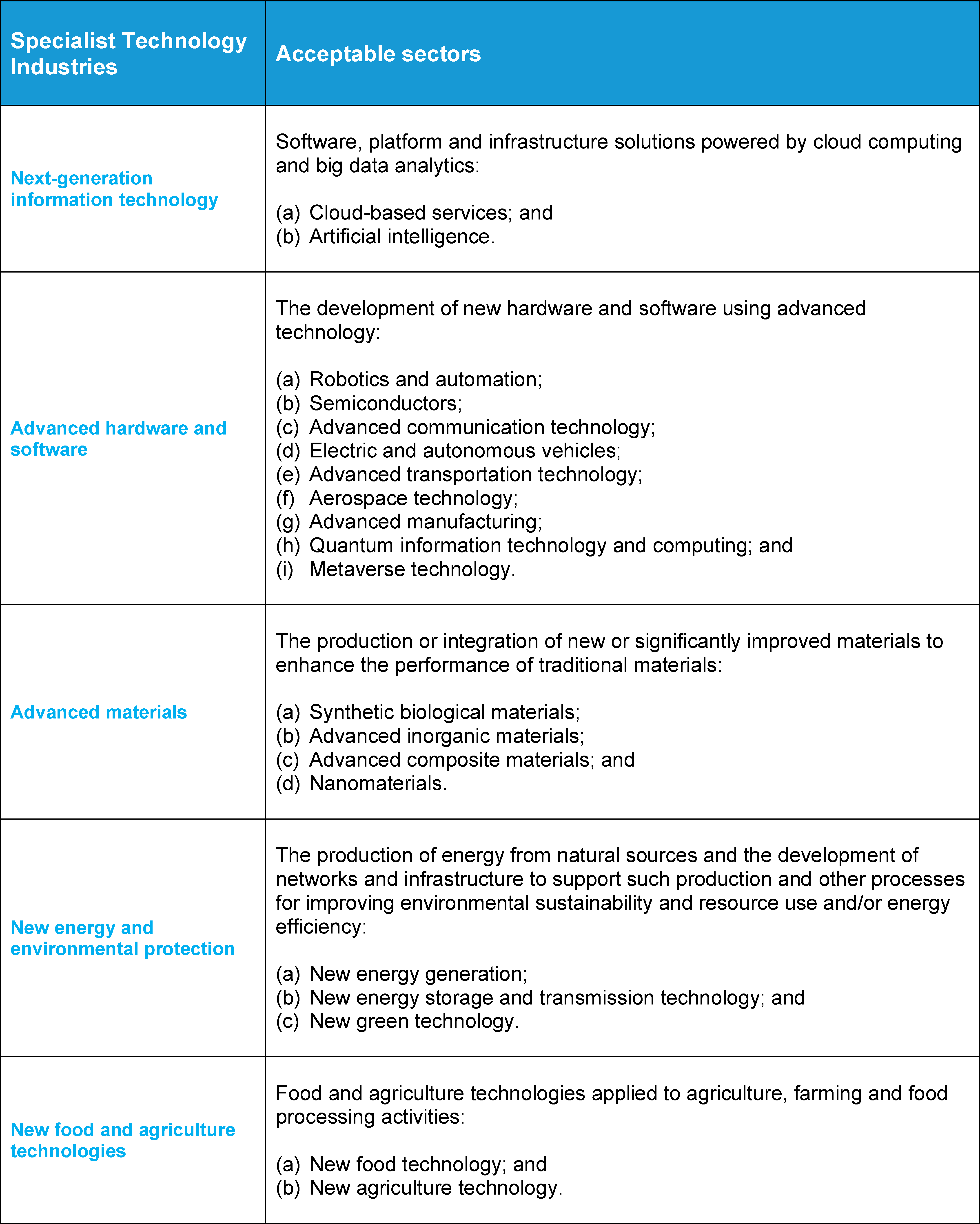
New economy companies (e.g. hard technology, new energy, Software-as-a-Service, big data and artificial intelligence) are new, high-growth industries with cutting edge technology. Given their new and innovative nature, these companies often require heavy investment and funding in research and development (“R&D”) prior to being fully profitable. They also see a longer product development cycle. As traditional financers focus on a company’s financial track record, new economy companies would find it difficult to have access to capital and investments. Therefore, the FSDC suggested that it is crucial to remain flexible in the listing regime to cater for these new economy pre-revenue companies in order to capture these opportunities alongside appropriate investor safeguarding. The FSDC suggested that the HKEX could introduce a new chapter to the Listing Rules like Chapter 18A, to capture these fast-growing R&D intensive sectors, which could be the way forward to allow more pre-revenue new economy companies with great prospect and market potential to be listed on HKEX.

Riding on the successful emergence of the new economy in China and the Guangdong-Hong Kong-Macao Greater Bay Area (GBA), the Chapter 18A and the recent introduction of Chapter 18B, the FSDC drew attention to the listing frameworks of pre-revenue biotech companies and SPACs and viewed that that the HKEX and SFC should consider the distinguishing and the successful features of their listing frameworks which could be applicable to a new specific framework for these new economy companies.

In particular, akin to these biotech companies, many non-biotech new economy companies also have long business development cycles before demonstrating revenue or profits. Thus, the FSDC considered if some of the features in Chapter 18A could be incorporated into those of the new economy companies, such as the enhanced disclosure requirement, the involvement of sophisticated investors, rounds of fundings and competent authorities.

Furthermore, in the up-and-coming new economy sectors, investors would be expected to be equipped with technological and financial sophistication as well as a higher level or risk tolerance. This is the reason why the FSDC also considered the SPAC to serve a useful reference for a potential regime for pre-revenue innovative companies. Therefore, the FSDC recommended that some of the features in Chapter 18B could be also applicable to these new economy companies, such as the involvement of professional investors only at the initial stage and the requirement of additional private investment in public equity (PIPE) funding, where investors are expected to be more sophisticated in finance and tolerant to risk.

Review and clarify the “innovativeness” requirement for issuers with WVR structure

At present, according to Chapter 8A and 19C of the Listing Rules and the Guidance Letter HKEX-GL94-18, issuers seeking to list with a WVR structure must be an “innovative company”. The FSDC has recognised that some bankers and legal professionals considered that the “innovativeness” requirement is subjective and brings uncertainty to the Listing Rules, ultimately causing discouragement to companies seeking to list in Hong Kong. For instance, a first mover issuer from a new economy industry may be sufficiently “innovative” to obtain listing approval. However, subsequent companies of a similar nature or industry with higher market capitalisation and business scale may then not fulfil the “innovativeness” requirement as they then fail to differentiate themselves from the precedent case. These potential issuers are thereby less likely to list in Hong Kong in view of the lesser certainty.

In comparison, the FSDC examined both the Science and Technology Innovation Board, also known as STAR Market, of Shanghai Stock Exchange (the “SSE”) and the ChiNext of Shenzhen Stock Exchange. Despite both exchanges targeting growing innovative or sci-tech innovation companies, they do not provide potential issuers with any subjective definition or guidance of “innovativeness”. On the other hand, these exchanges adopt a set of objective listing standards that take account quantifiable factors such as business integrity, profits and revenue. The FSDC also highlighted that the SSE’s STAR opens doors for companies which are “yet to be profitable or have accumulated deficits” to be listed. Therefore, the FSDC suggested that the subjective eligibility of “innovativeness” for issuers with WVR structure should be reviewed and clarified while recognising the policy direction of WVR to not to be ‘common place’ and retain investor protection.

Furthermore, with the policy of not making companies with WVR structures “commonplace”, the FSDC also observed that the Hong Kong listing regime for WVR companies is more prescriptive in comparison with other markets. For instance, the US regime adopts a “disclosure-based regime with few restrictions on the WVR structure” for companies with dual-class shares structures, while Hong Kong requires enhanced disclosure and corporate governance structure. The strict investor safeguards imposed in Hong Kong have prevented WVR structures from being widespread and commonplace. Nevertheless, the FSDC advised that the definition and interpretation of “innovativeness” should be clarified to accommodate companies with varying degrees of innovativeness.

Continuously and holistically review the listing system to cope with the evolving environment and market needs

Currently, continued geopolitical uncertainties linger the business operations of Chinese stocks listed in the US, which may in turn affect the global IPO market. Companies already listed or considering listing on other exchanges may be looking for alternatives. There has been a surge in issuer interest in Hong Kong as a potential second listing option.

Notwithstanding such interest, companies including those whose business is centered in Greater China still face several hurdles when seeking to list in Hong Kong. The FSDC identified the relatively time-consuming IPO process, and the exemption system for issuers with primary listings on eligible exchanges as existing hurdles. To maximise the potential of listing market and the broader capital market, the FSDC suggested that further optimization should be explored to streamline and maximize the effectiveness of the listing process of oversea issuers.

Provide more support to SMEs

International and Mainland support

There are increasing emphasis being placed on supporting SME financing globally. Observing the reformative establishment of the Beijing Stock Exchange (“BSE”), the FSDC highlighted the BSE’s success since it started trading on 15 November 2021. 11 new companies have debuted through IPOs, alongside the 71 listed companies that transferred from the premium board of the National Equities Exchange and Quotations (NEEQ). As at 12 November 2022, over 2.1 million investors applied for access as qualified investor for the BSE, with over 4 million investors estimated to be eligible. Furthermore, 112 securities firms have been granted official membership of the BSE. The FSDC suggested that Hong Kong may consider to approach its own SME initiatives by taking reference to the BSE’s adoption of R&D spending as an eligibility criterion, to support the technology and research driven growth companies.

A comprehensive and open review of GEM

GEM was established in 1999 with the aim of providing funding support to SMEs. However, since the reform of GEM into a standalone market and the removal of the streamlined process for GEM transfers to the Main Board, GEM listing activities have greatly declined. In 2020, the market only saw 8 listings and HK$3.6 billion of total funds raised through GEM. Notwithstanding the development of the GEM Board, many SMEs which are in the growth and development stage may find themselves ineligible for GEM Board listing. This is because while GEM Listing Rules do not impose profitability requirements for potential issuers, the operating cash flow and market capitalisation requirements, together with the strict and time-consuming IPO vetting process may limit those smaller potential issuers to gain access to capital markets, ultimately causing the relative inactivity of GEM. For instance, the minimum aggregate operating cashflow of HK$30 million deters growth companies with high valuations but are yet to incur revenue or profit.

As the growth potential of SMEs is tremendous, the HKEX should re-evaluate whether the existing market structure is still conducive for SMEs to seize opportunities. To do so, the FSDC is of the view that HKEX should conduct a comprehensive and open review of GEM Board, including to revamp GEM Board as an incubator of early-stage fast-growing companies in order to allow SME access.

According to the FSDC, the financial industry and market participants generally hold a view that Hong Kong can take a more aggressive approach to support SMEs. Some comment that a new market mechanism supporting SME financing should be explored, and that such a mechanism could be incorporated into a market where only professional investors can participate. There is a pressing need for Hong Kong to respond to such opinions and readjust its market segmentation strategy.

Analysis and Takeaways

In light of the accelerated advancement of the new economy sectors and Hong Kong long praised attractiveness as a strong international fund-raising financial centre, the FSDC has encouraged HKEX and SFC to take active steps in refining its listing regime to cope with the evolving environment and the market needs. It is worth-taking to expand the pre-revenue requirement to cater for new economy companies and review and clarify the subjective requirement of “innovativeness” for issuers with WVR listed through Chapter 8A of the Listing Rules. The cultivation of biotech and new economy ecosystem may create demands for new homecoming listings. Also, considering the globally increasing emphasis on the financial support to the SMEs, Hong Kong should explore a new listing framework to assist their capital needs. These recommendations encourage Hong Kong listing regime’s opportunities arising from the latest IPO landscape and stay ahead in the race and to continue vitalising the capital market.

Please contact our Partner Mr. Rodney Teoh and associate Ms. Angela Lau for any enquiries or further information.

This news update is for information purposes only. Its content does not constitute legal advice and should not be treated as such. Stevenson, Wong & Co. will not be liable to you in respect of any special, indirect or consequential loss or damage arising from or in connection with any decision made, action or inaction taken in reliance on the information set out herein.

17 Mar 2022

(中文) 港股除牌机制之解析(下篇):因业务不足而停牌公司的复牌之路

(中文)

《港股除牌机制之解析(上篇):规则概要及最新数据》中,我们分析了联交所除牌机制的规则和最新数据。近年,不少上市公司都因不符合《上市规则》第13.24条的规定,而被联交所停牌,甚至除牌。受到新冠疫情的影响,越来越多上市公司面对着不明朗的业务状况,因此也越来越多被停牌的上市公司被联交所要求证明其如何符合第13.24条的规定。在本篇中,我们将通过对《上市规则》、法庭判例以及成功复牌个案的研究为受影响的企业制定复牌策略提供参考。

)《上市规则》第13.24

于2019年10月1日起生效的经修订的《上市规则》第13.24条规定上市公司须有足够的业务运作并且拥有相当价值的资产支持其运营,其证券才得以继续上市。而修订前的条文仅要求足够的资产业务运作。

联交所在指引信GL106-19中列举了一些会应用第13.24条的情况,包括:

  • 发行人只余极少量业务及收入,其业务规模及前景似乎均难以解释何以要付出上市所需的成本费用又或证明其寻求上市的目的。例如发行人的业务收入并不足够应付公司支出,出现净亏损之余,营运现金流亦呈负数;
  • 发行人的业务多年来规模极小而且连年亏损,可见现时业务规模并非一时低迷;
  • 发行人未能证明其有相当价值的资产支持其营运,产生足够的收入及利润令其得以继续上市;
  • 发行人进行公司行动后只余极少量业务;
  • 出现财政困难,严重损害发行人继续经营业务的能力,或令其部分或全部业务停止运作;
  • 发行人破产,此可见于无争辩的清盘呈请、清盘令或委任临时或非临时清盘人;
  • 发行人失去主要营运附属公司;
  • 发行人缺乏具有实质的业务模式。

值得注意的是,联交所并不会仅仅因为上市公司被第三方申请清盘而指令上市公司停牌,也不会仅仅因为上市公司的子公司或上市公司的控股股东被第三方申请清盘而指令上市公司停牌。虽然如此,出现财政困难的上市公司很可能会因为其它原因,例如未能及时发布财务资料或部分或全部业务停止运作而被停牌。另外,出现财政困难的上市公司也可能因为等待公布内幕消息而主动申请停牌。

(二) 申请复牌准则

因没足够的业务运作或资产而被停牌的上市公司通常会根据《上市规则》第6.01A(1)条的规定进入18个月的复牌程序(创业板12个月)。在停牌期间,上市公司须向联交所提交其复牌建议,并在完成实行该复牌建议后才能申请复牌。

复牌建议须证明该上市公司拥有可行及可持续发展的业务,符合《上市规则》第13.24条的规定。虽然《上市规则》并无量化准则,但有关业务必须为实质,业务模式必须为可行及可持续发展。

如复牌建议涉及收购资产或向个别投资者大规模发行证券以换取现金发展新业务,联交所将引用反收购行动的条文,以确保有关建议并不触发相关的反收购规则,从而防止借壳上市来规避新上市规定的情况。倘若收购事项被联交所认为构成反收购行动,上市公司则必须向联交所提交A1申请,并附上所需文件,这将等同于新上市申请。

如是因财政困难而未能符合第 13.24 条,上市公司须公布其为解决财困而进行的公司行动,例如重组安排等。上市公司须在相关通函或公告中载列可佐证其经重组集团的业务是可行及可持续业务的资料。根据所披露资料,联交所可能就有关复牌的公司行动是否可行而提供指引,并可能要求上市公司提供额外数据(例如盈利预测)。

(三) 有关《上市规则》第13.24条的裁决

香港上诉法庭近期在中国趋势控股有限公司诉香港联合交易所有限公司(民事上诉案件2020年第652号)( China Trends Holdings Ltd v. Stock Exchange of Hong Kong Ltd (CACV 652/2020 )) 的裁决中,就《上市规则》第13.24条的要求作出了详细的解释:

  • 《上市规则》第13.24条的审核乃属于质量性的主观评估而非量化的客观评估
  • 因此,联交所须根据各上市公司的不同业务、行业状况营运、具体事实及特定情况而作出个别的个案评估
  • 在此过程中,上市公司须证明其整体业务的可行性及可持续性,且不能单单依赖其资产、收入或偿债能力等个别因素来证明其业务的可行性及可持续性

此裁决与较早前的三元集团有限公司诉香港联合交易所有限公司(分别为终院民事杂项案件2009年第52号及民事上诉案件2008年第191号)(SanyuanGroup Ltd v. Stock Exchange of Hong Kong Ltd (FAMV 52/2009;CACV 191/2008 )的案例中就《上市规则》第13.24条作出的解释一致。总括而言,被停牌的上市公司证明其符合《上市规则》第13.24条的方式,将因应各上市公司的个别情况和业务而有所差异。

(四) 个案研究

尽管如此,我们可以透过参考过往曾因《上市规则》第13.24条而被停牌的上市公司成功复牌的案例,从而得出被停牌的上市公司能如何证明其有足够的业务运作并且拥有相当价值的资产以支持其营运。

(a)      成功的债务重组方案

裕承科金有限公司(股份编号:279)(主板)(于2020/2/28停牌,于2021/11/1复牌)

  • 该公司从事证券及期货经纪、配售、包销及孖展融资业务,且提供保险经纪及理财策划服务。
  • 该公司自2019年收到其多个认购人及借贷人的违约通知,要求该公司立刻偿还债务,并于其后收到其债权人向高等法院要求将该公司清盘的呈请。
  • 基于上述的清盘呈请及其债务违约通知,该公司没有足够的资金以偿还其当前债务并继续其业务运营。
  • 于是,该公司与其债权人积极沟通,以探讨该公司的债务重组方案。同时,该公司积极物色有意参与该公司债务重组方案的潜在投资者。
  • 最后,该公司与新投资人签订该公司的重组方案契约,从而让新投资人将透过股份认购方式向该公司投入资金,从而解决该公司的债务问题,让公司有足够的资金继续其本身的业务运营。

(b)     改善原有业务

东方汇财证券国际控股有限公司(股份编号:8001)(创业板)(于2020/7/30停牌,于2021/7/31复牌)

  • 该公司本身从事承销及配售业务、经纪业务、保证金融资业务及放债业务。
  • 于2020年,该公司75%的股东于出售了其在该公司全部股权,令原有业务经营水平急剧恶化,该公司失去稳定的渠道来寻找或扩大客户群。
  • 为改善该公司的原有业务,该公司推出了多项政策,包括员工激励计划及保证金融资业务客户的最低交易门槛要求等。
  • 该公司积极探索新的业务商机,包括投资移民业务及资产管理业务。
  • 该公司达到了其盈利预测所预期的收入及盈利,其2020年和2021年的收入分别为5,729万港元和6,010万港元,净利润则分别为2,983 万港元和3,251万港元。
  • 综合上述的多个因素,联交所认为该公司的原有业务运营情况有所好转,且符合《上市规则》第13.24条的规定。

(c)     转亏为盈

国能集团国际资产控股有限公司(股份编号:918)(主板)(于2019/2/1停牌,于2020/12/7复牌)

  • 该公司本身从事成衣业务,并仅于暂停买卖股份前不久开展了ACCAPI 业务及Super X 业务。
  • 该公司积极发展其现有业务,包括成立内部设计团队、开展市场推广及宣传、积极拓展产品的销售渠道,并在微信小程序开设线上销售平台,亦加强其品牌知名度。
  • 基于上述的努力,该公司的收入由2018/2019财政年度的96.4 百万增加到2019/2020财政年度的约210.2百万港元。该公司亦成功由2018/2019财政年度的净亏损约30.1百万港元转亏为盈至2019/2020财政年度的纯利约10.9百万万港元。
  • 考虑到该公司的业务所取得的发展及财务业绩有所改善,联交所认为该公司已开展具有足够营运水平的业务,并拥有足够价值的资产以支持其业。

(d)     以原有业务为基础,开拓新业务,产生协同效应

亚洲果业控股有限公司(股份编号:73)(主板)(于2016/9/26停牌,于2020/9/1复牌)

  • 该公司本身的种植业务拥有可靠的经营历史和收入记录以及可持续的客户群,其收入的下降乃基于暂时性的不利的气候条件和农业疾病等原因。
  • 另外,该公司就其新拓展的水果分销业务与客户签署了多项销售框架协议及最低采购承诺。同时,该公司亦推出了新的优质橙子品牌,且该品牌获得广泛市场认可。上述的新业务均能帮助推进公司本身的种植业务。
  • 此外,该公司达到了其盈利预测所预期的收入及盈利,该盈利预测甚至可满足《上市规则》8.05(1)(a) 规定的 2,000 万港元的盈利测试要求 。
  • 该公司拥有足够价值的资产(其账面价值为人民币 9,210 万元),且该公司并不处于净负债状况。
  • 综合上述的多个因素,联交所认为该公司符合《上市规则》第13.24条的规定,并允许其复牌。

(五) 如何符合第13.24

参考上述的裁决及个案研究,被停牌的上市公司可以以下的方式证明其符合《上市规则》第13.24条:

  • 积极开拓公司的原有业务或新的业务,如寻找新客户以签署新的销售框架协议、开拓其销售渠道以吸引更多客户等,以改善公司的运营情况。
  • 证明公司的收入及盈利得以改善,如达到其盈利预测所预期的收入及盈利,及证明其拥有足够价值的资产且并不处于净负债状况。
  • 寻找新的投资人注资,让上市公司有足够的资金继续其业务运营。需要注意的是,当引入新的投资人涉及公司控制权变更时,有可能会触及反收购行动的条文,从而令上市公司被视为新的上市申请人。

然而,如上述裁决所述,联交所就《上市规则》第13.24条所作的评估乃基于各上市公司的不同业务做出的整体、主观及质量性评估。因此,被停牌的上市公司须因应其独特的情况作出符合《上市规则》第13.24条的调整。上述个案仅能用作参考。

本文由本所企业融资部劳恒晃律师、张源辉律师、刘砚枫律师、叶庭宜律师及黄虹博士共同合著。如有任何疑问或需要进一步的信息,请联系我们的劳恒晃律师张源辉律师刘砚枫律师

本文仅供参考之用。本文之内容不构成亦不应被视为法律意见。对于任何因资料不确或遗漏又或因根据或倚赖本文件所载资料所作决定、行动或不行动而引致的损失或损害,史蒂文生黄律师事务所概不负责。

16 Mar 2022

(中文) 港股除牌机制之解析(上篇):规则概要及最新数据

(中文)

近年来受到新冠疫情的影响,越来越多上市公司面对着不明朗的业务状况。加上国内政府加强对各行各业尤其是房地产开发企业的监管措施,港股企业被停牌甚至最终被强制除牌的例子已不鲜见。根据香港联合交易所有限公司「联交所」的最新统计,2021年被强制除牌的港股企业达到34家,再创新高。

我们将在一连两篇的系列研究文章中对港股企业停牌的原因、复牌的条件及除牌的过程进行详尽分析,并结合数据统计及个案研究,以期为港股企业提供参考。

在本篇中,我们将首先对港股上市公司的停牌成因,以及被停牌上市公司的复牌/除牌程序及时间进行剖析在下篇中,我们将重点针对上市公司因缺乏足够的业务和资产以支持其营运而被停牌的个案进行研究及总结。

(一)《主板上市规则》的停牌及除牌准则

联交所在2018年对上市公司的除牌机制进行了改革,对除牌的原因以及除牌的流程均做出了改善。目前主板上市公司的停牌及除牌规则主要依据《主板上市规则》(「《上市规则》」)的第6.01条以及联交所于20185月刊发的指引信HKEx-GL95-18(「GL95-18」)。

根据《上市规则》第6.01条,联交所可随时将任何证券停牌或除牌,以保障投资者及维持一个有秩序的市场。该条列明联交所可采取停牌或除牌行动的三个情况,包括:

§   联交所认为上市公司未能维持足够的公众持股量(详情请参阅《上市规则》第8.08(1)条);

§   联交所认为上市公司所经营的业务没有足够的业务运作且没有相当价值的资产以支持其运营(详情请参阅《上市规则》第13.24条);或 

§   联交所认为上市公司或其业务不再适合上市(详情请参阅《上市规则》第8.04条)

另外,如上市公司的财务资料披露出现问题,也会导致停牌,包括:

§   根据《上市规则》第13.50条,如上市公司未能如期发表定期的财务资料,联交所一般会要求该上市公司的证券停牌直至其按规定公布财务资料。

§   根据自2019年起实施的《上市规则》第13.50A条,如上市公司发布年度初步业绩公告时,其核数师已经或表示将会就上市公司的财务报表发出「否定意见」或「无法表示意见」,联交所一般会要求该上市公司停牌直至有关问题解决。如「否定意见」或「无法表示意见」仅与上市公司的持续经营有关,则上市公司的股票则一般不会被停牌。

1.       未能维持足够的公众持股量

若上市公司是因公众持股量不足而遭停牌,通常可在相当短时间内解决问题。 停牌公司应立即制定及公布恢复最低公众持股量的具体及可行的行动计划,例如由控股或主要股东配售现有股份,或由上市公司配售新股份。行动计划应清楚列明计划中每个阶段工作的时间表,证明及确保可在合理时间内恢复所需最低公众持股量并复牌。联交所可在适当情况下就计划是否足够提供指引及就时间表提供意见。(详情请参阅GL95-184751段)

2.       没有足够的业务运作或资产

上市公司未能遵守《上市规则》第13.24条的一般原因包括:上市公司已完全或大致上停止营运只维持有限度的营运或因财政困难或失去主要营运附属公司而停止所有或大部分营运。(详情请参阅GL95-182123

3.       联交所认为上市公司或其业务不再适合上市

联交所认为不再适合上市的例子包括上市公司中具有重大影响力的董事或其他人员因涉及例如欺诈或其他类型的不诚实行为,上市公司存在重大内部控制失误,上市公司刊发的财务报表被裁定为夸大业务及盈利等 

4.       逾期刊发财务业绩或核数师发出「否定意见」或「无法表示意见」 

上市公司未能如期发表定期的财务资料或核数师发出「否定意见」或「无法表示意见」,当中可能涉及会计及企业管治方面有重大失当行为或内部监控方面有重大缺失。具体的原因可包括:核数师在审核流程中发现会计失当,被董事会、核数师、传媒、证监会等第三方揭发的企业不当行为(详情请参阅GL95-182930段)。 

(二)被停牌上市公司的复牌/除牌程序及时间

在除牌机制改革前,根据《上市规则》第17项应用指引的规定,除牌程序由三阶段组成,每阶段最少为期6个月。实践中许多公司停牌状态维持超过36个月。但在20188月以后,除牌程序简化及加速,主板上市公司持续停牌18个月(创业板则为12个月),联交所即可将其除牌。

GL95-18所述,为促进证券在市场上持续交易,停牌时间均应尽可能短。上市公司在停牌后应立即着手找出相关问题所在,并制定复牌计划,列出补救措施及工作时间表。而各被停牌的上市公司的复牌程序及所需时间亦会因应其被停牌的不同原因而有所差异。

1.       因逾期刊发财务业绩或其他原因而被停牌的上市公司的复牌/停牌程序及时间

若上市公司因逾期刊发财务业绩或其他原因及而被停牌,这些上市公司若能解决及已向市场公布导致其停牌的问题,便可申请复牌(详情请参阅GL95-183338段):

§  若上市公司延迟刊发财务业绩,待该上市公司完成处理其审计问题及就尚未刊发的财务业绩完成审计,并刊发所有逾期及/或尚未刊发的财务业绩后就能申请复牌

§  若引致停牌的事宜涉及管理层及董事的诚信操守,该上市公司必须证明对管理层诚信可能会为股东或投资者带来风险或损害市场信心的忧虑并不存在(例如,对董事会作出所需变动)

§  若有董事涉嫌卷入有关问题,考虑设立独立委员会检讨有关事宜。独立委员会亦应评估,在内部调查进行期间,涉事董事是能否仍然适合担任董事。

§  若涉及潜在欺诈活动(譬如虚假会计账目或挪用资产),委聘法证会计师进行调查。待法证调查有结果,董事会或独立委员会应考虑有关结果是否已足以解决相关问题。如仍未能解决,则再考虑应采取哪些进一步行动。

§  若涉及内部监控系统不足,委聘独立专家检讨内部监控系统,找出重大缺失并提出补救行动。

如联交所认为该些上市公司已解决及已向市场公布导致其停牌的问题,联交所可根据《上市规则》第6.07(1)条规定,要求该上市公司按联交所全权指令的条款和期限刊发公告,表示其短暂停牌或停牌证券将行复牌,并在公告刊发之后指令该上市公司复牌。联交亦可根据《上市规则》第6.07(2)条的规定,由其直接刊登该上市公司短暂停牌或停牌证券将行复牌的公告,并指令该上市公司复牌。

在另一方面,如该些上市公司不愿意采取行动解决相关的停牌事宜,联交所可继续将该公司停牌,甚至根据《上市规则》第6.016.01A(1)条将其除牌。一般而言,联交所会给予被停牌的上市公司18个月时间解决相关的停牌事宜。但联交所也有权给予少于18个月的期限。联交所在GL95-18中提及,如其认为停牌公司须补救的问题应可在少于18个月的期限内解决(例如公众持股量不足)或停牌公司未能采取足够行动补救,因而延长了停牌的时间,则联交所可以实施较18个月为短的补救期。

2.       因没足够的业务运作或资产而被停牌的上市公司的复牌/除牌程序及时间

因没足够的业务运作或资产而被停牌的上市公司通常会根据《上市规则》第6.01A(1)条的规定进入18个月的复牌程序。在停牌期间,上市公司有责任自行制定并公布复牌计划,并定期公布复牌进度及业务发展的最新资料。联交所则会监察上市公司的复牌状况及在适当情况下提供指引。

有别于过往第17项应用指引的规定,目前适用的18个月的复牌程序没有硬性规定联交所于每6个月审阅被停牌的上市公司所提交的复牌建议及该被停牌的上市公司实行其复牌建议的情况进展。此新项修改给予相关的被停牌上市公司更多弹性在被停牌后的18个月内提交并实行其复牌建议在缩减了发行人完成复牌计划可用的时间的同时也鼓励被停牌的公司迅速采取行动。

被停牌的公司采取复牌行动后,须证明该上市公司拥有足够的资产及业务,重新符合《上市规则》第13.24条的规定,经联交所确认后才可以复牌。虽然《上市规则》并无量化准则,但有关业务必须为实质,业务模式必须为可行及可持续发展(详情请参阅下篇)。

3.       上市公司被停牌期间的披露责任

无论上市公司是因何原因而被停牌,停牌公司仍须遵守《上市规则》下的持续责任,包括须予披露的交易、关连交易、披露内幕消息等。而且,上市公司还须根据《上市规则》13.24A条在其尚未复牌期间定期刊发季度公告,从而向联交所及市场交代有关其停牌的发展情况。

4.       成功挑战除牌决定门槛極高

如停牌公司对联交所上市委员会的决定有异议,它可申请要求联交所上市复核委员会重新考虑该决定。但实际而言,由于上市复核委员会的决定是基于相同事实,若上市公司没有提供具说服力的理据,上市复核委员会很大机会维持原先決定。

近来因大量公司向上市复核委员会申请复核上市委员会所作的除牌决定或向香港法院就有关决定申请司法复核,使有关挑战数目飙升。然而,大比例的此类公司因未能证明其存在特殊情况以推翻联交所的决定或有必要延长18个月的规限,该等申请一再被拒绝。 

(三)已进入除牌程序或被停牌的上市公司数目统计

根据联交所的公开资讯,我们对2021年被停牌的上市公司进行了相应的统计及分析,以下为该统计及分析的概要。

1.       被停牌的原因/复牌条件的数目统计

2021年(即截至20211231日),约89家于联交所主板上市的上市公司被联交所列为停牌状态。当中约80家被停牌的上市公司的复牌条件包含「刊发逾期刊发财务业绩」,约81家被停牌的上市公司的复牌条件包含「证明公司符合《上市规则》第13.24条」,及约13家被停牌的上市公司的复牌条件包含「证明不存在有关管理层诚信操守的问题」。

被停牌的原因/复牌条件

主板上市公司数目

逾期刊发财务业绩

80 ((1))

不符合《上市规则》第13.24

81

其他

13 ((2))


2021年(即截至20211231日)被联交所列为停牌状态的主板上市公司总数:

89 ((3))

((1)) 在这约80家因逾期刊发的财务业绩而被停牌的上市公司中,大部分均因未能于2021331日或之前刊发其2020年的全年财务业绩而被停牌。部分上市公司解释,因新冠疫情持续严峻,其内部业务受到影响,因而未能准时刊发其财务业绩。在2020年初新冠疫情爆发初期,不少上市公司因受疫情或旅游限制措施影响而未能按时公布经审核的财务报表。为处理此等情况,202024日联交所与证监会共同发出《有关在严重新型传染性病原体呼吸系统病的旅游限制下刊发业绩公告的联合声明》(联合声明),允许受影响的上市公司在与联交所个别沟通的基础上刊发「未与其核数师议定的业绩公告或财务报表」,以符合于331日业绩发布的规定并继续交易。根据联交所于2022221日更新的有关联合声明常问问题及香港经济日报于202238向联交所作出查询回复,联交所将继续按联合声明的做法,按个别情况容许上市公司在发布「未与其核数师议定的业绩公告或财务报表」后继续交易

((2)) 其他原因包括存在有关管理层诚信操守的问题或联交所对该上市公司的某些交易存疑并要上市公司就该交易作独立调查

((3))2021年(即截至20211231日)约89家主板上市公司被列为停牌状态。当中的上市公司被停牌的原因或其复牌条件有所重复,如部分被停牌的上市公司的复牌条件同时包含「刊发逾期刊发的财务业绩」及「证明公司符合《上市规则》第13.24条」。

2.       相关的核数师的数目统计

核数师名称

担任多少间被停牌上市公司的核数师 ((4))

中汇安达会计师事务所有限公司

13

安永会计师事务所

10

罗兵咸永道会计师事务所

9

国卫会计师事务所有限公司

7

德勤关黄陈方会计师行

6

毕马威会计师事务所

5

罗申美会计师事务所

5

香港立信德豪会计师事务所有限公司

4

国富浩华(香港)会计师事务所有限公司

4

华融(香港)会计师事务所有限公司

4

开元信德会计师事务所有限公司

2

大华马施云会计师事务所有限公司

2


中审众环(香港)会计师事务所有限公司

3

郑郑会计师事务所有限公司

2

其他

13 ((5))


2021年(即截至20211231日)被联交所列为停牌状态的主板上市公司总数:

89

((4)) 此数据以被停牌的上市公司于被停牌当日的核数师计算

((5)) 其他是指担任一间于2021年被停牌上市公司的核数师

3.       停牌、复牌及除牌的数目统计

以下为于202111日被联交所列为停牌状态的上市公司,于截至20211231日的状态:

情况描述

主板上市公司数目

仍被列为停牌状态

89

已成功复牌

8

已被除牌

5

4.       一般复牌的所需时间

我们对上表中的8家已成功复牌公司的复牌时间进行了统计,该些公司的平均复牌所需时间约为1年。

序号

公司名称(股份编号)

停牌时间

复牌时间

复牌所需时间

1.   

Primeview Holdings Limited (789)

3/7/17

5/7/19

2

2.   

信保环球控股有限公司(723

10/10/18


26/5/2021

2.5

3.   

民众金融科技控股有限公司 (已委任临时清盘人)

(279)

28/2/20

1/11/21

1

4.   

福晟国际控股集团有限公司

(627)

29/3/21

26/11/21

8个月

5.   

旭通控股有限公司

(1826)

31/3/21

5/11/21

7个月

6.   

索信达控股有限公司

(3680)

1/4/21

1/12/21

8个月

7.   

保利协鑫能源控股有限公司

(3800)

1/4/21

1/11/21

7个月

8.   

蓝 河 控 股 有 限 公司

(498)

26/7/21

5/11/21

3个月


平均所需复牌时间:

1

接下来,我们将在《港股除牌机制之解析(下篇):因业务不足而停牌公司的复牌之路》进一步分析因未能维持足够业务运作而被停牌的上市公司的相关问题。感兴趣的读者敬请留意。

本文由本所企业融资部劳恒晃律师、张源辉律师、刘砚枫律师、叶庭宜律师黄虹博士共同合著。如有任何疑问或需要进一步的信息,请联系我们的劳恒晃律师张源辉律师刘砚枫律师

本文仅供参考之用。本文之内容不构成亦不应被视为法律意见。对于任何因资料不确或遗漏又或因根据或倚赖本文件所载资料所作决定、行动或不行动而引致的损失或损害,史蒂文生黄律师事务所概不负责。

本文由本所企业融资部劳恒晃律师、张源辉律师、刘砚枫律师、叶庭宜律师及黄虹博士共同合著。

NEWER OLDER 1 2 9 10 11