News Updates
Find out all about our firm’s latest news updates below. To learn more about any individual item, please contact us here.
 Stevenson, Wong & Co.
News Updates
Find out all about our firm’s latest news updates below. To learn more about any individual item, please contact us here.
(中文) 受新冠肺炎疫情影响,很多企业遭受经济损失,往往未能履约,产生违约事件,甚至面临破产和清盘。根据香港破产管理署在2021年1月15日发布的数据显示,2020年香港申请强制公司清盘和申请个人破产的宗数均创四年来新高。
清盘或破产呈请中,亦涉及了很多内地和香港的跨境破产程序,例如正在内地进行破产清算的企业有很多资产位于香港,内地的破产管理人需取得这些位于香港的资产的控制及处置权,这就需要香港法院对内地破产管理人提供相应的协助。
在2020年,香港法院先后颁下了两个重要判决,承认和协助由内地法院委任的破产管理人。这是内地和香港在跨境破产清盘法律方面的重大发展。本文将对两个案件进行简单介绍:
上海华信国际集团有限公司 ([2020] HKCFI 167) 案
2020年1月13日,香港高等法院原讼法庭夏利士法官 (Mr. Justice Harris) 在上海华信国际集团有限公司 ([2020] HKCFI 167) 一案中,颁下了香港法院首次承认和协助内地破产管理人的命令。
■ 案件背景
上海华信国际集团有限公司 (“上海华信”) 是一家于中国内地成立的公司。由于无力清偿债务,已在内地进入破产清算程序。上海市第三中级人民法院委任了上海华信的破产管理人。上海华信在香港拥有子公司,且在香港的主要资产是该子公司欠上海华信的720万港币的欠款,而此笔欠款已被另一独立第三方债权人以申请“第三债务人暂准命令” (garnishee order nisi) 的方式进行了扣押。一般而言,若债权人在取得“第三债务人暂准命令”后,再进一步取得“第三债务人绝对命令”的申请程序 (garnishee order absolute),则该债权人可就该等欠款立即执行,其他方将难以作出阻挠。
为阻止该第三方债权人取得“第三债务人绝对命令”,破产管理人紧急向香港法院申请承认和协助,以搁置该第三方债权人就“第三债务人绝对命令”的申请程序。
依照上海华信破产管理人的申请,香港法院提供了承认和协助,暂时搁置了上述法律程序。
■ 承认和协助内地破产管理人所适用的法律原则
夏利士法官认为,要承认并协助在大陆法系司法管辖区下提起的清盘程序,必须满足以下条件:
(a) 该域外清盘程序须为集体程序;以及
(b) 该域外清盘程序须在该企业成立的地区提起。
(判决原文:From these decisions the following criteria emerge, which must be satisfied before recognition and assistance will be granted.
(a) the foreign insolvency proceedings are collective insolvency proceedings.
(b) the foreign insolvency proceedings are opened in the company’s country of incorporation.
Provided the above criteria are satisfied, the Court may recognise insolvency proceedings opened in a civil law jurisdiction.)

夏利士法官解释道,承认和协助域外清盘程序并不意味着香港法庭会将香港本地清盘人在《公司(清盘及杂项条文)条例》(《香港法例》第32章) 下拥有的全部权力赋予域外清盘人。普通法下协助的权力仅限于:
(a) 让域外清盘人员能够在香港行使他们在获委任地的法律下可以行使的权力;
(b) 只有在域外清盘人员有必要履行其职务时;以及
(c) 与提供协助法院所适用的实体法和公共政策一致。
当清盘人获得委任的司法管辖区的清盘制度与香港的清盘制度相似,那么法院可以颁令使域外清盘人与香港本地清盘人拥有大体上相同的权力。
(判决原文:The Companies Court does not, however, grant a foreign liquidator, whose appointment it has recognised all the powers available to a liquidator appointed by it pursuant to the Companies (Winding Up and Miscellaneous Provisions) Ordinance, Cap 32 (‘Ordinance’). The principles that circumscribe the limits of the common law power of assistance are explained …:
(a) The power of assistance exists for the purpose of enabling foreign courts to surmount the problems posed for a world-wide winding up of the company’s affairs by the territorial limits of each court’s powers…
(b) The power of assistance is available only when it is necessary for the performance of the foreign officeholder’s functions.
(c) An order granting assistance must be consistent with the substantive law and public policy of the assisting court.
Accordingly, … ‘[i]n the case of liquidators appointed in jurisdictions with similar insolvency regimes to Hong Kong, the assistance may extend to granting orders that give the foreign liquidators substantially similar powers’.”)

基于本案事实和法庭的分析,夏利士法官颁下决定,承认和协助上海华信的内地破产管理人。这是香港法院第一次对内地破产管理人予以承认和协助,也为香港法院在处理相关案件时提供了详细的法律原则。
深圳市年富供应链有限公司 ([2020] HKCFI 965) 案
2020年5月26日,夏利士法官再就深圳市年富供应链有限公司 ([2020] HKCFI 965) 一案颁下判词,再一次承认和协助内地破产管理人在港履行职务。
■ 案件背景
深圳市年富供应链有限公司 (“深圳年富”) 于中国内地注册成立,从事的业务包括供应链管理、物流管理以及境内和国际货运代理等服务。
2018年12月,深圳年富在内地进入破产清算程序,并由深圳中院委任了破产管理人。深圳年富的业务与香港有着紧密的联系。
■ 香港子公司陷入财务困难
在进入破产清算前,深圳年富曾通过两家香港子公司开展了一系列供应链相关的业务。这些子公司于香港持有多个银行账户,总额约为1250万元人民币,亦持有对外贸易应收账款约人民币41亿元。但是,担任这些子公司的独任董事在内地被拘留,子公司已无人管理和收回这些应收账款。

为了履行破产管理人的相关职责,深圳年富的破产管理人需将子公司的财务正规化,并收回相关账款。因此,深圳年富的破产管理人向香港法院提出了承认和协助的申请,以便行使深圳年富对其在香港子公司的所有权利。
■ 法庭决定承认和协助深圳年富的内地破产管理人
夏利士法官运用了其于上海华信案里已详细阐述的法律原则,认为深圳年富的清盘程序是在企业成立地 (即内地) 提起的集体程序,且深圳法院已委任了破产管理人。于是法官颁令给予深圳年富的破产管理人所申请的承认和协助。
(判决原文:I am satisfied that the winding-up in the Mainland is a collective insolvency proceeding in the Company’s place of incorporation and that the Liquidator has been appointed by the Shenzhen Court to wind up the Company. I will, therefore, order that the winding-up and the Liquidator are recognized.)

总结
香港法院在2020年相继就上述两个案件作出了裁定,这是涉及内地和香港跨境破产及清算法律相互协助的一大发展。两个案件充分表明了香港法院对于涉及内地和香港跨境破产/清算法律援助的支持态度,对于跨境破产/清算法律的发展具有重要意义。
当然,香港法院是否会为内地破产管理人提供协助,将取决的每个案件的情况,也视乎于内地和香港是否会有统一的跨境破产清盘的方式。(判词原文:“The extent to which greater assistance should be provided to Mainland administrators in the future will have to be decided on a case by case basis and the development of recognition is likely to be influenced by the extent to which the court is satisfied that the Mainland, like Hong Kong, promotes a unitary approach to transnational insolvencies.”)
本文由本所合伙人,诉讼及争议解决部主管徐凯怡律师撰写。若阁下想了解更多详情,请联络本所徐凯怡律师。
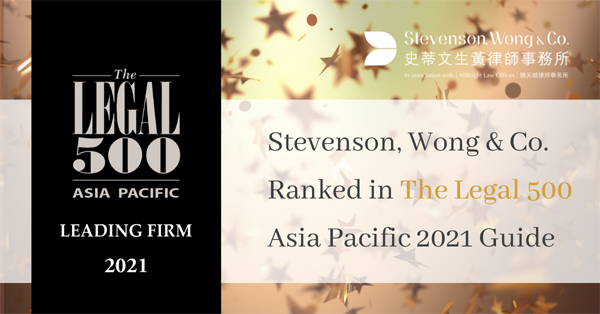
We are pleased to announce that our firm’s SW Private practice and Head of department, Ms. Catherine Por have been recognised in The Legal 500 Asia Pacific 2021 Guide.
Researchers carry out extensive research in each jurisdiction, canvassing law firms and contacting more than 300,000 clients for feedback on the lawyers they instruct. Recommended by the Legal 500, our SW Private practice “offers comprehensive private client coverage, includes matrimonial expertise, family wealth and succession planning, as well as niche expertise on managing the assets of the mentally incapacitated. Catherine Por heads the family law team and has broad-ranging contentious and non-contentious expertise, including ancillary relief and matters concerning custody and maintenance of children.”
Leading Firm | Private Client (Tax, Trusts, Wealth Management and Contentious Probate)
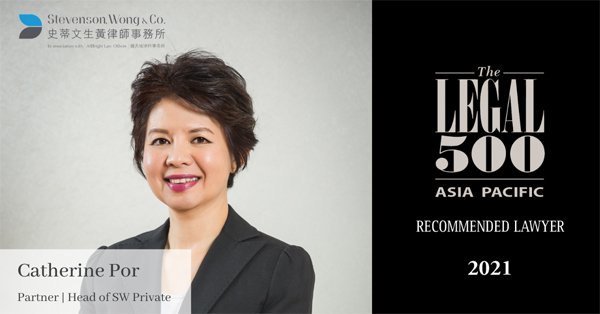
Recommended Lawyer | Ms. Catherine Por
About Ms. Catherine Por
Catherine heads SW Private in the firm. She specializes in all aspects of family law disputes, and has extensive experience in complex financial claims, intervener proceedings, financial claims under Part IIA of the Matrimonial Proceedings and Property Ordinance (Chapter 192), Child Abduction cases, relocation of children, claims under the Guardianship of Minors Ordinance (Chapter 13), custody cases, pre-nuptial and post-nuptial agreements, contentious and non-contentious trust cases, contentious estate matters; cross border issues and enforcement proceedings. She has on a number of occasions provided expert legal opinions on Hong Kong Family Law.
Catherine is also an Accredited General and Family Mediator, Fellow of the Chartered Institute of Arbitrators and is a Notary Public and Civil Celebrant of Marriages.
About The Legal 500 Asia Pacific
Published annually, The Legal 500 Asia Pacific provides unbiased commentary and insight into the legal marketplaces of 25 Asia Pacific jurisdictions. For 33 years, The Legal 500 has been analysing the capabilities of law firms across the world, with a comprehensive research programme revised and updated every year to bring the most up-to-date vision of the global legal market.
Please click here to see the ranking or contact Ms. Catherine Por for further enquiries.
We are delighted to announce that our firm’s Partner Sherlynn Chan and Senior Associate Gordon Tsang have received Gold Awards in the Pro Bono Community Work Recognition Programme 2020. Organised by the Law Society of Hong Kong, the award aims to recognise and commend its members’ selfless contributions in pro bono services.
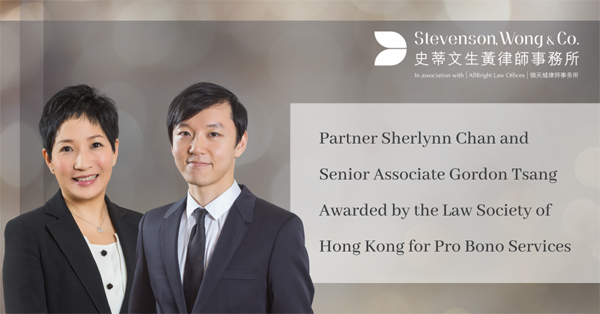
This is the first time for Sherlynn Chan to participate in the programme. She commented: “I am honoured to be recognised for my contribution to raising awareness on mental health, capacity and children issues in Hong Kong. I look forward to more collaboration with other NGOs and charitable organisations that have the same vision and passion in this area of work.”
Our senior associate, Gordon Tsang has been accorded with this accolade for 6 consecutive years, said “I am always passionate and enjoy the times in providing guidance to the youth.”
To receive the Gold award, a practitioner has to provide no less than 100 hours of pro bono professional volunteer services throughout the past year.
About the Pro Bono and Community Work Recognition Programme
The Law Society of Hong Kong’s Pro Bono and Community Work Recognition Programme aims to encourage law firms and members who carry out pro bono and community-focused work; it was set up in January 2010. All members, trainee solicitors and registered foreign lawyers who are active in giving back are given the opportunity to be recognised and appreciated.
Please click here to watch the ceremony or contact Ms. Sherlynn Chan and Mr. Gordon Tsang for further enquiries.
On 4 January 2021, China Business Law Journal published the A-list 2020: China’s Elite 100 Lawyers. We are delighted to announce that our firm’s partner and head of Corporate Finance, Hank Lo, has once again been recognised as one of China’s Elite 100 lawyers (Foreign firm) for 2nd consecutive year.
The list recognises leading lawyers in the China market. By conducting thousands of interviews with in-house counsels and partners of top law firms in Asia, the finalists are recognised for their landmark deals, cases and other notable achievements over the past year.
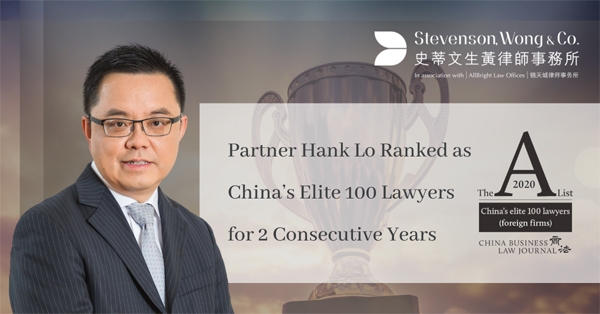
Hank, head of our firm’s Corporate Finance, specializes in capital markets, corporate finance and mergers and acquisitions. He has significant experience in advising issuers, sponsors and underwriters on initial public offerings on both the main and GEM boards of The Stock Exchange of Hong Kong Limited; advising publicly listed companies on a broad range of corporate finance transactions; advising private equity funds, venture capital funds and Hong Kong-listed companies on their investments in and exits from companies with an emphasis on China. He also advises companies in Mainland China on matters of property transactions, foreign investment and initial public offerings in other overseas stock markets.
For more information, please visit here or contact Mr. Hank Lo.
On 18 December 2020, The Stock Exchange of Hong Kong Limited (the “Exchange”) published the Consultation Conclusions on “Proposals to Introduce a Paperless Listing & Subscription Regime, Online Display of Documents and Reduction of the Types of Documents on Display” (the “Consultation Conclusions”). This followed its earlier consultation by way of its consultation paper published on 24 July 2020 on the relevant proposals (the “Consultation Paper”). In the Consultation Conclusions, the Exchange observed that, having given due consideration of the matter, it will implement all relevant proposals with minor modifications. As such, new arrangements will be put in place such that any application for listing of equities, debt securities and collective investment schemes by a new applicant requiring a listing document excluding any Mixed Media Offer (“MMO”) (as explained below) (“New Listing”), shall be paperless from 5 July 2021 onwards. Moreover, the new arrangements for displaying documents online to support listings and transactions shall take effect from 4 October 2021 onwards.
Paperless Listing and Subscription Regime
Noting, among other things, that some recent popular IPOs have been fully paperless and their subscription processes have operated smoothly without paper documentation, as well as the high internet penetration rate in Hong Kong, the Exchange concluded that save for situations where an issuer opts for an MMO, whereby an issuer can distribute paper application forms for public offers of certain securities without a printed prospectus under certain circumstances, the new requirements will apply such that (i) all listing documents in a New Listing must be published solely in an electronic format; and (ii) New Listing subscriptions, where applicable, must be made through online electronic channels only. These changes would be effective starting 5 July 2021. It should be noted that the current requirement for the publication of listing documents in newspapers would also be repealed.
The Exchange considered that any inconvenience caused to investors by the proposals would be minimal and significantly outweighed by the benefits including enhanced market efficiency, improved cost effectiveness and positive environmental impact. In the meantime, it mentioned that (i) it remains up to individuals to print listing documents from the e-Publication System (“EPS”) if they prefer to read hard copies; (ii) investors can instruct brokers or custodians to submit electronic applications on their behalf; and (iii) issuers who anticipate a high demand for printed applications forms for the IPO may still adopt an MMO.
If MMO is the medium adopted by an issuer of an IPO, it is important for these issuers to note that, (i) printed subscription forms are still required but they will not be accompanied by a printed form prospectus relating to the offer; (ii) the printed subscription forms must still comply with the Exchange’s guidance letter(s); and (iii) MMO issuers have to rely on retail brokers and / or share registrars for inputting orders from subscribers into the relevant online platform directly.

Online Display of Documents
Under the new arrangements, the Exchange would require issuers to post relevant documents, such as contracts pertaining to the transaction which facilitate shareholders’ assessment in respect of relevant notifiable transactions and connected transactions subject to shareholders’ approval (see discussion below), on both EPS and the issuer’s website while physical display of printed copies in tandem would no longer be required. It should be noted that display of documents on online platforms for inspection purpose is not entirely new to the Hong Kong listing regime, given that under the present regime material contracts and directors’ service agreements are already required to be made available electronically or online by other Hong Kong regulators. Incidentally, there would be no restriction for the public to download or print these electronic documents, nor would the identity of any person accessing the documents displayed online be recorded or verified by the issuers.
Undoubtedly, the display of documents online can facilitate documentary accessibility by both domestic and foreign investors alike. While it is noted that certain documents, such as contracts in relation to certain notifiable or connected transactions may contain confidential or proprietary information that may possibly be unsuitable for widespread distribution, protective measures such as specific disclosure relief (“Disclosure Relief”) are available to issuers in need upon their application for redaction of the relevant information. The Exchange will assess such application on a case-by-case basis. Redaction may be allowed in very limited circumstances as set out in the Guide on Applications for Waivers and Modifications of the Listing Rules (the “Waiver Guide”). Under its proposals, amendments will be made to the Waiver Guide to accommodate for information that is not material to the assessment of the subject transaction where the issuers can demonstrate to the satisfaction of the Exchange that, among other things, disclosure of the relevant information concerned would (i) breach the Personal Data (Privacy) Ordinance (Cap. 486) or other applicable privacy laws; or (ii) cause competitive harm to the applicant, such as where the information is a trade secret.
Considering that it would be onerous for PRC issuers to display the register online which is currently not required by the PRC law and to ensure consistency in the treatment of PRC issuers and other issuers, the register of members of PRC issuers would not be required to be displayed online, while such would continue be available for physical inspections.

Reduction of Documents on Display
The final proposal by the Exchange serves to reduce the documents required to be on display. In respect of relevant notifiable transactions and connected transactions subject to the approval of shareholders, only contracts pertaining to the concerned transactions are required for display. Contrarily, (i) material contracts entered into by the issuer within the last two years before the issue of the circular of a relevant notifiable transaction and (ii) contracts referred to in a connected transaction circular and directors’ service contracts (except for those expiring or determinable by the employer within one year without payment of compensation) would not be required for display under the new arrangements. Nonetheless, for the avoidance of doubt, regardless of the effect of the amendments relating to the reduction of documents on display, issuers would still be required to include a summary of material contracts and particulars of directors’ service agreements in the transaction circulars.
The new approach removed the requirement to display documents unrelated to the subject transaction and so are irrelevant to shareholders’ assessment of the particular transaction, which serves to further prevent unnecessary disclosure of sensitive information.

Implications
There is a historical reliance on printed publications and hard copy documents by Hong Kong’s securities market participants. With the implementation of the proposals, it is expected that the regime would become more environmentally conscientious, which is conducive to positioning Hong Kong as an international green finance centre and aligning it with the standards of other signatory markets to the United Nation’s Sustainable Stock Exchanges Initiative, such as NYSE, Nasdaq and LSE. The new arrangements are also expected to modernise the Hong Kong’s public offering processes, thus enhancing efficiency and transparency for market stakeholders. It should also be noted that stronger adherence to electronic means has been largely favoured by most institutions, regulators and activists as shown in the Consultation Conclusions, suggesting that a general favouring market sentiment for the greener path forward.
This article is authored by Rodney Teoh (Partner, Corporate Finance). Please contact our Rodney Teoh for any enquiries or further information.
This newsletter is for information purposes only. Its content does not constitute legal advice and should not be treated as such. Stevenson, Wong & Co. will not be liable to you in respect of any special, indirect or consequential loss or damage arising from or in connection with any decision made, action or inaction taken in reliance on the information set out herein.
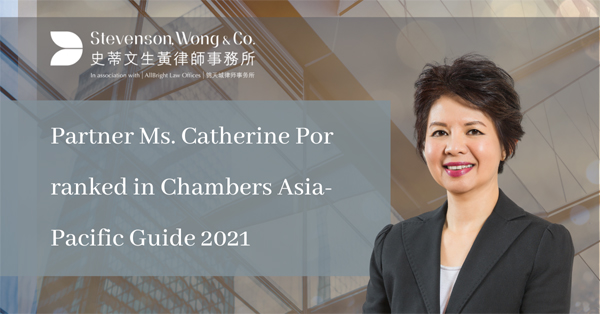
We are pleased to announce that our firm’s SW Private practice and Head of department, Ms. Catherine Por has for 3 consecutive years been recognised by the Chambers and Partners Asia-Pacific Guide.
In the Chambers Review:
What the team is known for Solid family law practice handling a range of complex, contentious matters involving high-value assets. Especially skilled in ancillary relief cases. In addition to advising on divorce law, the team is also well versed in succession planning, probate applications and wardship issues. Also notable for non-contentious work, such as prenuptial and postnuptial agreements.
Strengths One practitioner observes: “They are traditionally strong in the market, and continue to be very competent and hard-working.”
Catherine Por is well recognised for her expertise handling family and matrimonial matters. Considered “a very solid, calm and measured lawyer,” she is regularly sought out by clients to advise on post-separation financial and child issues, as well as trust and estate matters. “She is very experienced, very practical and firm about what her clients require and request,” says one source.
About Ms. Catherine Por
Catherine heads SW Private in the firm. She specializes in all aspects of family law disputes, and has extensive experience in complex financial claims, intervener proceedings, financial claims under Part IIA of the Matrimonial Proceedings and Property Ordinance (Chapter 192), Child Abduction cases, relocation of children, claims under the Guardianship of Minors Ordinance (Chapter 13), custody cases, pre-nuptial and post-nuptial agreements, contentious and non-contentious trust cases, contentious estate matters; cross border issues and enforcement proceedings. She has on a number of occasions provided expert legal opinions on Hong Kong Family Law.
Catherine is also an Accredited General and Family Mediator, Fellow of the Chartered Institute of Arbitrators and is a Notary Public and Civil Celebrant of Marriages.
About Chambers and Partners
Chambers has been the leading source of legal market intelligence for over 30 years with the aim to offer reliable recommendations on the best law firms and lawyers in Asia-Pacific, providing the information necessary for clients to make an informed decision. Candidates are reviewed based on 5 criteria: client services, commercial vision and business understanding, diligence, value for money and professional conduct.
Please click here to see the ranking or contact Ms. Catherine Por for further enquiries.