News Updates
Find out all about our firm’s latest news updates below. To learn more about any individual item, please contact us here.
News Updates
Find out all about our firm’s latest news updates below. To learn more about any individual item, please contact us here.
On 14 April 2023, The Stock Exchange of Hong Kong Limited (the “Hong Kong Stock Exchange”) published the consultation paper (the “Consultation Paper”) seeking public feedback on the proposed enhancement of climate-related disclosures under the environmental, social and governance (“ESG”) framework. The public consultation period (the “Consultation Period”) will end on 14 July 2023.
…
Subject to responses during the Consultation Period, the revised ESG Reporting Guide (the “ESG Reporting Guide”) set out in Appendix 27 (“Appendix 27”) to the Rules Governing the Listing of Securities on The Stock Exchange of Hong Kong Limited (“Listing Rules”) will come into effect on 1 January 2024 (the “Effective Date”), and apply to ESG reports in respect of financial years commencing on or after the Effective Date.
Key Proposals
As an update from the current “comply or explain” mechanism for climate-related disclosures in ESG reports, the new climate-related disclosures based on the ISSB Climate Standard 1 will be introduced as a new Part D of Appendix 27. These disclosures will be categorised under four core pillars, namely Governance, Strategy, Risk management and Metrics and Targets. The key proposed disclosures are set out in the table below, including interim provisions for an issuer’s first and second reporting periods following the Effective Date (the “Interim Period”).
| Key proposed disclosures | Key proposed disclosures for the Interim Period |
| A. Governance | |
| Disclose the issuer’s governance process, controls and procedures used to monitor and manage climate-related risks and opportunities, including:
(1) the identity of any board committee or board members responsible for oversight of climate-related risks and opportunities; (2) how the board ensures that the appropriate skills and competencies are available to oversee strategies designed to respond to climate-related risks and opportunities; (3) how and how often the board and its committees are informed about climate-related risks and opportunities; and (4) a description of management’s role in assessing and managing climate-related risks and opportunities, including (i) the scope of climate-related responsibilities and duties performed by management-level position(s) or committee(s); (ii) how the board’s oversight is exercised over such management-level position or committee; and (iii) whether dedicated controls and procedures are applied to the issuer’s management of climate-related risks and opportunities. |
Not applicable. |
| B. Strategy | |
| Climate-related risks and opportunities | |
| Disclose climate-related risks and, where applicable, opportunities faced by the issuer and their impact on the issuer’s business operations, business model and strategy, including:
(1) description of each of climate-related risks identified and the time horizon over which each could reasonably be expected to have a material effect on the issuer; (2) the method for the issuer to define short, medium and long term and how they are linked to the issuer’s strategic planning horizons and capital allocation plans; and (3) current and anticipated effects of any climate-related risks identified on the issuer’s business operations, business model and strategy, products or services and/or suppliers and other parties in its value chain. |
Not applicable. |
| Transition plans | |
| Disclose issuer’s response to the climate-related risks and, where applicable, opportunities identified in B. Strategy above, including:
(1) any current or anticipated changes to the issuer’s business model, strategy and resource allocation to address climate-related risks and opportunities identified; (2) any adaptation and mitigation efforts (direct or indirect) undertaken or to be undertaken by the issuer; (3) how the aforementioned plans will be resources; (4) information in respect of any climate-related targets the issuer has set and any greenhouse gas (GHG) emission targets the issuer is required to meet by local legislation such as specific target set by the issuer for addressing climate related risks and opportunities, scope and objective of the target, base period from which progress is measured and any milestones or interim targets; and (5) comparison of the progress made in the most recent reporting year in respect of plans disclosed above. |
Not applicable. |
| Climate resilience | |
| Disclose information that enables investors to understand resilience of the issuer’s strategy (including its business model) and operations to climate-related changes, developments or uncertainties, including:
(1) the extent assets and business activities at risk covered by the issuer’s strategy, mitigation actions, implications of the issuer’s findings for its strategy and the significant areas of uncertainty considered in the analysis of climate resilience; and (2) description of the climate-related scenario analysis used to assess the effect of climate-related risks, opportunities on the issuer’s business model, strategy and cash flows, access to finance and its cost of capital including inputs used in the analysis and how the analysis has been conducted. |
Not applicable. |
| Financial effects of climate-related risks and opportunities | |
| Disclose the current (quantitative where material) and anticipated (qualitative) financial effects of climate-related risks and opportunities on the issuer’s financial position, financial performance and cash flows;
For current financial effect: (1) description of effect of climate-related risks and opportunities identified on the issuer’s financial position, financial performance and cash flows for the most recent reporting period; and (2) description of whether and how much risks and opportunities may result in a material adjustment to the carrying amount of assets and liabilities reported in the financial statements within the next financial year. For anticipated financial effect: (1) how the issuer expects its financial performance to change over the short, medium and long term (and how the issuer defines them), considering its strategy to address significant climate-related risks and opportunities; and (2) how the issuer expects its financial position to change over the short, medium and long term, considering funds (e.g. capital expenditure, R&D expenditure) required to pursue its current and committed plans and its planned sources of funding to implement its strategy to address significant climate-related risks and opportunities; and |
For current financial effect:
(1) allow qualitative disclosures. For anticipated financial effect: (1) information that enables investors to understand the aspects of financial statements that are most affected; and (2) work plan, progress and timetable for full disclosure. |
| C. Risk Management | |
| Disclose the process the issuer used to identify, assess and manage climate-related risks (and opportunities), including:
(1) how the issuer assesses the likelihood and effects associated with such risks (such as qualitative factors, quantitative thresholds and other criteria used); (2) how the issuer prioritises climate-related risks relative to other types of risks, including its use of risk-assessment tools; and (3) how the issuer monitors and manages its climate related risks. |
Not applicable. |
| D. Metrics and Targets | |
| Greenhouse gas (GHG) emissions | |
| Disclose:
(1) absolute gross GHG emissions generated during the reporting period, expressed as metric tons of CO2 equivalent, classified as scope 1 emissions, scope 2 emissions and scope 3 emissions; and (2) information in relation to GHG emissions including a statement describing the standard in accordance with which the issuer’s GHS emissions have been measure, the GHG emissions consolidation approach used and a summary of specific exclusion of sources, facilities and/or operations with a justification for their exclusion. |
For Scope 3 emissions:
(1) information that enables investors to understand the issuer’s relevant upstream or downstream activities along the value chain; and (2) work plan, progress and timetable for full disclosure. |
| Other cross-industry metrics | |
| Transition risks | |
| The amount and percentage of assets or business activities vulnerable to transition risk. | For issuers who have yet to provide quantitative disclosure:
(1) description of the assets or business activities identified to be vulnerable to transition risk with the location, nature of asset/business activity and the transition risk involved; and (2) disclosure of the work plan, progress and timetable for making the required disclosure. |
| Physical risks | |
| The amount and percentage of assets or business activities vulnerable to physical risk. | For issuers who have yet to provide quantitative disclosure:
(1) description of the assets or business activities identified to be vulnerable to physical risk with the location, nature of asset/business and the physical risk involved; and (2) disclosure of the work plan, progress and timetable for making the required disclosure. |
| Climate-related opportunities | |
| The amount of capital expenditure, financing or investment deployed towards climate-relate risks and opportunities. | For issuers who have yet to provide quantitative disclosure:
(1) description of the assets or business activities identified to be aligned with climate-related opportunities with the location, nature of the asset/business activity and the opportunity involved; and (2) disclosure of the work plan, progress and timetable for making the required disclosure. |
| Capital deployment | |
| The amount of capital expenditure, financing or investment deployed towards climate-relate risks and opportunities. | For issuers who have yet to provide quantitative disclosure:
(1) description of the types of activities requiring capital expenditure, financing or investment towards climate-related risks and opportunities; and (2) disclosure of the work plan, progress and timetable for making the required disclosure. |
| Internal carbon prices | |
| For issuers who maintain an internal carbon price:
(1) the price for each metric tonne of GHG emissions that that the issuer uses to assess the costs of its emissions; and (2) an explanation of how the issuer is applying the carbon price in decision-making (for example, investment decisions, transfer pricing and scenario analysis). |
Not applicable. |
| Remuneration | |
| Description of how climate-related considerations are factored into remuneration policy. | Not applicable. |
| Industry-based metrics | |
| Issuers are encouraged to consider the industry-based disclosure requirements prescribed under other international ESG reporting frameworks such as the SASB Standards 2 and the GRI Standards3 , and make disclosures as they see fit. | Not applicable. |
Analysis and Takeaways
Recently, thematic investment has become a popular trend and ESG investment is undeniably one of the major investing themes among investors, shareholders and other stakeholders. The Hong Kong Stock Exchange also notes the importance of promoting high standards of ESG practice and disclosure, and has incorporated certain elements of the Recommendations of the Task Force on Climate-related Financial Disclosures (“TFCD“) in the ESG reporting requirements that became effective in July 2020. In November 2021, the Hong Kong Stock Exchange further published a Guidance on Climate Disclosure to promote TCFD-aligned climate change disclosures.
While the Hong Kong Stock Exchange aims to keep up with international developments, it should also take into account the particular circumstances of the Hong Kong market when formulating the ESG reporting framework. The diversified business profile, specialised industry sectors and operating locations of Hong Kong-listed issuers, as well as their applicable laws and regulations, are all key concerns that the Hong Kong Stock Exchange should take into consideration.
In the future, it is expected that ESG and corporate governance matters would continue to be the key focus of the Hong Kong Stock Exchange. The Hong Kong Stock Exchange should also provide more guidance or training to cater for different levels of sophistication for ESG matters of the issuers. The Hong Kong Stock Exchange also encouraged issuers to visit its ESG educational platform, ESG Academy, for guidance materials. Issuers are advised to seek professional support for ESG advisory and reporting to meet the increasingly stringent and granular ESG requirements.
Please contact our Partner Mr. Rodney Teoh for any enquiries or further information.
This news update is for information purposes only. Its content does not constitute legal advice and should not be treated as such. Stevenson, Wong & Co. will not be liable to you in respect of any special, indirect or consequential loss or damage arising from or in connection with any decision made, action or inaction taken in reliance on the information set out herein.
1 The IFRS S2 Climate-related Disclosures Exposure Draft, as supplemented or modified by deliberations of the ISSB available on https://www.ifrs.org/news-and-events/updates/issb.
2 A set of industry-based standards that guide the disclosure of financially material sustainability information by companies to their investors. Effective from 1 August 2022, the SASB Standards are under the oversight of the ISSB.
3 A set of interrelated sustainability reporting standards that enable organisations to report publicly on their economic, environmental and social impacts and contribution towards sustainable development developed by the Global Sustainability Standards Board of the GRI.
Stevenson, Wong & Co. acted as the Hong Kong legal advisers to Revere Securities, LLC, the underwriter of Millennium Group International Holdings Limited (NASDAQ: MGIH) (“Millennium Group”) in their successful listing on the Nasdaq Capital Market on 4 April 2023. Millennium Group offered a total of 1,250,000 Ordinary Shares, priced at US$4.00 per share. The aggregate gross proceeds from the Offering was US$5 million.
…
Founded in 1978, Millennium Group is a long-established paper packaging solutions provider. Headquartered in Hong Kong, Millennium Group has two production facilities in Guangdong, China and a supply chain management office in Vietnam to provide their global clients with packaging solutions from Vietnam and other ASEAN countries.
Our Partners, Mr. Hank Lo and Mr. Gordon Tsang, together with Associate Mr. Bun Chan, acted as the Hong Kong legal counsel for the underwriter in the Nasdaq Listing.

Please contact Mr. Hank Lo or Mr. Gordon Tsang for any enquiries or further information about this transaction.
Our Senior Associate Terence Lau has been appointed by the Government of the Hong Kong Special Administrative Region as a member of the Appeal Panel (Housing) with effect from 1 April 2023 for a term of two years.
…
The Appeal Panel (Housing) is established under section 7A of the Housing Ordinance (Cap. 283) to determine appeals lodged by tenants against the termination of leases by the Hong Kong Housing Authority. For more information on the Appeal Panel (Housing), please see here.
Terence specialises in corporate finance law and has been advising listed issuers, sponsors and/or underwriters in a broad range of transactions, including initial public offering on The Stock Exchange of Hong Kong Limited, general offer and regulatory and compliance matters. Terence is also a panel solicitor of the Free Legal Advice Service on Building Management under the Home Affairs Department and a member of the Membership & Corporate Affairs Committee of the Hong Kong Tennis Association.
For more information, please contact Terence Lau at terence.lau@sw-hk.com.
On 24 March 2023, The Stock Exchange of Hong Kong Limited (the “Exchange”) published the consultation conclusions (the “Conclusions”) on the new listing framework for Specialist Technology Companies (“STCs”). The Conclusions were issued in response to the two-month consultation (the “Consultation”) in respect of the consultation paper (the “Consultation Paper”) published by the Exchange on 19 October 2022 (see our news update on the Consultation).
The new listing regime will be added as Chapter 18C of the Rules Governing the Listing of Securities on The Stock Exchange of Hong Kong Limited (the “Listing Rules”), and the corresponding amendments, together with the Guidance Letter on Specialist Technology Companies (the “Guidance Letter”) will come into effect on 31 March 2023. Commencing on the same day, companies may submit a formal application for listing under the new regime.
The Exchange will implement the proposals as set out in the Consultation Paper, subject to certain amendments. Set out below are the key features of the new listing regime.
…
Definition of “Specialist Technology Companies”
The Exchange will adopt the proposed definitions of STCs without amendment,1 which is defined as “a company primarily engaged (whether directly or through its subsidiaries) in the research and development of, and the commercialisation and/or sales of, Specialist Technology Products (“STPs”) within an acceptable sector of a Specialist Technology Industry”.
STP is defined as “a product and/or service (alone or together with other products or services) that applies Specialist Technology”, and “Specialist Technology” is defined as “science and/or technology applied to products and/or services within an acceptable sector of a Specialist Technology Industry”.2
List of Specialist Technology Industries and acceptable sectors
In respect of the Specialist Technology Industries and acceptable sectors, the Exchange will adopt the proposed list set out in the Consultation Paper with amendments, and the list will be published in the Guidance Letter to be updated from time to time by the Exchange after consultation with the Securities and Futures Commission and with its approval.3 Summary of the list of Specialist Technology Industries and the non-exhaustive acceptable sectors are as follows:4

The Exchange has specifically excluded blockchain and digital asset related business in the list as such companies’ success is considered generally attributable to the expansion of mining capacity, rather than the application of new technology, with minimal contribution of research and development (R&D) to the companies’ expected value5 .
Applicants falling outside the existing list of Specialist Technology Industries and acceptable sectors
An applicant falling outside the list of Specialist Technology Industries or acceptable sectors above may still be considered as “within an acceptable sector of a Specialist Technology Industry” for the purpose of the definitions of STC and “Specialist Technology” if it can demonstrate that:6
(a) it has high growth potential;
(b) its success can be demonstrated to be attributable to the application, to its core business, of new technologies and/or the application of the relevant science and/or technology within that sector to a new business model, which differentiates it from traditional market participants serving similar consumers or end users; and
(c) research and development significantly contributes to its expected value and constitutes a major activity and expense.
Such applicant must submit a pre-IPO enquiry to the Exchange before submitting a listing application under Chapter 18C of the Listing Rules7 , and the Exchange will assess by taking into account all relevant facts and circumstances and consult with the SFC and seek its approval.8
Companies with multiple business segments
In respect of applicants with multiple business segments, the Exchange will adopt a holistic assessment of the non-exhaustive factors set out in the Guidance Letter and take into account the following additional factors when assessing whether an applicant is eligible for listing under Chapter 18C:9
(a) the proportion of the revenue (if any) generated by the Specialist Technology business segment(s) relative to the total revenue of the company (instead of prescribing a “bright line” percentage threshold); and
(b) the reason for retaining the non-Specialist Technology business segment(s) and the history of the company’s operations.
Categorisation of Commercial / Pre-Commercial Companies
The Exchange has adopted its proposal to accommodate the listings of Commercial Companies and Pre-Commercial Companies, with more stringent requirements imposed on Pre-Commercial Companies than Commercial Companies11 , and that all investors (including retail investors) be allowed to subscribe for, and trade in, the securities of Pre-Commercial Companies.12
Requirements
The below table sets out a comparison of the key requirements for Commercial Companies and Pre-Commercial Companies to be eligible for listing as set out in the Conclusions:


Additional qualification requirements for Pre-Commercial Companies24
Post-IPO lock-up25
Scope of the target persons subject to post-IPO lock-up of STCs is wider than the main board issuers with a longer lock-up period. In particular, the applicable post-IPO lock-up for STCs is as follows:

Analysis and Takeaways
While the value of STCs may be difficult to estimate, due diligence and in-depth research on the capabilities of performance of STCs, as well as the participation of investors with professional experience and industry expertise are crucial to the price setting of shares of STCs. The IPSI mechanism, with a 50% share allocation percentage requirement, introduced by the Exchange in view of overcoming the difficulty in price-setting, has in fact created certain challenges for STC listing applicants as they lose some flexibilities in seeking general investors’ support.
Nevertheless, the introduction of the IPSI mechanism, together with other adjustments made after considering the market feedback, such as lowering the market capitalisation requirement for listing and modifying the requirements for the minimum R&D expenditure ratio, demonstrated the Exchange’s efforts in promoting the feasibility of the new listing regime without compromising the protection offered to investors.
This new route to the market is expected to support some of the most innovative and progressive companies of the future. Since the listing reforms implemented by the Exchange in 2018, Hong Kong has made a great leap forward in catching up with the international capital market’s development progress of regulatory framework to accommodate the ever-changing market needs. The introduction of such series of rules and regulatory frameworks, including this new Specialist Technology chapter, will greatly enhance Hong Kong’s competitiveness as a fundraising market in Asia, and Hong Kong would be able to make an even greater use of its connectivity with Mainland China.
Please contact our Partner Mr. Rodney Teoh for any enquiries or further information.
This news update is for information purposes only. Its content does not constitute legal advice and should not be treated as such. Stevenson, Wong & Co. will not be liable to you in respect of any special, indirect or consequential loss or damage arising from or in connection with any decision made, action or inaction taken in reliance on the information set out herein.
1 Conclusions, p. 6
2 Conclusions, pp. 6 and 7
3 Conclusions, p. 12
4 Conclusions, pp. V-2 to V-6, paragraph 7 of the Guidance Letter
5 Conclusions, pp. 10 to 11
6 Conclusions, pp. 11 and V-7, paragraph 10 of the Guidance Letter
7 Conclusions, p. V-7, paragraph 11 of the Guidance Letter
8 Conclusions, p. V-7, paragraphs 12 and 13 of the Guidance Letter
9 Conclusions, pp. 14 and V-8, paragraphs 16 and 17 of the Guidance Letter
10 Companies that have achieved meaningful commercialisation of their Specialist Technology Products and achieved a minimum revenue of HK$250 million in the most recent audited financial year, and are also expected to demonstrate year-on-year growth of revenue from the Specialist Technology business.
11 Conclusions, pp. 17-18
12 Conclusions, pp. 18-19
13 Conclusions, pp. 1, 22 to 29
14 Conclusions, pp. 29 to 31
15 Conclusions, pp. 2 and 39 to 42
16 Conclusions, pp. 42 to 43
17 Conclusions, pp. 45 to 62
18 Conclusions, pp. 58-59
19 Conclusions, p. 60
20 Conclusions, pp. 75-84
21 Conclusions, pp. 82 to 84
22 Conclusions, pp. 84 to 88
23 Conclusions, p. 90
24 Conclusions, pp. 63 to 70
25 Conclusions, pp. 93 to 100
26 Key personnel responsible for the STC’s technical operations and/or the R&D of its STP(s) (including the head and the key personnel of its R&D department) whose expertise is primarily relied upon by the company for the development of its STP(s), and the lead developer(s) of the core technologies in relation to the STP(s). In determining whether a person should be designated as a Key Technical and R&D Personnel, an applicant should consider factors including the shareholding of such personnel, his/her remuneration relative to other R&D staff, and his/her seniority.
Stevenson, Wong & Co. acted as the Hong Kong legal advisers to Pacific Century Securities, LLC, the underwriter of CBL International Limited (NASDAQ: BANL) (“CBL”) in their successful listing on the Nasdaq Capital Market on 23 March 2023. CBL offered a total of 3,325,000 Ordinary Shares, priced at US$4.00 per share. The aggregate gross proceeds from the Offering was US$13.3 million.
…
CBL is a bunkering facilitator in the bunkering industry, headquartered in Malaysia. CBL has established an extensive supply network in South Korea, PRC, Taiwan, Hong Kong, Malaysia, Singapore, Philippines, and Thailand. CBL provides their customer a one-stop solutions for vessel refueling with more options and flexibility in fulfilling their vessel refueling requirements.
Our Partners, Mr. Hank Lo, Mr. Gordon Tsang, and Associate Mr. Andrew Fung, acted as the Hong Kong legal counsel for the underwriter in the Nasdaq Listing.


Please contact Mr. Hank Lo or Mr. Gordon Tsang for any enquiries or further information about this transaction.
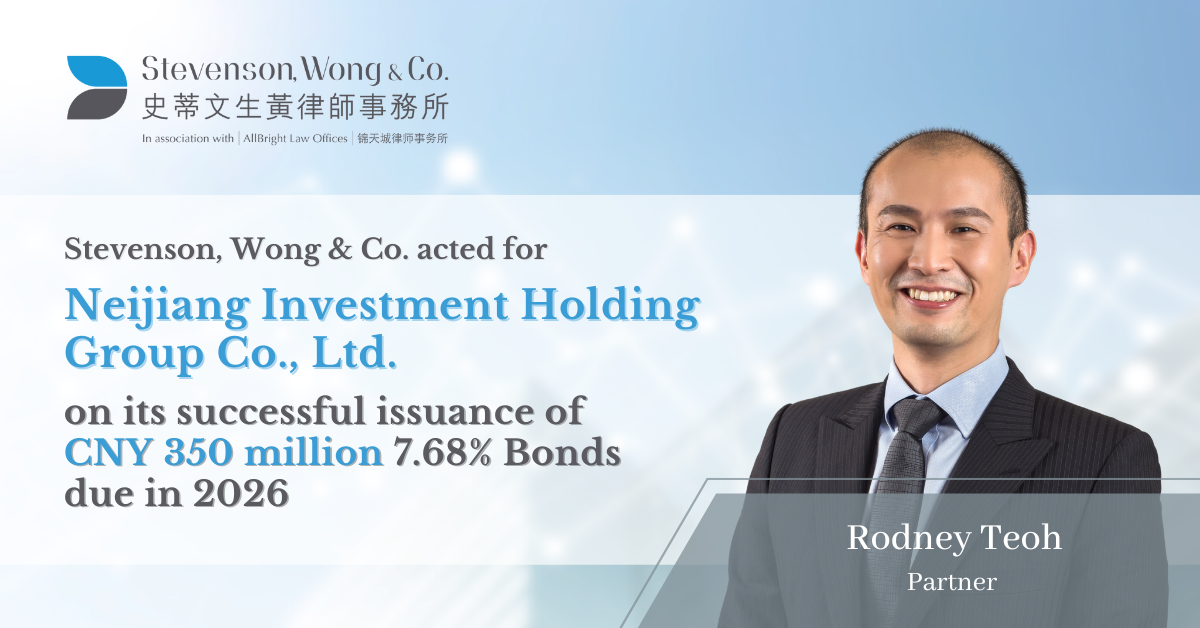
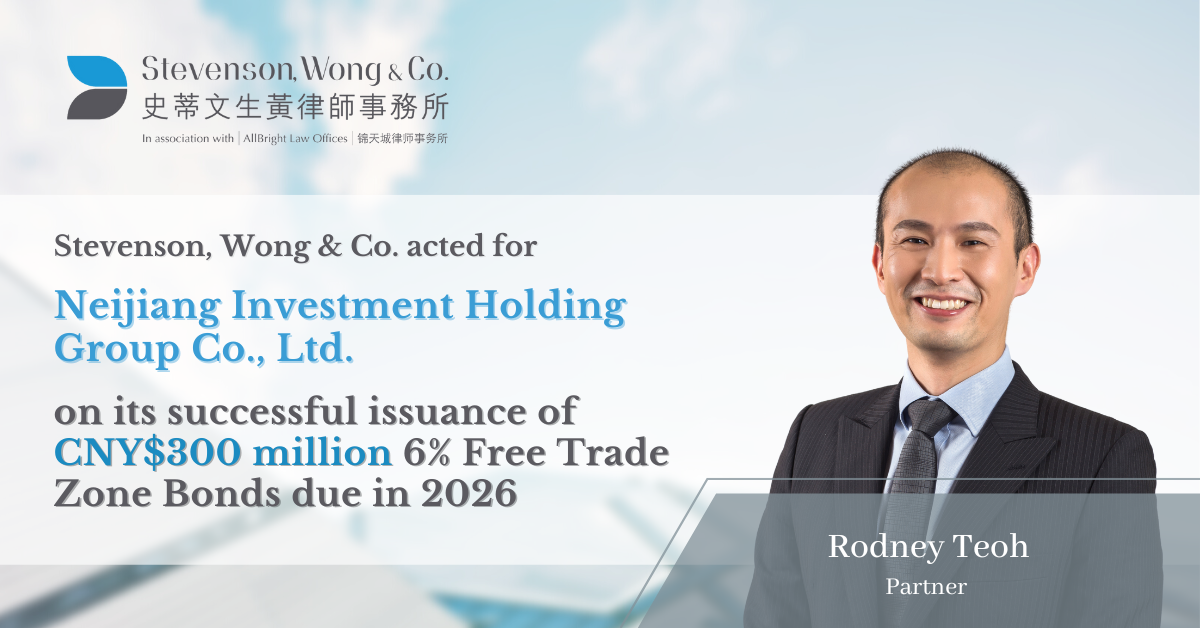
Stevenson, Wong & Co. acted for Neijiang Investment Holding Group Co., Ltd. (the “Issuer”) on its successful issuance of US$50 million 7.5% guaranteed bonds due in 2026.
…
The Issuer is a state-owned enterprise 90% owned by the State-owned Assets Supervision and Administration Commission of Neijiang Municipal Government and 10% owned by Sichuan Provincial Department of Finance. It is the major investment and financing entity of the development and construction in Neijiang City.
Donghai International Securities (Hong Kong) Limited, China International Capital Corporation Hong Kong Securities Limited, China Securities (International) Corporate Finance Company Limited, TFI Securities and Futures Limited, Industrial bank Co., Ltd. Hong Kong Branch, Zhongtai International Securities Limited, Shenwan Hongyuan Securities (H.K.) Limited, Dingxin (Securities) Limited, Chief Securities Limited, and Riches Depot Securities Co., Limited acted as the placing agents.
Our team was led by our Partner Mr. Rodney Teoh, supported by team members including Associates Ms. Angela Lau, Mr. Calvin KW Lo, Ms. Audrey Ng, Trainee Solicitor Mr. Austin Kot and Paralegal Mr. Gabriel Yu .
Please contact our Partner Mr. Rodney Teoh for any enquiries or further information.