News
Find out all about our firm’s latest news and activities below. To learn more about any individual item, please contact us here.
 Stevenson, Wong & Co.
News
Find out all about our firm’s latest news and activities below. To learn more about any individual item, please contact us here.
Introduction
On 28 January 2022, the Securities and Futures Commission (the “SFC”) and the Hong Kong Monetary Authority (the “HKMA”) issued a joint circular (the “Joint Circular”) providing guidance to banks and SFC-licenced intermediaries intending to engage in virtual asset (“VA”)-related activities (the “VA-related activities”).
Indeed, we are seeing enormous development in the Hong Kong regulatory landscape. In late 2019, the SFC introduced its new opt-in regulatory framework of virtual asset trading platforms (see our news update). In May 2021, the Financial Services and the Treasury Bureau (the “FSTB”) issued consultation conclusions on implementing a licensing regime for virtual asset service providers (“VASP licensing regime”) (see our news update). More recently, in mid-January 2022, the HKMA issued a discussion paper on crypto-assets and stablecoins (see our news update).
The Joint Circular has three main focuses: (a) the distribution of VA-related products; (b) the provision of VA dealing services (the “VA dealing services”); and (c) the offering of VA advisory services (the “VA advisory services”).
A. Distribution of VA-Related Products
VA-related products (the “VA-related products”) are likely to be considered complex products, due to their inherent risks which may not be easily understood by a retail investor. Thus, intermediaries distributing VA-related products should comply with the following additional requirements as appropriate.
Complex products requirements
Intermediaries should comply with the SFC’s requirements which govern the sale of complex products, including ensuring the suitability of VA-related products, minimum information and warning statements.[1]
“Professional investors only” selling restriction
VA-related products which are considered complex products should only be offered to “professional investors”[2] only. For example, an overseas VA non-derivative ETF would very likely be considered a complex product and it should only be offered to professional investors.
However, it is noted that there is a limited suite of VA-related derivative products traded on regulated exchanges as specified by the SFC and, in the case of exchange-traded VA derivative funds, authorised or approved for offering to retail investors in designated jurisdictions (including Australia, United Kingdom and United States of America). The “professional investors only” restriction is not imposed on the distribution of these products. Nevertheless, given such products are considered complex exchange-traded derivatives, they are still subject to derivative product requirement and VA knowledge test requirement.
It should be noted that the provisions under Part IV of the Securities and Futures Ordinance (Cap. 571) (the “SFO”) continue to apply, which prohibit the offering of investment products which have not been authorised by the SFC to the Hong Kong public. Where the VA-related products are distributed on an online platform, it must be properly designed and have appropriate access rights and controls to ensure compliance with the selling restrictions in Hong Kong and other jurisdictions and exchange, as appropriate.
VA knowledge test
Other than institutional professional investors and qualified corporate professional investors[3], intermediaries should assess whether their clients have knowledge of investing in VAs or VA-related products prior to effecting a transaction in VA-related products on their behalf. If not, intermediaries may only proceed if it acts in the client’s best interests and shall provide requisite training and sufficient information to ensure that the clients understand the VA-related products and are able to assume the related risks before making an investment decision.

Suitability obligation requirements
Intermediaries should ensure the suitability of VA-related products, including ensuring that any recommendations or solicitations made are suitable for clients in all circumstances and in their best interests, taking into account, among others, the clients’ risk tolerance and financial situation. Intermediaries should ensure that the aggregate amount to be invested in VA-related products is reasonable considering the clients’ net worth.
In addition, intermediaries should conduct proper due diligence on the products to understand their risks and features, the targeted investors and the products’ regulatory status. For an unauthorised VA fund, this means to conduct due diligence on the fund’s constitution, fund managers, operation, trading and custodian services providers and others.
Disclosure
Intermediaries should provide information to clients in relation to VA-related products and the underlying VA investments in a clear and easily comprehensible manner, together with warning statements specific to VAs.
Derivative products
Where the VA-related product is a derivative product, intermediaries are required to conduct additional know-your-client procedures pursuant to paragraphs 5.1A and 5.3 of the Code of Conduct, including to assess the clients’ knowledge of derivatives and characterize the clients based on their knowledge of derivatives and to ensure that the clients understand the nature and risks of the products and have sufficient net worth to be able to assume the risks and bear the potential losses.
Provision of financial accommodation
Intermediaries should be cautious in providing any financial accommodation. They should assure that the clients have the financial capacity to meet the obligations arising from leveraged or margin trading in VA-related products, including in a worst-case scenario.

B. Provision of VA Dealing Services
Currently, the SFC and the HKMA are only prepared to allow intermediaries licensed or registered for Type 1 (dealing in securities) regulated activity to provide VA dealing services. Accordingly, intermediaries are expected to comply with all the regulatory requirements imposed by the SFC and the HKMA when providing VA dealing services, irrespective of whether or not the virtual assets involved are securities. To ensure adequate investor protection, intermediaries wishing to provide VA dealing services are also subject to the following conditions/requirements:
SFC-licensed VA trading platforms only
Intermediaries are required to partner only with SFC-licensed VA trading platforms[4] (the “SFC-licensed platforms”) for provision of VA dealing services, either by way of acting as introducing agent (introducing clients to the platforms for direct trading) or establishing an omnibus account with the platform (acting as agent on behalf of the clients to execute instructions). These services should only be provided to professional investors.
Introducing agent
Where intermediaries are acting as introducing agents, they should only introduce professional investor clients to SFC-licensed platforms. They should not relay any orders on behalf of their clients to the platforms or hold any client assets for the introducing services.
Omnibus account
Intermediaries providing VA dealing services through operating an omnibus account established and maintained with an SFC-licensed platform shall comply with expected conduct requirements imposed by the SFC as licensing or registration conditions. One of the conditions is to adhere to the prescribed terms and conditions, which include the following:
1. Maintain in Hong Kong at all times excess liquid capital equivalent to at least 12 months of its actual operating expenses calculated on a rolling basis, in addition to the requirements under the Securities and Futures (Financial Resources) Rules (Cap. 571N).
2. Only permit clients to deposit or withdraw fiat currencies, instead of VAs, from their accounts.
3. Fully disclose the nature and risks that the clients may be exposed to when dealing in VAs in a clear and fair manner which is not misleading.
4. Not engage in VA market making activities on an SFC-licensed platform through which it provides to its clients the VA dealing services.
5. Establish and implement policies for preventing market manipulation or abusive trading activities.
6. Ensure that its anti-money laundering and counter-financing of terrorism systems can adequately manage the money laundering and terrorist financing risks.

C. Provision of VA Advisory Services
Intermediaries should comply with all the regulatory requirements imposed by the SFC and the HKMA when providing advisory services, irrespective of the nature of the VAs. Furthermore, such services should only be provided to intermediaries’ existing clients who are “professional investors” to which they provide services in Type 1 (dealing in securities) or Type 4 (advising on securities) regulated activities.
Where an intermediary provides advisory services in VA-related products, it should observe the same requirements as highlighted in section “Distribution of Virtual Asset-Related Products” above, which includes the professional investors selling restriction, VA knowledge test and suitability obligation requirements, and at the same time, it must ensure the suitability of its recommendations.
Transitional arrangements
The new regulatory regime is immediately applicable to new market entrants upon their engagement in VA-related activities. For market participants providing existing VA-related activities to clients, there is a 6-month transition period before this regime is implemented in full.

Analysis and Takeaways
Virtual assets are gaining popularity around the world. Nevertheless, the global regulatory landscape largely remains uneven. In light of the market’s growing interest in VA-related products, we see the Joint Circular as a big step in providing clarity and certainty for intermediaries involved or interested in distributing VA-related products or providing VA dealing services. Indeed, the Joint Circular does contextualise the principal requirements for intermediaries for the distribution of VA-related products, such as complex products, “professional investor only”, VA knowledge test and derivative product requirements, and their interaction and application thereon. Furthermore, the SFC and the HKMA have expressed their general stance that only Type 1 regulated activity licensed or registered intermediaries can provide VA dealing service.
We believe Hong Kong should leverage its position and expertise as the leading international finance hub in developing its emerging Fintech ecosystem. The Joint Circular issued by the SFC and HKMA, together with the FSTB’s proposal for a VASP licensing regime, as well as the HKMA discussion paper on crypto-assets and stablecoins, are proactive initiatives thereby enabling a regulatory framework with sufficient protection and safeguard in place, where investors, VA operators, intermediaries and other stakeholders can venture into and utilise VAs and the blockchain technology as a whole.
Please contact our Partner Mr. Rodney Teoh and associate Ms. Angela Lau for any enquiries or further information.
This news update is for information purposes only. Its content does not constitute legal advice and should not be treated as such. Stevenson, Wong & Co. will not be liable to you in respect of any special, indirect or consequential loss or damage arising from or in connection with any decision made, action or inaction taken in reliance on the information set out herein.
[1] See more discussion in the subsections headed “Suitability obligation requirements” and “Disclosure” below.
[2] The term “professional investor” is as defined in section 1 of Part 1 of Schedule 1 to the SFO (as defined below).
[3] “Institutional professional investors” is defined under paragraph 15.2 of the Code of Conduct for Persons Licensed by or Registered with the SFC (the “Code of Conduct”) as persons falling under paragraphs (a) to (i) of the definition of “professional investor” in section 1 of Part 1 of Schedule 1 to the SFO. “Qualified corporate professional investors” refers to corporate professional investors which have passed the assessment requirements under paragraph 15.3A and gone through the procedures under paragraph 15.3B of the Code of Conduct.
[4] VA trading platforms which are licensed pursuant to section 116 of the SFO under the 2019 regulatory framework for VA trading platforms.
As one of the founding members of INTERLAW in 1982 and the only Hong Kong representative, we are delighted to announce that INTERLAW has again been awarded the highest ranking, Band One in the Leading Law Firm Networks category by Chambers Asia Pacific 2022.
Chambers and Partners recognises INTERLAW as “an extensive network of practitioners who offer cross-border support to clients with business interests throughout the Asia-Pacific region. This strong alliance aims to cultivate networking and the sharing of knowledge through regional and annual meetings. Additionally, it encourages members to form practice-specific groupings, thereby offering specific expertise across jurisdictions. The quality of its membership is ensured through peer reviews, and mentors are assigned to new members, while existing member firms build relationships, share insights and host workshops and webinars with and for each other.”
About INTERLAW
INTERLAW is an elite global law firm network of top-tier independent corporate and commercial law firms in 150 cities worldwide. The network distinguishes itself by its longevity, quality of client service, and the strong professional and personal relationships of its lawyers. For over 38 years, Interlaw has been refining its provision of global legal services and continues to grow worldwide, offering clients unrivalled high quality legal advice, wherever in the world they want to do business.
Members of INTERLAW are selected after a comprehensive due diligence process that identities full-service law firms with a solid reputation for impeccable professional and ethical standards.
For more information, please contact our Partner Mr. Willy Cheng .
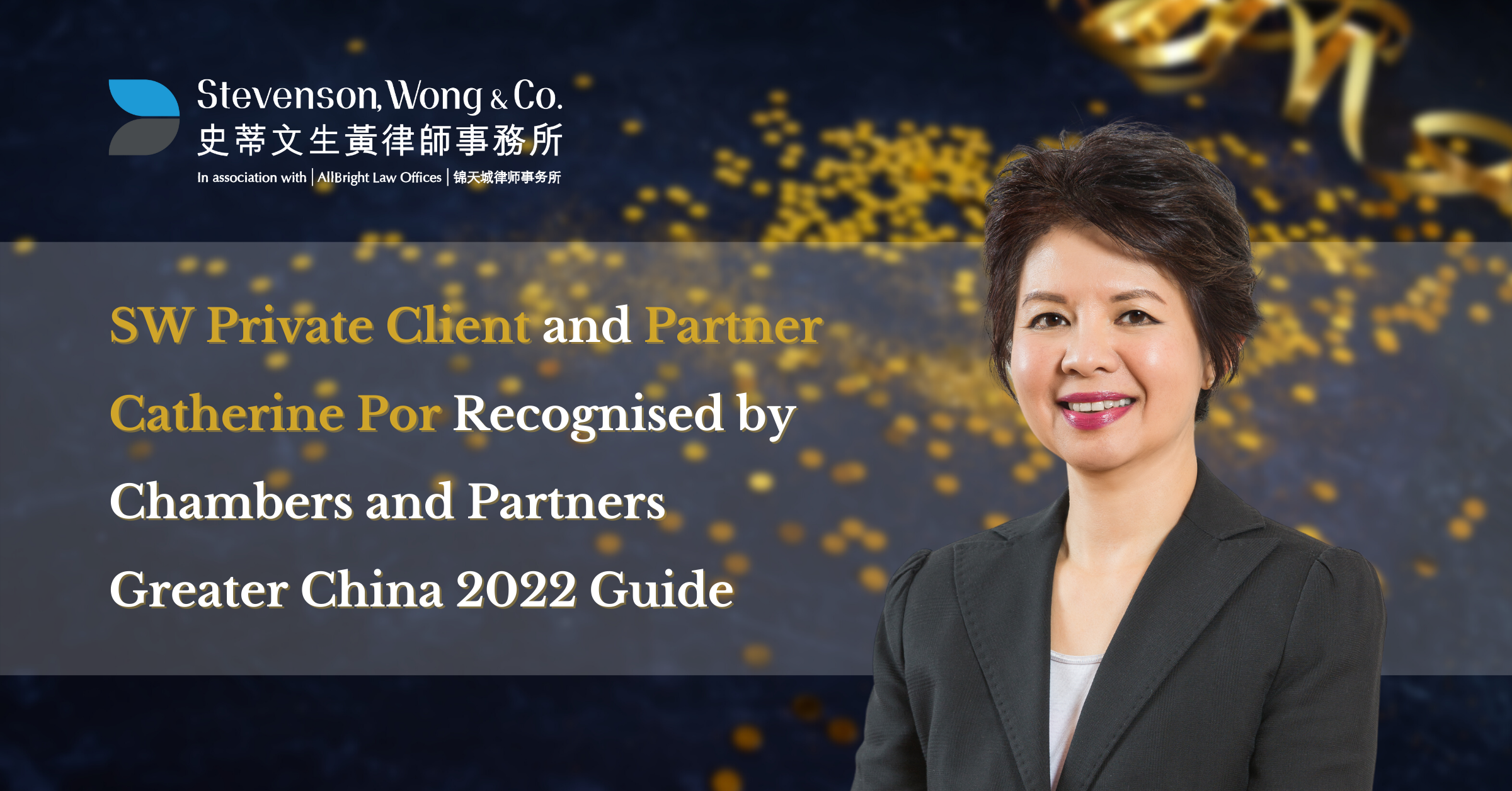
We are pleased to announce that our SW Private Client Practice and head of the department, Partner Catherine Por, has again, been ranked by Chambers and Partners in their Greater China 2022 guide.
• Family/ Matrimonial (International Firms)
Chambers’ Review:
Stevenson, Wong & Co houses a solid family law practice handling a range of complex, contentious matters involving high-value assets. Especially skilled in ancillary relief cases. In addition to advising on divorce law, the team is also well versed in succession planning, probate applications and wardship issues. Also notable for non-contentious work, such as prenuptial and postnuptial agreements.
Strengths:
Considering it to be a “very well-established team with very well-respected practitioners,” one market source affirms: “They’re straight down the line and protect their clients very well.”
• Notable practitioners- Catherine Por; Family/ Matrimonial (International Firms)
Chambers’ Review:
Catherine Por is well recognised for her expertise handling family and matrimonial matters. She is regularly sought out by clients to advise on post-separation financial and child issues, as well as trust and estate matters. “She’s had some hard-fought cases and is highly respected,” says an interviewee.
About Chambers and Partners
Chambers is known for its objectivity and rigor and is a trusted, authoritative reference for clients around the world seeking exceptional legal services. It is also widely regarded as one of the most important rating guides in the legal profession. Chambers’ dedicated research team selected the top law firms and lawyers by conducting market analysis on the legal fields in Greater China and interviews with a large number of in-house counsels and lawyers.
For more information, please contact our Partners and Heads of SW Private Client, Catherine Por and Wendy Lam, or visit Chambers and Partner’s Greater China 2022 guide.
Our Partner and Head of Litigation and Dispute Resolution Department, Ms. Heidi Chui, has been re-appointed by the Secretary for Financial Services and the Treasury of HKSAR as a member of Disciplinary Panel of the Hong Kong Institute of Certified Public Accounts (HKICPA), for a term of two years effective from 1 February 2022.
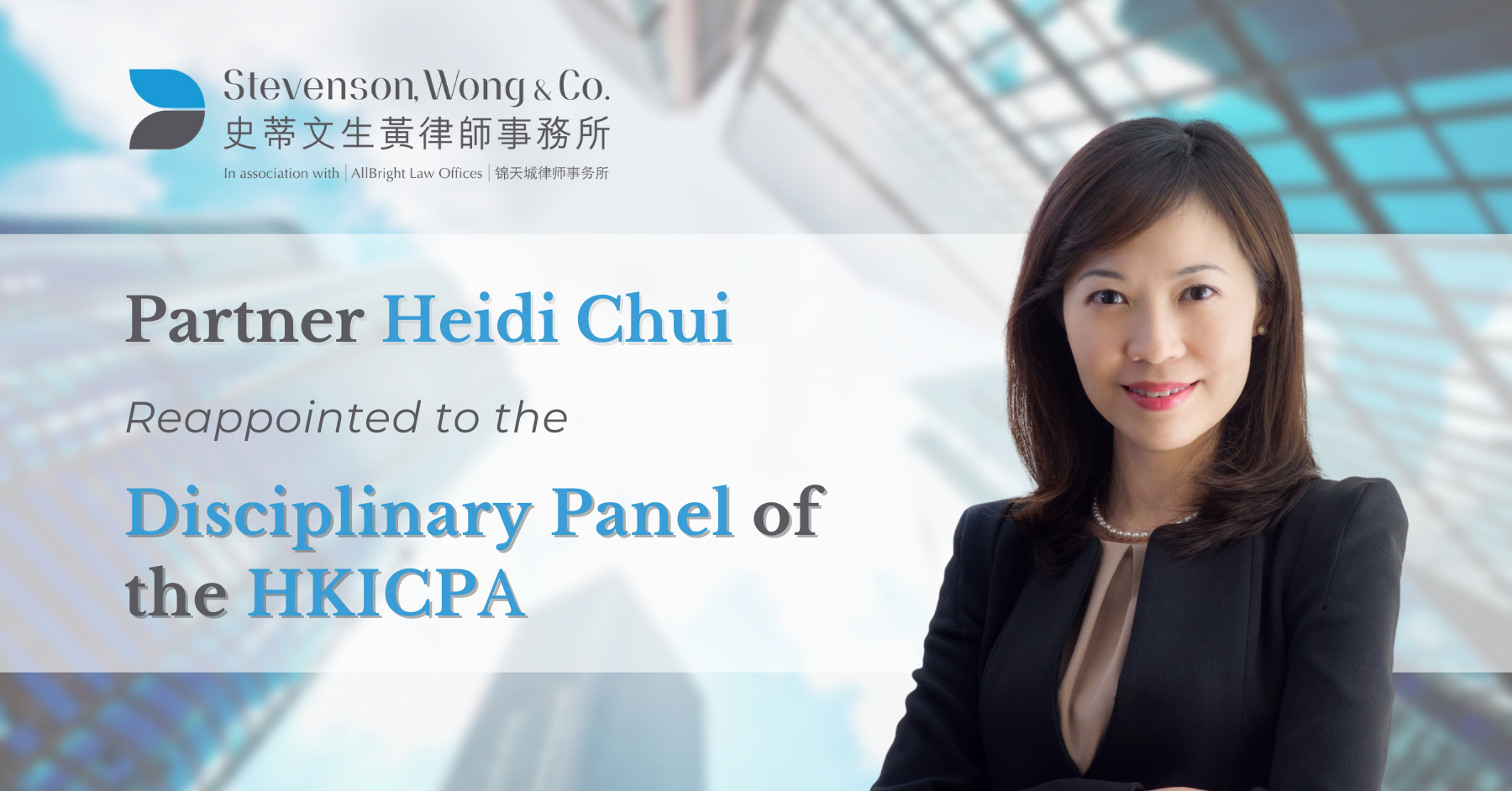
HKICPA is the only body authorized by law to register and grant practising certificates to certified public accountants with over 40,000 members in Hong Kong. Members of Disciplinary Panel are appointed by the Secretary for Financial Services and the Treasury under the authority delegated by the Chief Executive.

I am truly honoured and grateful for the trust and support by the Secretary for Financial Services and the HKICPA. I will continue to try my best to perform my official duties diligently.
Ms. Chui is an arbitrator on the panel of The Law Society of Hong Kong, one of the few solicitors who got accreditation and listed on the panel. She is also an arbitrator of Hong Kong International Arbitration Centre, China International Economic and Trade Arbitration Commission, Shanghai International Arbitration Center, Shenzhen Court of International Arbitration, Hainan International Arbitration Court (Hainan Arbitration Commission), Shanghai Arbitration Commission, Nanjing Arbitration Commission, Guangzhou Arbitration Commission, Ningbo Arbitration Commission, Hefei Arbitration Commission and Langfang Arbitration Commission. She is also an accredited mediator of Hong Kong International Arbitration Centre, The Law Society of Hong Kong and a Panel Mediator for Buildings Management Cases of the Lands Tribunal, a fellow of the Chartered Institute of Arbitrators (U.K.) and a Civil Celebrant of Marriages. She is a China Appointed Attesting Officer as appointed by the Ministry of Justice PRC.
In addition, Ms. Chui has also been appointed as Expert of Professional Committee on Real Estate Arbitration of China Academy of Arbitration Law. She has been appointed by The Honourable Chief Justice Geoffrey Ma, the Chief Justice of the Hong Kong Court of Final Appeal, as a Practising Solicitor Member of the Solicitors Disciplinary Tribunal Panel.
For more information, please contact our Partner Ms. Heidi Chui, or click here to visit HKICPA’s Disciplinary Panel.
With the recent escalation of cybercrime and internet scams, we have handled a wide range of asset tracing and recovery actions domestically and internationally. As time is of the essence, there always is the risk that the misappropriated assets would be dissipated quickly. To advise our clients taking out costs-effective applications for Mareva and/or proprietary injunction and/or banker’s trust orders against the fraudsters in a timely manner with further assets tracing, if necessary, we have assisted our clients recovering the stolen monies by and large in the current legal system.
Traditionally, upon receipt of any victim’s Suspicious Transaction Report (“STR”) or police report, the Joint Financial Intelligence Unit (“JFIU”) of the HK Police Force (“HKPF”) may issue a Letter of No Consent (“LNC”) to the relevant financial institution(s), pursuant to which the recipient should stop further disposal of the misappropriated assets. A financial institution disregarded the LNC and allowed the assets to be transferred out of the account would be liable for an offence under Section 25 of the Organised Serious Crime Ordinance, Cap. 455 (“OSCO”).
However, in a recent Hong Kong case Tam Sze Leung & Ors v Commissioner of Police [2021] HKCFI 3118, the Court of First Instance on 30 December 2021 held that the LNC regime is unlawful.
Brief Facts
Four Applicants, who had a total of 12 bank accounts maintained in several banks in Hong Kong, were found unable to withdraw funds from their accounts since around December 2020. Upon making enquiries with the banks and the Commissioner of HKPF (“the Commissioner”), the Applicants were informed that they were under investigation by the Financial Investigations Division of Narcotics Bureau in relation to an indicatable offence of dealing with property known or believed to represent proceeds under Section 25 of the OSCO.
It transpired that the Applicants were suspected of having involved in a money-laundering scheme and were under investigation by the Securities and Futures Commission (“SFC”) since 2019. In November 2020, the JFIU notified the relevant banks about their investigations, procured them to file STRs and informed them that LNCs would be issued soon. As per the JFIU’s request, each of these banks filed their STRs and received LNCs from the JFIU. All the relevant bank accounts were then frozen. The LNCs were maintained for the next 10 months until the restraint orders against the Applicants and the said accounts were awarded by the Court.
Court’s Decision
The Applicants raised six grounds to challenge the LNC regime and three of them were successful, namely (i) ultra vires, (ii) not prescribed by law and (iii) lack of proportionality.
(i) Ultra vires
The Court accepted that the LNC regime might contribute to the overall objectives of the OSCO when the Forces Procedure Manual (“FPM”) and the Police’s internal guidelines set out the procedures to comply with for the issuance of LNCs. However, looking at the language of Section 25A(2)(a) of the OSCO, the Court agreed with the submissions made by the Applicant’s Counsel that it was implausible that the legislature could have intended to enact the secret, informal and unregulated asset freezing power which the Commissioner asserted to be enjoyed under the LNC regime.
As the Court decided that using the express provision relating to LNC under Section 25A(2)(a) of the OSCO for securing an informal and unregulated freezing of assets was to use that power for a purpose other than that for which it was supplied, the Court held that the LNC regime was ultra vires OSCO.
(ii) Not prescribed by law
The Court held that the LNC regime was not ‘prescribed by law’. The requirements for the concept ‘prescribed by law’ include the law should be adequately accessible and formulated with sufficient precision to enable citizens to regulate their conduct. In the present case, there was insufficient clarity as to the scope of the power under the LNC regime and the manner of its exercise, together with inadequate effective safeguards against abuse under the OSCO and the FPM, the Court concluded that the LNC regime was not prescribed by law.
(iii) Lack of proportionality
The Court accepted that there was a legitimate purpose for the LNC regime to deter criminal activity by restricting access to the proceeds of crime. Nonetheless, the LNC regime operated without temporal limitation but only having been observed with intermittent internal review and lacking of proportional assessment on the reasonable length of its operation, the Court did not consider that a reasonable balance had been struck between the necessity to combat money laundering and one’s right to the use of property under Article 105 of the Basic Law. Therefore, the Court held that the LNC regime failed in the proportionality assessment.

Analysis and Takeaways
In Tam Sze Leung, the Court accepted that although the Commissioner was free to express or report suspicious transactions after its ongoing investigations to financial institutions so as to take all steps which appeared necessary for keeping peace, preventing crime and protecting property from criminal actions, the Court was reluctant to uphold the LNC regime which would violate to our current laws. Be that as it may, we trust that the relevant financial institutions will continue at the moment to follow the LNC regime unless there is any new development in the Hong Kong legislation catching up with the ratio herein.
Moreover, Tam Sze Leung does not affect the obligations of the bankers under Sections 25 and 25A of OSCO. The bankers are still obliged to closely monitor any suspicious accounts and to file STRs where appropriate. It is prudent for the bankers to ensure effective anti-money laundering policies and mechanisms, which have to be in place and to keep a good record of all the documentation and evidence in support of their decision to restrict or freeze any suspected accounts. We recommend the bankers to regularly review their decisions on freezing the suspected accounts and to check with the law-enforcing authorities in response to any changes or updates in circumstances.
The full impact of Tam Sze Leung remains to be seen, pending the relief to be granted by the Court to the Applicants and the potential appeal of the decision by the parties. In addition, the constitutional problems identified in this case are yet to be resolved or addressed through legislative amendment or enactment. With the uncertain development of the LNC regime, for now, it is advisable for the victims of commercial crimes to apply for relevant injunctions and/or appropriate court orders to stop any dissipation of funds as early as possible.
This article is authored by Ms. Milly Hung, Partner, Mr. Michael Lau, Senior Associate and Mr. Warwick Tam , Associate of Litigation Department of Stevenson, Wong & Co. If you have any problem in relation to this matter, please contact Ms. Milly Hung on (852) 2533 2561 or email to millyhung.office@sw-hk.com.
This article is for information purposes only. Its content does not constitute legal advice and should not be treated as such. Stevenson, Wong & Co. will not be liable to you in respect of any special, indirect or consequential loss or damage in relation thereto.
We are delighted to announce that China Business Law Journal (CBLJ) has named our Partner Hank Lo, who is Head of our firm’s Corporate Finance Department, and Partner Heidi Chui, Head of Banking and Finance and the Litigation and Dispute Resolution Departments, on their A-List China’s Elite 100 Lawyers (Foreign Lawyers) for their extensive experience and exceptional recognition by clients.
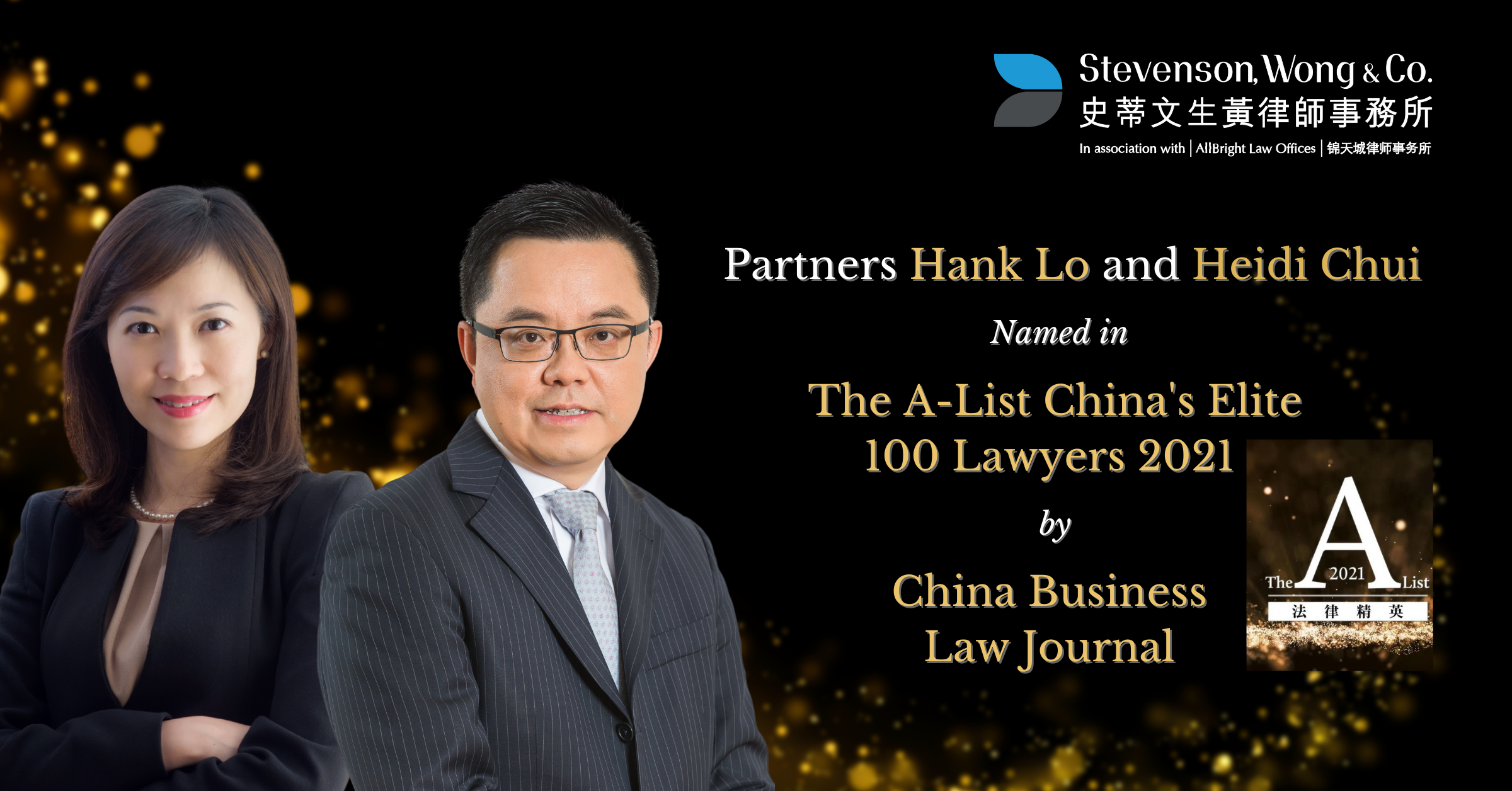
The A-List is based on extensive research conducted by CBLJ by consulting thousands of in-house counsels, clients, and partners at PRC and international law firms. The final list of 200 elite lawyers (100 lawyers from PRC firms and 100 lawyers from international firms committed to China-related business) is selected from over 2,000 nominations and feedback from business professionals and clients, combined with CBLJ’s years of experience and insights into China’s legal market.

I am honoured to be recognised by CBLJ for 3 consecutive years. The market has been under the impact of a pandemic, so I am very grateful for the trust and recognition from our clients, as well as the support and hard work of our team. We will continue to work closely with our association firm, AllBright Law Offices, to expand and enhance our services in China’s legal market.
Mr. Lo, the head of Corporate Finance, specializes in capital markets, corporate finance, and mergers and acquisitions matters. He has significant experience in advising issuers, sponsors and underwriters on initial public offerings on both the main and GEM boards of The Stock Exchange of Hong Kong Limited; advising publicly listed companies on a broad range of corporate finance transactions; advising private equity funds, venture capital funds and Hong Kong-listed companies on their investments in and exits from companies with an emphasis on China. He also advises companies in Mainland China on matters including property transactions, foreign investment and initial public offerings in other overseas stock markets.
Mr. Lo has been recognised by multiple international industry-leading legal directories. In addition to being named as “The A-List China’s Elite 100 Lawyers” by CBLJ for 3 consecutive years, Mr. Lo was also named one of the “Dealmakers of Asia 2021” by Asian Legal Business (ALB), and “Highly Regarded Leading Lawyer in Capital Markets: Equity 2021-22” by IFLR1000.
It is an honour for me to be recognised by CBLJ’s “A-List China’s Elite 100 Lawyers” alongside other exceptional lawyers. Thank you CBLJ for the recognition and our team members for their dedication, especially the long-term trust and support of our clients. I look forward to having closer collaborations with our clients in China’s legal market, in particular, in the Greater Bay Area, to provide innovative and pragmatic solutions.
Ms. Chui heads our firm’s banking and finance and litigation and dispute resolution departments. She has also served as an internal legal advisor of several Chinese banks.
Ms. Chui specializes in commercial litigation, international arbitration, and dispute resolution. Ms. Chui is experienced and adept at providing legal advice on asset tracing, mortgage litigation, corporate takeover, enforcement of judgments, winding-up of companies and receivership.
In addition, Ms. Chui provides legal advisory services for cases adjudicated in mainland China, taking the role of expert witness on Hong Kong law, and is experienced in cross-border litigation and international arbitration. She also specializes in handling matters relating to default payments and commercial fraud, assisting liquidators, receivers, official receivers, creditors, and other professionals in charge of insolvency and bankruptcy matters in debt restructuring and cross-border asset tracing.
Ms. Chui was the winner of Client Choice Award- Hong Kong’s Litigation practice organized by Lexology in 2016. She was nominated by Asian Legal Business for Dispute Resolution Lawyer of the Year in 2017, 2019 & 2020, and Woman Lawyer of the Year in 2017, 2020, and 2021. She has also been recognized as a distinguished practitioner in Banking and Finance (2018 & 2019) and Dispute Resolution (2018 – 2022) by Asialaw Leading Lawyers.
For any inquiries, please contact our Partners, Mr. Hank Lo or Ms. Heidi Chui, or visit “The A-List” here.