News Updates
Find out all about our firm’s latest news updates below. To learn more about any individual item, please contact us here.
News Updates
Find out all about our firm’s latest news updates below. To learn more about any individual item, please contact us here.
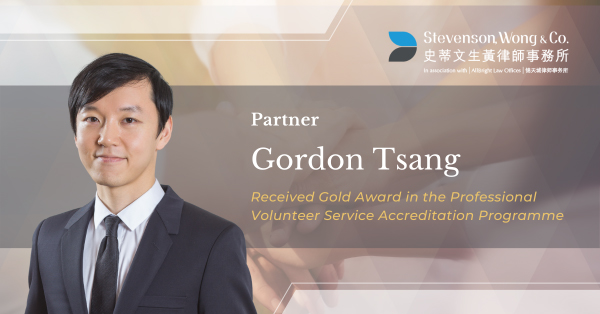
We are delighted to announce the promotions of Mr. Calvin Lo, Mr. Gordon Tsang, and Mr. Dominic Lau from senior associates to the firm’s partnership, effective from 1 July 2021.

Mr. Calvin Lo | Partner, SW Private Client
Mr. Lo joined the firm in 2015. He has a wide range of experience in private client work, including family and matrimonial matters, trust advisory work, estate and succession planning, often with cross-border elements, jurisdiction and forum disputes. He also specialises in handling MIP Committee and guardianship applications as well as for personal injury and fatal accident claims. He is also a HKMAAL accredited family mediator.
Mr. Lo is a Full Member (TEP) of the Society of Trust and Estate Practitioners (STEP). He recently won a STEP Excellence Award for being the top scorer worldwide at distinction level in the exam of STEP Diploma in International Trust Management.
Mr. Gordon Tsang | Partner, Corporate Finance
Mr. Tsang was admitted to practise as a solicitor in Australia in 2012 and in Hong Kong in 2013. He joined the firm in 2015. Mr. Tsang has extensive experience in handling a wide range of corporate and commercial matters, including pre-IPO restructuring and financing, Hong Kong and U.S. IPOs, mergers and acquisitions, loan and financing transactions, corporate governance and general compliance for listed companies as well as private enterprises.
Mr. Tsang is also the Non-Executive Director of China Regenerative Medicine International Ltd (Stock Code: 8158); the Company Secretary of Sunshine 100 China Holdings Ltd (Stock Code: 2608), Mabpharm Limited-B (Stock Code: 2181) and Sundy Service Group Co. Ltd (Stock Code: 9608).
Mr. Dominic Lau | Partner, Regulatory Enforcement & Compliance
Mr. Lau is dual-qualified in New York (USA) and Hong Kong. He joined the firm in 2019.
He is experienced in a broad range of commercial litigation including shareholders’ disputes, international arbitration, and land and property disputes.
In September 2018, Mr. Lau gained higher rights of audience in the high court.
Background
Following the consultation paper (the “Consultation Paper”) published by the The Stock Exchange of Hong Kong Limited (the “Exchange”) in November 2020 on the proposed increase in the Main Board profit requirement (the “Profit Requirement”), the Exchange published the highly anticipated Consultation Conclusion on “The Main Board Profit Requirement” (the “Consultation Conclusions”) on 20 May 2021.

Summary
After careful consideration of stakeholder feedback about the quantum and timing of the proposed increase as set out in the Consultation Paper, the Exchange modified its proposal as follows:
(a) Smaller increase in the Profit Requirement (the “Modified Profit Increase”)
(i) the Profit Requirement shall be increased by 60% (rather than the proposed 150% and 200%), resulting in a three-year aggregate profit threshold of HK$80 million (the “Aggregate Profit Threshold”), up from the current HK$50 million aggregate profit threshold requirement.
(ii) the profit spread is amended to a 56%:44% split (as compared to current 60%:40% split), such that the minimum aggregate profit required for the first two years of the track record period will be HK$45 million (from the current HK$30 million) and the final financial year of HK$35 million (from as the current HK$20 million) (the “Profit Spread”).
The Modified Profit Increase translates into an implied historical P/E ratio of approximately 14 times (as oppose to current 25 times), a change that is in line with the average P/E ratio of the Heng Sang Index between 1994 and 2020; and
(b) Implementation Date – the Modified Profit Increase will become effective on 1 January 2022.
(c) More flexible relief from the Profit Spread – the Exchange will also be prepared to grant a relief from the profit Spread on case-specific circumstances.
The table below sets out a comparison of the Modified Profit Increase with the proposals in the Consultation Paper:

Implementation of the Proposal
The Modified Profit Increase with the relevant consequential amendments to the Main Board Listing Rules, will take effect on 1 January 2022 (the “Effective Date”). Any Main Board listing applications submitted on or after the Effective Date will be assessed under the Modified Profit Increase.
This Effective Date would also be applicable to any renewals of previously submitted applications or GEM transfer applications. A listing applicant will not be permitted to withdraw its listing application before it lapses and resubmit the listing application shortly thereafter before the Effective Date such that the application will be assessed in accordance with the current profit requirement.

Temporary Relief
If the listing applicant meets an increased Aggregate Profit Threshold of HK$80 million, the Exchange will be prepared to grant relief from the Profit Spread on case-specific circumstances rather than through a set of fixed conditions. In this regard, the Exchange will ordinarily, among other things, evaluate the applicant’s business nature and evaluate any underlying reasons for its inability to meet the Profit Spread.
The Exchange will also impose conditions where appropriate. When considering an application for a waiver from the revised Profit Spread, the Exchange will critically assess the need to include a mandatory disclosure of the listing applicant’s profit forecast in the listing document and may also enquire on how the issuer’s IPO price was determined with reference to the book-building process.
Listing of SMEs
The Exchange stated in the Consultation Conclusions that the increase of profit requirement would not deprive suitable SMEs of the opportunities to list in Hong Kong as the Exchange saw GEM as a viable alternative. The Exchange further reassured that pre-revenue and pre-profit companies do not rely on the Profit Requirement to list. Such companies will also continue to be eligible for listing if they can demonstrate compliance with alternative eligibility and suitability requirements under the relevant Listing Rules and related guidance materials.
Pre-revenue biotech company could continue to rely on industry-specific pre-conditions as set out in Guidance Letter HKEX-GL92-18, and attain a market capitalisation of HK$1.5 billion and a public float of HK$375 million under Listing Rules 18A.03 and 18A.07. Similar requirements also continue to be applicable for mining companies under Chapter 18 of the Listing Rules.

Impact on GEM Listings
The Exchange taken note that there has recently been a significant decrease in the number of new GEM listings (from 75 in 2018 to 8 in 2020). The Exchange has attributed this observation to the lack of interest in “shell companies” due to the regulatory actions taken by the Exchange and the SFC as well as the removal of the streamline transfer process from GEM to the Main Board in 2018. The Exchange viewed these new regulations as designed to curb “shell” manufacturing and not to prohibit suitable companies from listing on GEM.
The Exchange further reiterated that GEM remains a viable alternative listing venue for companies and will consider a review of GEM in terms of its positioning and market perception. A consultation paper to seek market feedback on appropriate reforms may be forthcoming when necessary.
Competitiveness of the Exchange
The Exchange considers that the Modified Profit Increase will not compromise the Exchange’s competitiveness against other overseas exchanges. In particular, the HK$80 million profit requirement is still lower than that of SGX (approximately pre-tax profit of HK$170 million) and NYSE (approximately pre-tax profit of HK$194 million). Furthermore, the US markets typically also requires a higher public free float of approximately HK$310 million as compared to HKEX’s minimum of HK$125 million for Main Board applicants.
The market capitalisation requirement of HK$500 million also remains competitive when compared against that of NASDAQ (approximately HK$1,242 million), NYSE (approximately HK$3,881 million), SGX (approximately HK$850 million), ChiNext and STAR Board (approximately HK$1,200 million). Certain listing applicants may be considered ineligible to list in view of industry specifications or other eligibility requirements imposed by such overseas market, such as “high tech, emerging or innovative’ as required by ChiNext and STAR Board.
The below table sets out a comparison of the profit requirements with the profit-related eligibility requirement of the selected overseas main markets, ChiNext and STAR Board:

Source: Consultation Conclusions
Implications and Takeaways
A proposal involving an exchange’s listing requirements, especially its profit requirement, has always been a delicate balancing act of interests among various stakeholders. Against the backdrop of COVID-19, concepts of curtailing “shell” activities, protecting the interest of the investing public, while affording a fair chance for SMEs to list despite their size, as well as magnitude and timing of such implementation, are all valid considerations.
The jury is still out – as it how the Hong Kong future IPO scene eventually unfolds. Meanwhile, we suggest prospective listing applicants to seek appropriate advice and discussions on this topic, in order to formulate their listing plans that best suit their circumstances.
Please contact our Partners Mr. Hank Lo, Ms. Cornelia Chu or Mr. Rodney Teoh for any enquiries or further information.
This newsletter is for information purposes only. Its content does not constitute legal advice and should not be treated as such. Stevenson, Wong & Co. will not be liable to you in respect of any special, indirect or consequential loss or damage arising from or in connection with any decision made, action or inaction taken in reliance on the information set out herein.
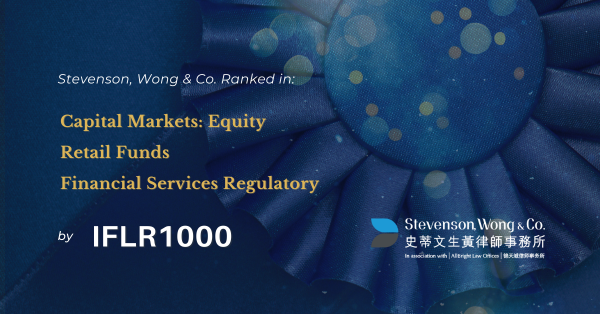
IFLR1000 has recently released their 31st edition rankings. Stevenson, Wong & Co. is pleased to announce that we have been ranked in Financial Services Regulatory.

IFLR1000 evaluates law firms and lawyers by practice area based on transactional evidence and client feedbacks. Firms are recognized for advising on some of the most complex or innovative transactions in their markets and receiving excellent feedback for their work.
About IFLR1000
The IFLR1000 is an international legal market’s leading guide focusing on financial and corporate law firms. Since 1990, IFLR1000 has published over 750 practice area rankings across 235 jurisdictions globally.
Please contact our Partners Mr. Hank Lo, Ms. Cornelia Chu, Mr. Rodney Teoh, Mr. Osbert Hui, or Ms. Erica Cheng for any inquiries or further information.
Please click here to see the full rankings.
Background
On 10 May 2021, The Securities and Futures Commission of Hong Kong (the “SFC”) announced the implementation of the Hong Kong Government’s grant scheme (the “Grant Scheme”) to provide subsidies for setting up qualified open-ended fund companies (the “OFCs”) and real estate investment trusts (the “REITs”) in Hong Kong. The Grant Scheme covers 70% of eligible expenses paid to Hong Kong-based service providers, subject to a cap of HK$1 million per OFC and HK$8 million per REIT.

Grant Scheme for OFCs and REITs
The application period of the Grant Scheme is three years starting from 10 May 2021 until 9 May 2024 on a first-come-first-served basis[1]. The table below sets out a general summary of the Grant Scheme:
|
OFC |
REIT |
|
| Eligibility | The OFCs that incorporated in or non-Hong Kong fund corporations re-docmiciled to Hong Kong. | The REITs that are listed on The Stock Exchange of Hong Kong Limited (“Exchange”) with a market capitalisation of at least HK$1.5 billion (or equivalent) at the time of listing. |
| Maximum amount of the grant | 70% of the eligible expenses subject to a cap of HK$1 million per OFC. | 70% of the eligible expenses subject to a cap of HK$8 million per REIT. |
| Scope of eligible expenses | Examples include fees charged by: 1. legal advisers for legal work in relation to incorporation or re-domiciliation of an OFC; 2. auditors, accountants or tax advisors for accounting and/or tax services in relation to incorporation or re-domiciliation of an OFC (but excluding annual audit review fees); 3. fund administrators, corporate service provides or company secretaries for set-up of an OFC, including work done for all necessary filings or registration of an OFC; and 4. regulatory consultants for works done in relation to authorisation of an OFC with the SFC. It should be noted that generally it does not include statutory fees such as registration or application fees to the SFC. |
Examples include fees charged by: 1. underwriters for underwriting commissions in relation to the listing of a REIT; 2. auditors, accountants or tax advisors for accounting and/or tax services in relation to the listing of a REIT (but excluding annual audit review fees); 3. legal advisers for legal work in relation to listing of a REIT; 4. valuer of a REIT to produce valuation report on properties for the listing of a REIT; and 5. marketing agencies or consultants for advertisement and marketing related services for the listing of a REIT, such as roadshow expenses. It should be noted that listing fees to the Exchange will not be covered. |
| Application procedures | Applicants should submit to the SFC a duly signed and completed application form for the Grant Scheme together with all requisite supporting information and documents and scanned copies of the invoices/receipts.
SFC may request submission of additional and necessary information and documents during the vetting process. |
|
| Timing of submission to the SFC |
1. for private OFCs, within 3 months from the date of certificate of incorporation or re-domiciliation issued by the CR; 2. for public OFCs, within 3 months from the date on which the authorisation of the public OFC becomes effective. |
Within 3 months after the listing date of the REIT. |
| Clawback of the grant awarded | The OFC commences winding-up or applies for termination of registration within 2 years from the date of incorporation or re-domiciliation. |
1. The REIT is delisted or suspended from trading within 2 years of its listing date; or 2. The REIT has been suspended from trading for a continuous period of 18 months within 2 years of its listing date. |
Applicants are recommended to consult the Investment Products Division of the SFC for further details.
According to Mr. Ashley Alder, the Chief Executive Officer of the SFC, the Grant Scheme “will reinforce Hong Kong as a leading capital raising venue and its status as an international assets and wealth management centre”[2].
Please contact our Partner Mr. Rodney Teoh for any enquiries or further information.
This newsletter is for information purposes only. Its content does not constitute legal advice and should not be treated as such. Stevenson, Wong & Co. will not be liable to you in respect of any special, indirect or consequential loss or damage arising from or in connection with any decision made, action or inaction taken in reliance on the information set out herein.
On 1 January 2021, a tabloid reported the suicide of a 55-year-old American man, found inside a private car in Sai Kung. This was hardly sensational and would have easily gone unnoticed – except perhaps by the princes and barons of the financial sectors.
The deceased was Mr. Paul Lincoln Heffner (“Heffner”), the Founder/CEO/Managing Partner of Adamas Asset Management (HK) Limited (“Adamas”).
Flash back to the end of 2019, the Securities and Futures Commission (the “SFC”) penalised Adamas for regulatory breaches. This may have set in motion a chain of events ultimately leading to Heffner’s tragic demise.

The Prologue
Adamas is a Hong Kong company incorporated in August 2011. It has, since February 2013, been licensed under the Securities and Futures Ordinance (Cap. 571) (the “SFO”) to carry on Type 9 (asset management) regulated activity and used to act as a fund manager and adviser of various offshore funds offered specifically to professional investors.
In December 2019, the SFC announced that Adamas was reprimanded and fined HK$2.5 million for failing to make prompt and proper disclosure of its notifiable interests in the shares of eight companies listed on the Stock Exchange of Hong Kong (the “SEHK”) held in the client portfolios it managed between February 2013 and March 2016.
Adamas applied to the Securities and Futures Appeals Tribunal for a review of the SFC’s sanction but aborted it soon thereafter.
Regulatory Requirements
The SFC’s sanction on Adamas is a reminder of the all-too-familiar disclosure and regulatory requirements, including, inter alia:
Hefty fine aside, it is curious how Adamas, being the manager and advisor of funds offered to professional investors, could have made the apparently “rookie” mistakes?
SFC’s Winding-up Petition & Appointment of Provisional Liquidators
Since Heffner’s death, all of Adamas’ employees have resigned and all of its operations and business activities had come to a standstill.
It transpired that Heffner was Adamas’ sole beneficial owner and director, thus no one other than Heffner was authorised to manage and handle the assets of the funds managed by Adamas and be the bank signatory of Adamas.
Against the backdrop that the business matters of Adamas had been left unattended, the SFC brought a winding-up petition against Adamas on public interest grounds (the “Petition”) and applied for the appointment of provisional liquidators to Adamas pending determination of the Petition pursuant to section 193 of the Companies (Winding Up and Miscellaneous Provisions) Ordinance (Cap. 32) (the “SFC’s Application”).
It appears that the SFC had over the years only sought to wind up a handful of companies, amongst which Adamas is the exceptional one not listed on the SEHK.
In March 2021, the High Court published a judgment in Securities and Futures Commission v Adamas Asset Management (HK) Ltd[6] in relation to the SFC’s Application.
The judgment sets out the Court’s reasons for allowing the SFC’s Application: –
|
The Epilogue, or the end of the First Chapter?
Underneath its professional façade, the ironically named Adamas was a flimsy one-man band, and its operation came to a grinding halt after the unexplained death of Heffner. This was followed by surreptitious attempts by unknown persons to usurp the control of the now unmanned company.
We expect this matter to spawn further regulatory and criminal investigations.
At the moment, we have more questions than answers.
Please contact our Partner Osbert Hui and Senior Associate Dominic Lau for any enquiries or further information.
This newsletter is for information purposes only. Its content does not constitute legal advice and should not be treated as such. Stevenson, Wong & Co. will not be liable to you in respect of any special, indirect or consequential loss or damage arising from or in connection with any decision made, action or inaction taken in reliance on the information set out herein.
References:
1. Cap. 32 Companies (Winding Up and Miscellaneous Provisions) Ordinance
2. Cap. 571 Securities and Futures Ordinance
3. News article titled “American man who committed suicide in a Tesla in Sai Kung was the CEO of Adamas Asset Management, ex-wife’s father – founder of Dragon Air (Updated)”: https://www.dimsumdaily.hk/american-man-who-committed-suicide-in-a-tesla-in-sai-kung-was-the-ceo-of-adamas-asset-management-wifes-father-founder-of-dragonair/
4. News article titled “SFC fines Fidelity and Adamas”: https://fundselectorasia.com/sfc-fines-fidelity-and-adamas/
5. SFC media release titled “SFC reprimands and fines Adamas Asset Management (HK) Limited $2.5 million”: https://apps.sfc.hk/edistributionWeb/gateway/EN/news-and-announcements/news/enforcement-news/doc?refNo=19PR122
6. Securities and Futures Commission v Adamas Asset Management (HK) Ltd [2021] HKEC 1107 (HCCW 88/2021, Hearing Date: 9 March 2020; Date of Judgment: 24 March 2021)
[1] Section 310(1) of the SFO.
[2] Section 315 of the SFO.
[3] Section 325(1)(a) of the SFO.
[4] General Principle 7 of the Code of Conduct for Persons Licensed by or Registered with the SFC (the “Code of Conduct”)
[5] Paragraph 12.1 of the Code of Conduct
[6] HCCW 88/2021, Hearing Date: 9 March 2020; Date of Judgment: 24 March 2021
Background
On 31 March 2021, the Singapore Exchange Regulation (the “SGX”) published a consultation paper on the proposed listing framework (the “Proposed Framework”) for special purpose acquisition companies (the “SPACs”) and invited comments by 28 April 2021. The Proposed Framework proposed to introduce a regime for SPACs in Singapore to list on the Mainboard of Singapore Exchange Securities Trading Limited (“SGX-ST”). According to the SGX, the Proposed Framework was in light of various developments including the market development in United States SPACs listings in recent years and potential merger and acquisition opportunities in the Asia Pacific region.

SPACs
The SGX defined SPACs as typically listed on stock exchanges as companies with no prior operating history, operating and revenue-generating business or asset at the time of listing. They are formed to raise capital through IPOs for the sole purpose of acquiring operating business(es) or asset(s). A SPAC is generally established and initially financed by experienced founding shareholders (typically referred to as sponsors). The majority of IPO funds raised are typically required to be placed in an escrow account, where the utilisation will be primarily for the consummation of the business combination. After listing, the SPAC begins its search for a target company for a business combination which must be completed within a permitted time frame.

The SGX has identified key benefits of SPACs to include: (i) sponsors are able to tap on public capital at the time of the listing, and through business combinations, invest in later-stage private companies and in turn stand to receive potential significant upside through the sponsor’s promote; (ii) A SPAC IPO process is relatively simpler and quicker as compared to a traditional IPO given that a SPAC is a newly-formed company with no operational history nor commercial operations at the time of listing; (iii) there is better market certainty and price certainty; and (iv) Investors have the opportunity to co-invest with experienced sponsors, who often have a demonstrated track record and experience in achieving meaningful investment returns. However, the SGX also mentioned certain concerns and risks, including: (a) SPACs are susceptible to execution risks; (b) there is inherent uncertainty to the target company as the business combination is subjected to shareholders’ approval; (c) shareholders remaining with the resulting issuer may be subject to significant dilution; and the equitability of the regulatory treatment for the business combination as the target company is not subject to the level of initial listing review and scrutiny by the relevant securities regulators as compared to a traditional IPO, and limited market professionals’ due diligence may be conducted.
Proposed admission and related criteria, suitability assessment factors, permitted time frame for completion of business combination and other requirements
In the Consultation Paper, the SGX proposed to set admission and related criteria on minimum market capitalisation (S$300 million), public float (at least 25% of a SPAC’s total number of issued shares to be held by at least 500 public shareholders at the time of the SPAC listing on SGX-ST), minimum issue price (S$10 per share or unit), jurisdiction of incorporation (must be incorporated in Singapore) and dual class share structure (dual class share structure not permitted).
Under the Proposed Framework, in assessing the suitability of a SPAC for listing, SGX will consider factors such as (i) the profile including the track record and repute of the founding shareholders and experience and expertise of the management team of the SPAC; (ii) the nature and extent of the management team’s compensation; (iii) the extent of the founding shareholders and the management team’s equity ownership in the SPAC; (iv) the alignment of interests of the founding shareholders and the management team with the interest of other shareholders; (v) the amount of time permitted for completion of the business combination prior to the liquidation distribution; (vi) the dilutive features and events of the SPAC, including those which may impact shareholders and whether there are any mitigants for such dilution; (vii) the percentage of amount to be held in the escrow account that must be represented by the fair market value of the business combination; and (viii) such other factors as the Exchange believes are consistent with the aims of protecting investors and promoting public interest.

The SGX also proposed that the SPAC must complete a business combination within a maximum time frame of 36 months from the date of listing. SPAC sponsors may voluntarily specify a shorter time frame to complete the business combination in the SPAC’s constitution. The SPAC will be liquidated and the remaining funds (comprising a majority of the proceeds raised at IPO) held in the escrow account are returned to shareholders if the SPAC is unable to complete the business combination within the permitted time frame.
In relation to the minimum percentage of IPO proceeds to be held in escrow, it is proposed that the SPAC is required to place at least 90% of the gross proceeds raised from its IPO in an escrow account. Until the completion of a qualifying business combination, the SPAC may invest the escrowed funds in permitted investments such as cash or cash equivalent short-dated securities of at least A-2 rating (or an equivalent).
It is also proposed that the business combination must comprise an initial acquisition of a business or asset with a fair market value forming at least 80% of the amount held in the escrow account.
Under the Proposed Framework, the founding shareholders and the management team will also be subject to a minimum aggregate subscription value for alignment of their economic interest in the SPAC with that of other shareholders. The minimum aggregate value will be dependent on the market capitalisation size of the SPAC at IPO.

Analysis and Takeaways
The Consultation Paper represented an attempt of the SGX to explore SPACs listings as a viable alternative to traditional IPOs for fund raising in Singapore and the region.
Following the examples of the United States, Canada and Malaysia, various regions have explored the feasibilities of introducing regimes to allow for SPACs listings. Apart from Singapore, Hong Kong is also on this route. In early March 2021, the Financial Leaders Forum chaired by Hong Kong’s Financial Secretary had asked the Securities and Futures Commission and Hong Kong Exchanges and Clearing Limited “to explore suitable listing regimes to enhance the competitiveness of Hong Kong as an international financial centre, while safeguarding the interests of the investing public.” The Financial Secretary had also said in an interview with Bloomberg TV that the government was seriously looking into allowing SPACs.
The proposal for the regime in Hong Kong is yet to be released. Nevertheless, under the encouragement at official level and guided by overseas examples, it is expected that the market will embrace more discussions on a potential SPAC-listing regime in the future. Such a regime, if introduced in Hong Kong, is expected to provide further avenues for listing of businesses, and more options for general investors to participate in the markets.
Please contact our Partner Mr. Rodney Teoh for any enquiries or further information.
This newsletter is for information purposes only. Its content does not constitute legal advice and should not be treated as such. Stevenson, Wong & Co. will not be liable to you in respect of any special, indirect or consequential loss or damage arising from or in connection with any decision made, action or inaction taken in reliance on the information set out herein.