News

Find out all about our firm’s latest news and activities below. To learn more about any individual item, please contact us here.
14 Apr 2022

RECENT INSIGHTS AND DEVELOPMENT IN PRIVATISATION VIA SCHEME OF ARRANGEMENT IN HONG KONG

Introduction

In the past few years, Hong Kong has seen a series of privatisations of listed companies, and a considerable amount of which have been carried out by way of scheme of arrangement. In this article, we will discuss the recent Hong Kong High Court judgement in Chong Hing Bank Limited (HCMP 968/2021, [2021] HKCFI 3091) (“Chong Hing”), which could draw potential implications for parties using court sanctioned schemes of arrangement to privatise Hong Kong listed companies or reductions of capital. Indeed, the way of dealing with concert parties’ votes on a privatisation scheme at a court-convened shareholder meeting may affect its validity. Furthermore, this High Court decision could affect the drafting of the scheme documents and notice of court meeting going forward.

Background

The case concerned a petition hearing presented by Chong Hing Bank Limited (the “Company”) regarding the court’s sanctioning of the scheme of arrangement dated 30 July 2021 (the “Scheme”) between the Company and all the scheme shareholders (i.e. the Concert Parties (as defined below) and independent shareholders) (the “Scheme Shareholders”) pursuant to sections 673 and 674 of the Companies Ordinance (Cap. 622) (the “Ordinance”) and the reduction of capital pursuant to section 229 of the Ordinance.

The Company was a listed company on the Main Board of The Stock Exchange of Hong Kong Limited (the “Hong Kong Stock Exchange”). In May 2021, the offeror, the single largest shareholder of the Company, requested the board of directors of the Company (the “Board”) to put forward a proposal for the privatisation of the Company by way of the Scheme and withdrawal of the listing of the shares on Hong Kong Stock Exchange (the “Proposal”). There were also a few concert parties (the “Concert Parties”) that were presumed to be acting in concert[1] with the offeror under the Code on Takeovers and Mergers (the “Takeovers Code”) for the purpose of the Proposal. [1]

It was stipulated in the scheme document that the Scheme would be subject to approval by the independent shareholders, and that the Concert Parties would not attend or vote at the meeting of the Scheme Shareholders convened at the direction of the Court (the “Court Meeting”). The Court Meeting was then convened for the purpose of approving the Scheme and the Concert Parties did not attend nor vote at the Court Meeting.

In sanctioning the Scheme, the Honourable Madam Justice Linda Chan considered, among other things, the Company’s compliance with Rule 2.10 of the Takeovers Code.

Rule 2.10: Disinterested Shareholders’ Approval Requirement in relation to the Scheme

Rule 2.10 of the Takeovers Code provides that:

“Except with the consent of the Executive, where any person seeks to use a scheme of arrangement or capital reorganisation to acquire or privatise a company, the scheme or capital reorganisation may only be implemented if, in addition to satisfying any voting requirements imposed by law:-

(a) the scheme or the capital reorganisation is approved by at least 75% of the votes attaching to the disinterested shares that are cast either in person or by proxy at a duly convened meeting of the holders of the disinterested shares[2]; and

(b) the number of votes cast against the resolution to approve the scheme or the capital reorganisation at such meeting is not more than 10% of the votes attaching to all disinterested shares.”

The Court’s interpretation of Rule 2.10 of the Takeovers Code was relevant to the case in determining: (i) the validity of the notice convening the Court Meeting; and (ii) if the Court Meeting was validly constituted. In particular, the question whether the Court Meeting was duly convened and constituted by excluding the Concert Parties from attending and voting at such Court Meeting depended partly on the true meaning of Rule 2.10.

Interpretation of Rule 2.10

Previous High Court Decision

Prior to Chong Hing, in Re Cosmos Machinery Enterprises Limited (HCMP 601/2021, [2021] HKCFI 2088) (19 July 2021), the Honourable Mr Justice Jonathan Harris suggested two schools of thought regarding the meaning of Rule 2.10:

i. the offeror and his concert parties are prohibited from voting on the relevant resolution (the “Prohibition View”); and

ii. the offeror and his concert parties are not prohibited from voting, but their votes cannot be counted for the purposes of complying with the Takeovers Code (the “Non-Prohibition View”).

The learned Judge concluded that the Non-Prohibition View is the correct position as it is more consistent with the natural and ordinary meaning of Rule 2.10 and section 674(2) of the Ordinance. An offeror’s concert parties who are part of a scheme must be allowed to vote as a matter of scheme law.

Position adopted in Chong Hing

Chan J considered Mr Justice Harris’ views in Re Cosmos Machinery, which she considered to be obiter dicta as the scheme in the case was not approved by the requisite majority of shareholders. She then concluded that the Prohibition View is the correct interpretation of Rule 2.10 based on the following reasons:

    1.  The Prohibition View is more consistent with the ordinary and natural meaning of Rule 2.10 as it plainly envisages that the Court Meeting shall only be a meeting of holders of disinterested shares (i.e. not a meeting of holders of disinterested shares and concert parties) in order to ensure that their discussions are unhampered by the presence of others who may have a different interest.
    2. The Prohibition View is consistent with the drafting history of Rule 2.10. The current Rule 2.10 was enacted in 2002 following the Consultation Paper in April 2001. In contrast with the old Rule 2.10, the current Rule 2.10 embodies the plain intention for Rule 2.10 to be prohibitory in nature.
    3. The prohibition view would result in more coherence in the interpretation of related rules in the Takeovers Code which are all aims at protecting the minority interests.

Chan J further concluded that in view of the undertaking provided by the Concert Parties and that they did not attend the Court Meeting of the Scheme, the requirements under Rule 2.10 were fulfilled and the Scheme was sanctioned accordingly.

Her Ladyship additionally set out three types of meetings that could be ordered by the Court for approval of privatisation or takeover schemes involving parties acting in concert with the offeror:

  • One court meeting for all the shareholders to be bound by the scheme with the concert parties undertaking to the court not to attend and vote at the meeting.
  • Two court meetings for the disinterested shareholders and the concert parties respectively. The court may, however, dispense with ordering the second meeting if the concert parties have agreed with the company or given an undertaking to the court at the time when the company sought an order to convene meetings that they will be bound by the terms of the scheme.
  • If the concert parties have agreed with the company or the offeror to be bound by the terms of the scheme or the offer, then the scheme may simply be entered into between the company and the disinterested shareholders, in which case there is only one court meeting.

Analysis and Takeaways

In light of the ruling in Chong Hing, offerors should be mindful when seeking to use a scheme of arrangement to privatise a company listed on the Hong Kong Stock Exchange. To avoid complications in future privatisation schemes and to avoid two court meetings for a privatisation scheme (one for concert parties only), offerors should ensure that concert parties subject to the scheme irrevocably undertake that they will (i) neither attend nor vote on the proposed court meeting and (ii) be bound by the terms of the scheme. Wordings relevant to the attendance, voting and irrevocable undertaking on the scheme documents, as well as notice of meeting should also be carefully constructed to ensure compliance with the court’s ruling.

Please contact our Partner Mr. Rodney Teoh and associate Ms. Angela Lau for any enquiries or further information.

This news update is for information purposes only. Its content does not constitute legal advice and should not be treated as such. Stevenson, Wong & Co. will not be liable to you in respect of any special, indirect or consequential loss or damage arising from or in connection with any decision made, action or inaction taken in reliance on the information set out herein.

[1] Acting in concert is defined as persons who pursuant to an agreement or understanding, actively cooperate to obtain or consolidate “control” of the company by acquisition through voting rights.

[2] Disinterested shares are shares in the company other than those which are owned by the offeror or persons acting in concert with it.

13 Apr 2022

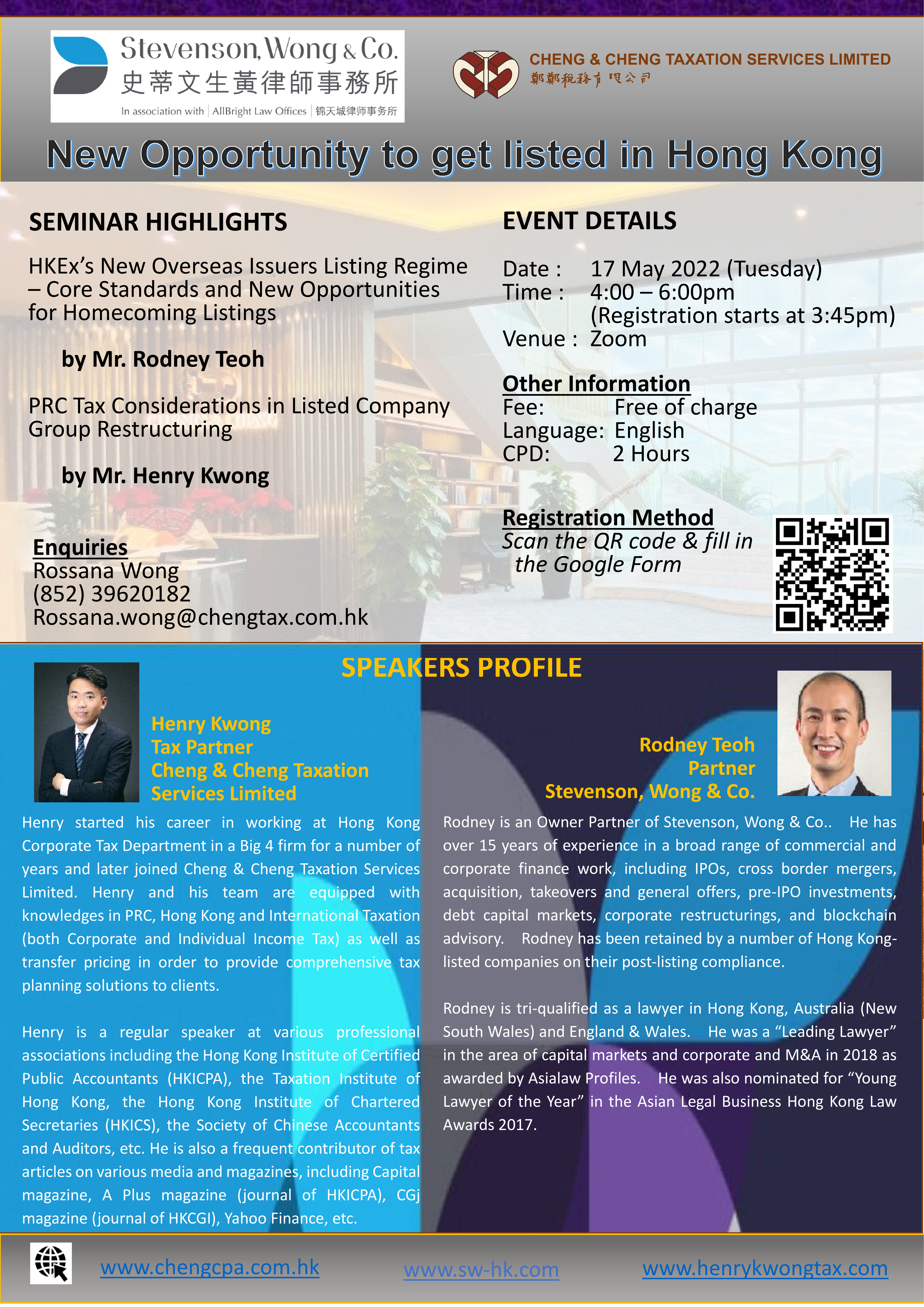
Partner Rodney Teoh Invited to Speak at “Navigating the SPAC listing in Hong Kong” Webinar

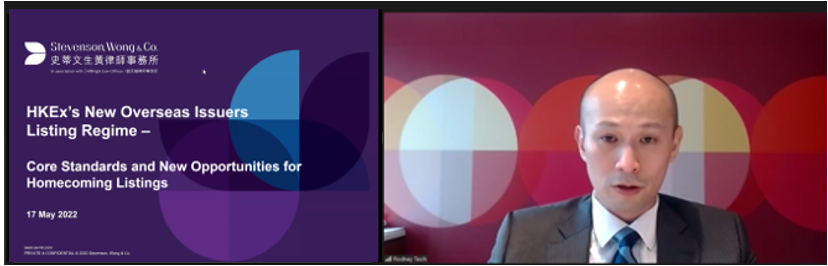
On 12 April 2022, our Partner Rodney Teoh was invited by Alliance Advisors to be one of their webinar guest speakers at the Webinar “Navigating the SPAC listing in Hong Kong”.


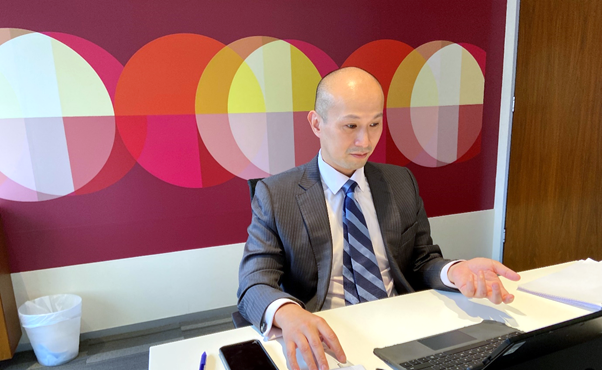
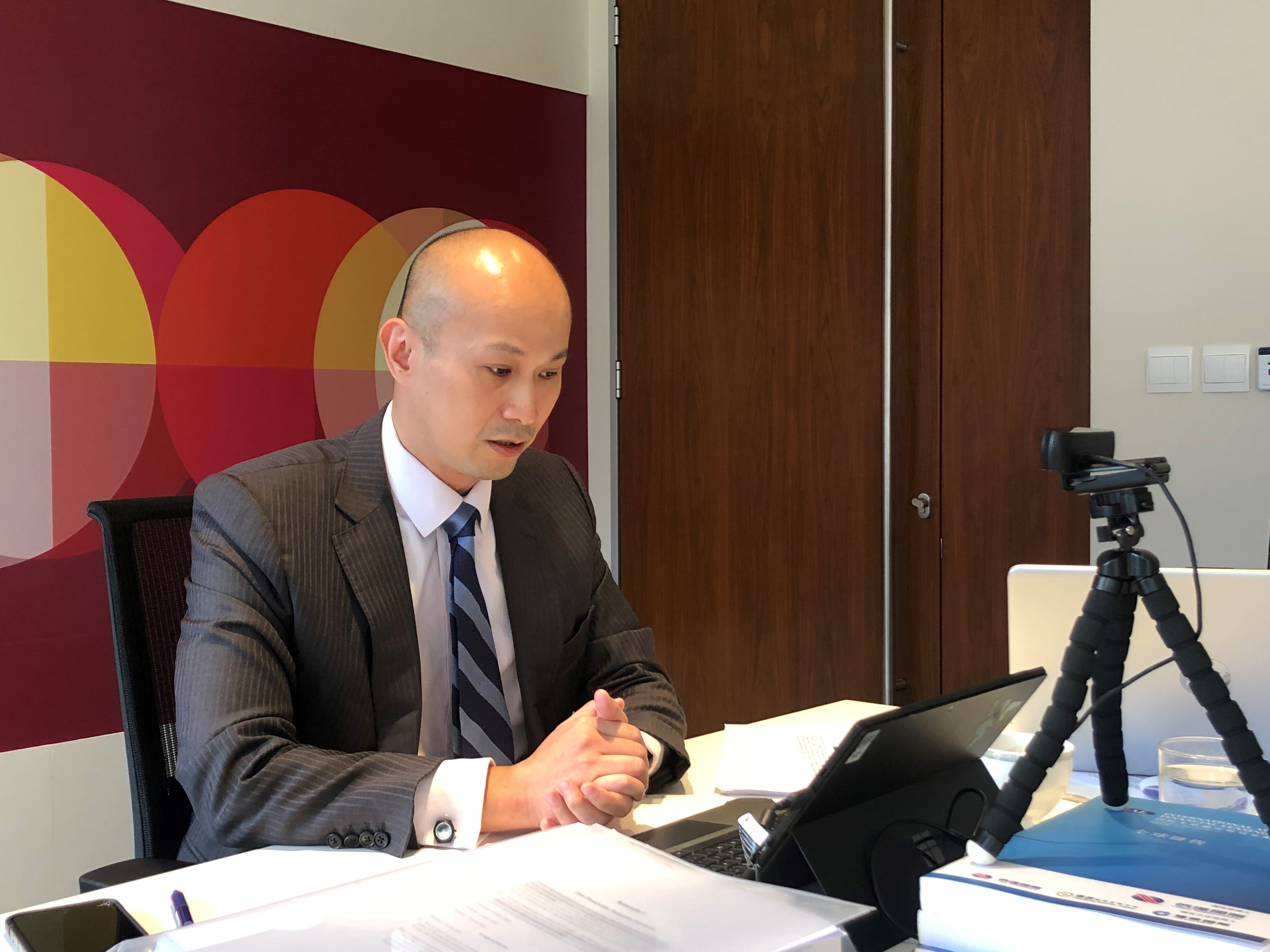
Our Partner Rodney Teoh (bottom).

During the webinar, Rodney shed light on the Hong Kong SPAC (Special Purpose Acquisition Company) listing regime by introducing the background and key listing requirements of SPACs in Hong Kong. He also illustrated the pros and cons of SPAC listings as compared with traditional IPOs, and the differences among the SPAC regimes around the world. He concluded the sharing with an analysis on the recent SPAC listing applications in Hong Kong, as well as by highlighting the benefits of the Hong Kong SPAC listing regime for potential listing applicants in the Mainland and the prospects of development.

The webinar was a great success, which received positive feedbacks from an audience of hundreds.

For more information, please contact our Partner Rodney Teoh

7 Apr 2022

FSDC PAPER ON THE ENHANCEMENT OF HONG KONG’S INITIAL PUBLIC OFFERING

Introduction

On 3 March 2022, the Financial Services Development Council (the “FSDC”) released a research report, recommending the Securities and Futures Commission (the “SFC”) and the Hong Kong Exchanges and Clearing Limited (the “HKEX”) to reform Hong Kong’s listing framework, with an objective to boost the competitiveness of Hong Kong as the leading Asian bourse and maximise the capital markets in Hong Kong.

In essence, the FSDC’s recommendations included the following:

• Consider whether the distinguishing features of the listing framework for pre-revenue biotech companies (Chapter 18A of the Rules Governing the Listing of Securities on The Stock Exchange of Hong Kong Limited (the “Listing Rules”) and special purpose acquisition companies (Chapter 18B of the Listing Rules) (“SPACs”) can be applicable to new economy companies;

• Review and clarify the subjective eligibility requirements of “innovativeness” for issuers with weighted voting rights (the “WVR”) structure to list in Hong Kong (Chapter 8A of the Listing Rules), with the policy aim of not making companies with WVR structure “commonplace” and retain investor protection;

• Continuously and holistically review the listing regime to cope with the evolving environment and market needs; and

• Provide more support to small and medium enterprises’ (“SMEs”) fundraising needs and access to the capital market, such as exploring a new listing framework and reviewing the existing GEM board regime.

Creating a friendly listing framework for innovative pre-revenue companies

New economy companies (e.g. hard technology, new energy, Software-as-a-Service, big data and artificial intelligence) are new, high-growth industries with cutting edge technology. Given their new and innovative nature, these companies often require heavy investment and funding in research and development (“R&D”) prior to being fully profitable. They also see a longer product development cycle. As traditional financers focus on a company’s financial track record, new economy companies would find it difficult to have access to capital and investments. Therefore, the FSDC suggested that it is crucial to remain flexible in the listing regime to cater for these new economy pre-revenue companies in order to capture these opportunities alongside appropriate investor safeguarding. The FSDC suggested that the HKEX could introduce a new chapter to the Listing Rules like Chapter 18A, to capture these fast-growing R&D intensive sectors, which could be the way forward to allow more pre-revenue new economy companies with great prospect and market potential to be listed on HKEX.

Riding on the successful emergence of the new economy in China and the Guangdong-Hong Kong-Macao Greater Bay Area (GBA), the Chapter 18A and the recent introduction of Chapter 18B, the FSDC drew attention to the listing frameworks of pre-revenue biotech companies and SPACs and viewed that that the HKEX and SFC should consider the distinguishing and the successful features of their listing frameworks which could be applicable to a new specific framework for these new economy companies.

In particular, akin to these biotech companies, many non-biotech new economy companies also have long business development cycles before demonstrating revenue or profits. Thus, the FSDC considered if some of the features in Chapter 18A could be incorporated into those of the new economy companies, such as the enhanced disclosure requirement, the involvement of sophisticated investors, rounds of fundings and competent authorities.

Furthermore, in the up-and-coming new economy sectors, investors would be expected to be equipped with technological and financial sophistication as well as a higher level or risk tolerance. This is the reason why the FSDC also considered the SPAC to serve a useful reference for a potential regime for pre-revenue innovative companies. Therefore, the FSDC recommended that some of the features in Chapter 18B could be also applicable to these new economy companies, such as the involvement of professional investors only at the initial stage and the requirement of additional private investment in public equity (PIPE) funding, where investors are expected to be more sophisticated in finance and tolerant to risk.

Review and clarify the “innovativeness” requirement for issuers with WVR structure

At present, according to Chapter 8A and 19C of the Listing Rules and the Guidance Letter HKEX-GL94-18, issuers seeking to list with a WVR structure must be an “innovative company”. The FSDC has recognised that some bankers and legal professionals considered that the “innovativeness” requirement is subjective and brings uncertainty to the Listing Rules, ultimately causing discouragement to companies seeking to list in Hong Kong. For instance, a first mover issuer from a new economy industry may be sufficiently “innovative” to obtain listing approval. However, subsequent companies of a similar nature or industry with higher market capitalisation and business scale may then not fulfil the “innovativeness” requirement as they then fail to differentiate themselves from the precedent case. These potential issuers are thereby less likely to list in Hong Kong in view of the lesser certainty.

In comparison, the FSDC examined both the Science and Technology Innovation Board, also known as STAR Market, of Shanghai Stock Exchange (the “SSE”) and the ChiNext of Shenzhen Stock Exchange. Despite both exchanges targeting growing innovative or sci-tech innovation companies, they do not provide potential issuers with any subjective definition or guidance of “innovativeness”. On the other hand, these exchanges adopt a set of objective listing standards that take account quantifiable factors such as business integrity, profits and revenue. The FSDC also highlighted that the SSE’s STAR opens doors for companies which are “yet to be profitable or have accumulated deficits” to be listed. Therefore, the FSDC suggested that the subjective eligibility of “innovativeness” for issuers with WVR structure should be reviewed and clarified while recognising the policy direction of WVR to not to be ‘common place’ and retain investor protection.

Furthermore, with the policy of not making companies with WVR structures “commonplace”, the FSDC also observed that the Hong Kong listing regime for WVR companies is more prescriptive in comparison with other markets. For instance, the US regime adopts a “disclosure-based regime with few restrictions on the WVR structure” for companies with dual-class shares structures, while Hong Kong requires enhanced disclosure and corporate governance structure. The strict investor safeguards imposed in Hong Kong have prevented WVR structures from being widespread and commonplace. Nevertheless, the FSDC advised that the definition and interpretation of “innovativeness” should be clarified to accommodate companies with varying degrees of innovativeness.

Continuously and holistically review the listing system to cope with the evolving environment and market needs

Currently, continued geopolitical uncertainties linger the business operations of Chinese stocks listed in the US, which may in turn affect the global IPO market. Companies already listed or considering listing on other exchanges may be looking for alternatives. There has been a surge in issuer interest in Hong Kong as a potential second listing option.

Notwithstanding such interest, companies including those whose business is centered in Greater China still face several hurdles when seeking to list in Hong Kong. The FSDC identified the relatively time-consuming IPO process, and the exemption system for issuers with primary listings on eligible exchanges as existing hurdles. To maximise the potential of listing market and the broader capital market, the FSDC suggested that further optimization should be explored to streamline and maximize the effectiveness of the listing process of oversea issuers.

Provide more support to SMEs

International and Mainland support

There are increasing emphasis being placed on supporting SME financing globally. Observing the reformative establishment of the Beijing Stock Exchange (“BSE”), the FSDC highlighted the BSE’s success since it started trading on 15 November 2021. 11 new companies have debuted through IPOs, alongside the 71 listed companies that transferred from the premium board of the National Equities Exchange and Quotations (NEEQ). As at 12 November 2022, over 2.1 million investors applied for access as qualified investor for the BSE, with over 4 million investors estimated to be eligible. Furthermore, 112 securities firms have been granted official membership of the BSE. The FSDC suggested that Hong Kong may consider to approach its own SME initiatives by taking reference to the BSE’s adoption of R&D spending as an eligibility criterion, to support the technology and research driven growth companies.

A comprehensive and open review of GEM

GEM was established in 1999 with the aim of providing funding support to SMEs. However, since the reform of GEM into a standalone market and the removal of the streamlined process for GEM transfers to the Main Board, GEM listing activities have greatly declined. In 2020, the market only saw 8 listings and HK$3.6 billion of total funds raised through GEM. Notwithstanding the development of the GEM Board, many SMEs which are in the growth and development stage may find themselves ineligible for GEM Board listing. This is because while GEM Listing Rules do not impose profitability requirements for potential issuers, the operating cash flow and market capitalisation requirements, together with the strict and time-consuming IPO vetting process may limit those smaller potential issuers to gain access to capital markets, ultimately causing the relative inactivity of GEM. For instance, the minimum aggregate operating cashflow of HK$30 million deters growth companies with high valuations but are yet to incur revenue or profit.

As the growth potential of SMEs is tremendous, the HKEX should re-evaluate whether the existing market structure is still conducive for SMEs to seize opportunities. To do so, the FSDC is of the view that HKEX should conduct a comprehensive and open review of GEM Board, including to revamp GEM Board as an incubator of early-stage fast-growing companies in order to allow SME access.

According to the FSDC, the financial industry and market participants generally hold a view that Hong Kong can take a more aggressive approach to support SMEs. Some comment that a new market mechanism supporting SME financing should be explored, and that such a mechanism could be incorporated into a market where only professional investors can participate. There is a pressing need for Hong Kong to respond to such opinions and readjust its market segmentation strategy.

Analysis and Takeaways

In light of the accelerated advancement of the new economy sectors and Hong Kong long praised attractiveness as a strong international fund-raising financial centre, the FSDC has encouraged HKEX and SFC to take active steps in refining its listing regime to cope with the evolving environment and the market needs. It is worth-taking to expand the pre-revenue requirement to cater for new economy companies and review and clarify the subjective requirement of “innovativeness” for issuers with WVR listed through Chapter 8A of the Listing Rules. The cultivation of biotech and new economy ecosystem may create demands for new homecoming listings. Also, considering the globally increasing emphasis on the financial support to the SMEs, Hong Kong should explore a new listing framework to assist their capital needs. These recommendations encourage Hong Kong listing regime’s opportunities arising from the latest IPO landscape and stay ahead in the race and to continue vitalising the capital market.

Please contact our Partner Mr. Rodney Teoh and associate Ms. Angela Lau for any enquiries or further information.

This news update is for information purposes only. Its content does not constitute legal advice and should not be treated as such. Stevenson, Wong & Co. will not be liable to you in respect of any special, indirect or consequential loss or damage arising from or in connection with any decision made, action or inaction taken in reliance on the information set out herein.

31 Mar 2022

(中文) 合伙人徐凯怡律师参加「2022巴黎仲裁周」第一届元宇宙全球线上仲裁论坛

(中文) 2022年3月30日,本所合伙人、诉讼及争议解决部主管徐凯怡律师,透过其虚拟形象(avatar)出席了2022巴黎仲裁周中首届元宇宙全球线上论坛- “元宇宙中的第一届仲裁论坛:web 3.0的法律影响”。

本次虚拟全球仲裁论坛由MetaverseLegal主办,在虚拟空间Horizon Workroom举行。16位参与者以虚拟形象方式(包括徐律师)参加了桌上讨论,超过170名参与者通过视频链接参与论坛。论坛重点讨论了四大热点议题,包括:元宇宙的关键特征、元宇宙中可能出现的争议、元宇宙争议解决的现况,以及元宇宙的去中心化争议解决。

徐律师表示,以自己的虚拟形象方式参加元宇宙第一届仲裁论坛是一次大开眼界的经历。她对 MetaverseLegal 组织了这次盛大的活动表示感谢,并期待未来能与全球不同司法区域的业界友好在虚拟世界空间中进行交流和互动。

如阁下有任何查询或想了解更多详情,请联络本所徐凯怡律师

25 Mar 2022

Partner Heidi Chui Represented The Law Society of Hong Kong to Meet with Australian Consul

On 22 March 2022, our Partner, Head of Banking and Finance department, and Dispute Resolution department, Ms. Heidi Chui, represented The Law Society of Hong Kong to meet with the Deputy Consul-General of Australia in Hong Kong, Mr. Ryan Neelam, and Consul Mr. Patrick Orchard, regarding the legal practice in the Greater Bay Area (GBA). Ms. Chui is a member of the Hong Kong Law Society’s Greater China Legal Affairs Committee and Vice-Chairperson of the Organising Committee of Cross Strait Four Regions Young Lawyers Forum 2022.

Our Partner Heidi Chui (Bottom left)

The meeting discussed the wealth of opportunities presented within the GBA, including the established framework for Hong Kong legal practitioners to qualify and practise law in the GBA, the GBA Legal Professional Examination and the Pilot Administrative Measures for Hong Kong legal practitioners to practise law in the GBA as issued by the Department of Justice of Guangdong Province.

For more information, please contact our Partner Ms. Heidi Chui.

23 Mar 2022

Partner Gordon Tsang Interviewed by Thomson Reuters

Thomson Reuters Beijing recently interviewed our Partner Gordon Tsang in two articles: ” Sany Heavy Plans Swiss Listing through Shanghai-London Stock Connect – Europe May become the New Overseas Listing Option for Chinese Companies” and “Bilibili Pursue Voluntary Conversion to Dual-Primary Listing – China Concept Stocks Are Expected to Follow, But It Is Not Easy for The Hong Kong Stock Exchange to Take Over” on his experiences on Chinese companies listing in US and Hong Kong.


For more information, please click the above links to read the full articles (available in simplified Chinese only) or contact our Partner Mr. Gordon Tsang .

NEWER OLDER 1 2 54 55 56 193 194