On 26 February 2025, the Hong Kong Government announced in its 2025-26 Budget the introduction of new fees structure for visa applications under the following talent and capital investment admission schemes:
 …
…
- Top Talent Pass Scheme;
- General Employment Policy;
- Admission Scheme for Mainland Talents and Professionals;
- Quality Migrant Admission Scheme;
- Immigration Arrangements for Non-local Graduates;
- Admission Scheme for the Second Generation of Chinese Hong Kong Permanent Residents;
- New Capital Investment Entrant Scheme;
- Capital Investment Entrant Scheme;
- Technology Talent Admission Scheme; and
- Vocational Professionals Admission Scheme.
Principal applicants and/or their dependants under the specified schemes are required to pay a non-refundable application fee of HKD600 for each application of entry, change of conditions of stay or extension of stay. In addition, the visa and entry permit issuance fees for approved applications are increased from the original flat rate of HKD230 to HKD600 for visas with a validity period of 180 days or less, and to HKD1,300 for visas with a validity period of 181 days or more. The changes reflect the “user pays” principle adopted by the Government.
The Hong Kong Immigration Department has accordingly implemented the new fees structure on 26 February 2025. Our Immigration Practice Team helps applicants pursue their applications in the respective schemes.
Please contact our Partner Willy Cheng for any enquiries or further information.
This news update is for information purposes only. Its content does not constitute legal advice and should not be treated as such. Stevenson, Wong & Co. will not be liable to you in respect of any special, indirect or consequential loss or damage arising from or in connection with any decision made, action or inaction taken in reliance on the information set out herein.
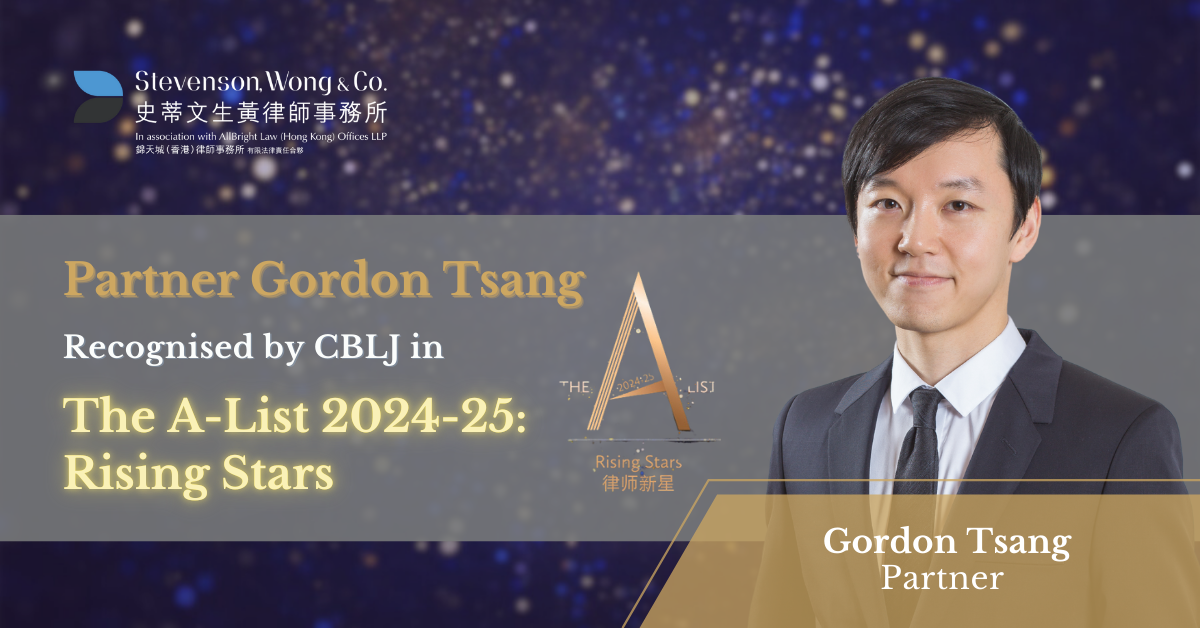
Partner Gordon Tsang Recognized by CBLJ in The A-List 2024-25: Rising Stars
We are delighted to announce that our Partner, Gordon Tsang, has been named a Rising Star in The A-List 2024-25 by China Business Law Journal (CBLJ).
 …
…
The A-List highlights the most highly recommended private practice lawyers across various fields within China’s legal market. Following months of rigorous market research, CBLJ has identified future leaders who are redefining excellence through innovation, reshaping value standards, and bringing new momentum to the legal industry.
We would like to take this opportunity to thank CBLJ for the recognition and express our gratitude to our clients for their continued trust and support.

For more information, please contact our Partner Gordon Tsang, or click here to see the rankings on the CBLJ.
Hong Kong Court Clarifies Principles of Parental Consent in International Child Abduction Dispute
 …
…
The Court of First Instance of the Hong Kong Special Administrative Region recently delivered a judgment in TE v LSY [2024] HKCFI 3652 that sheds light on the complexities surrounding child abduction and custody under the Child Abduction and Custody Ordinance (Cap. 512) (“CACO”) and the Hague Convention on the Civil Aspects of International Child Abduction, 1980 (“the Convention”). Delivered on 23 December 2024, this ruling examines the issue of consent as a ground of objection to the return of the child following the child’s abduction and/or retention.
Mr. Calvin Lo, our partner at Stevenson, Wong & Co, represented the Plaintiff father (“the Father”) in these proceedings.
Case Summary
The proceedings involved a child, GT (“the Child”), who was born in wedlock. The Defendant mother (“the Mother”) took the Child from Italy to Hong Kong in the summer of 2024. It was undisputed that Italy was the habitual residence of the Child and that both parties had custody of the Child in Italy. The only issue was whether there was consent and/or acquiescence.
The Mother contended that the parties reached an agreement during a conversation in June 2024, that she would permanently relocate with the Child to Hong Kong. The Father argued that he only consented to the Mother taking the Child on a summer trip, thus the Mother was wrongfully retaining the Child in Hong Kong when she refused to bring the Child back to Italy.
Legal Principles
The jurisdiction of the Hong Kong Court in child abduction cases is primarily governed by the CACO and the Convention. The key issue in this case was whether the Father had consented to the Child’s relocation or had acquiesced to the Mother’s actions following the removal.
Consent to the removal of the child must be established on the balance of probabilities by clear and cogent evidence: EW v LP [2013] HKCFI 1405; HCMP1605/2011 at para 37. The burden of proving consent rests on the person who asserts it. The inquiry is inevitably fact-specific, and the facts and circumstances vary from case to case. The ultimate question, although influenced by numerous facts, remains straightforward: Had the other parent clearly and unequivocally consented to the removal: Re P-J (Children) [2009] EWCA Civ 588 at para 48.
Key Issues Addressed
- Consent and Acquiescence: The crux of the case hinged on conflicting accounts of conversations on 2 June 2024. The Mother alleged the Father had consented to the permanent relocation of the Child; in contrast, the Father contended his agreement was limited to a temporary visit for the summer. The Court was tasked with evaluating the evidence surrounding this pivotal discussion.
- Evidence of Conduct: The Mother relied on subsequent conduct of the parties, such as her notes of the parties’ conversation and the purchase of single journey tickets to Hong Kong to prove the Father’s consent. Communications between the parties, including the tone of the messages and the parties’ emotional reactions, were also scrutinized to determine if consent was given.
Court’s Decision
The Court ultimately ruled in favour of the Father and found that the evidence was insufficient to establish consent, which must be clear and unequivocal. The judgment detailed the following findings:
- Insufficient Evidence of Consent: The Court determined that the evidence relied on by the Mother was not clear or cogent enough to establish that the Father gave his consent. Some evidence, such as the purchase of single journey tickets and the Father assisting the Mother in packing away of belongings, could be interpreted to suit the case of either party. Some evidence, such as the Mother’s own note of the conversation on 2 June 2024 and the affirmations of her friends, was self-serving, which would be unsafe to put much weight on. The Court therefore found that the Mother could not establish that the Father had given consent, either expressly or by conduct.
- Rejection of Acquiescence Argument: The Mother’s alternative case that the Father had subsequently acquiesced to the relocation also failed based on the same evidence. The Court highlighted that some messages exchanged between the parties, where they showed that the Father was objecting to the Child staying and studying in Hong Kong.
Given the findings, the Court ordered that the Child be returned to Italy at the earliest opportunity, reinforcing the primary objective of the Convention, which is to secure the prompt return of the children, who had been wrongfully removed, to their place of habitual residence.
Conclusion
This case illustrates how the Convention is applied in the Court in Hong Kong and the importance of clear and unequivocal consent in disputes over child relocation and abduction. As cross-border and international marriages and family arrangements become more common, the legal community must remain vigilant about the implications of parental consent in child abduction cases. This judgment also serves as a reminder of the legal principles behind the Convention, and in particular, the need for comprehensive evidence to substantiate claims of consent or acquiescence in abduction cases.
Please contact our Partners Wendy Lam or Calvin Lo for any enquiries or further information.
This news update is for information purposes only. Its content does not constitute legal advice and should not be treated as such. Stevenson, Wong & Co. will not be liable to you in respect of any special, indirect or consequential loss or damage arising from or in connection with any decision made, action or inaction taken in reliance on the information set out herein.
Recent Articles/Events
- USM Countdown: Is Your Company Ready?
- Going Concern Disclaimers: Regulators Signal Greater Scrutiny and Potential Suspension Risk
- Korea FSC Unveils Three-Phase Roadmap for Tokenised Securities
- Hong Kong and Malaysia Launch Single-Submission Framework for Simultaneous Dual IPO Listings
- What Distressed Issuers Must Know in 2026: HKEx’s Refined Suspension Framework
- October 2026
- September 2026
- August 2026
- July 2026
- June 2026
- May 2026
- April 2026
- March 2026
- February 2026
- January 2026
- December 2025
- November 2025
- October 2025
- September 2025
- August 2025
- July 2025
- June 2025
- May 2025
- April 2025
- March 2025
- February 2025
- January 2025
- December 2024
- November 2024
- October 2024
- September 2024
- August 2024
- July 2024
- June 2024
- May 2024
- April 2024
- March 2024
- February 2024
- January 2024
- December 2023
- November 2023
- October 2023
- September 2023
- August 2023
- July 2023
- June 2023
- May 2023
- April 2023
- March 2023
- February 2023
- January 2023
- December 2022
- November 2022
- October 2022
- September 2022
- August 2022
- July 2022
- June 2022
- May 2022
- April 2022
- March 2022
- February 2022
- January 2022
- December 2021
- November 2021
- October 2021
- September 2021
- August 2021
- July 2021
- June 2021
- May 2021
- April 2021
- March 2021
- February 2021
- January 2021
- December 2020
- November 2020
- October 2020
- September 2020
- August 2020
- July 2020
- June 2020
- May 2020
- April 2020
- March 2020
- February 2020
- January 2020
- December 2019
- November 2019
- October 2019
- September 2019
- August 2019
- July 2019
- June 2019
- May 2019
- April 2019
- March 2019
- February 2019
- January 2019
- December 2018
- November 2018
- October 2018
- September 2018
- August 2018
- July 2018
- June 2018
- May 2018
- April 2018
- March 2018
- February 2018
- January 2018
- December 2017
- November 2017
- October 2017
- September 2017
- August 2017
- July 2017
- June 2017
- May 2017
- April 2017
- March 2017
- February 2017
- January 2017
- December 2016
- November 2016
- October 2016
- September 2016
- August 2016
- July 2016
- June 2016
- May 2016
- April 2016
- March 2016
- February 2016
- January 2016
- December 2015
- November 2015
- October 2015
- September 2015
- August 2015
- July 2015
- June 2015
- May 2015
- April 2015
- March 2015
- February 2015
- January 2015
- December 2014
- November 2014
- October 2014
- September 2014
- August 2014
- July 2014