(English)  …
…
HKEX Publishes Consultation Paper on Enhancements to Board Lot Framework
9 January 2026
- Introduction
On 18 December 2025, Hong Kong Exchanges and Clearing Limited (“HKEX” or the “Exchange”) published a consultation paper on proposed enhancements to the board lot framework in the Hong Kong securities market (the “Consultation Paper”). The initiative, mandated by the HKSAR Government’s Task Force on Enhancing Stock Market Liquidity established in August 2023, aims to streamline trading, clearing and settlement processes while expanding investor participation.
The consultation period will run until 12 March 2026. Stakeholders are invited to submit feedback via HKEX’s online questionnaire, with a consultation conclusions paper tentatively (the “Consultation Conclusions”) scheduled for release by the end of the first half of 2026. This update breaks down the core proposals, their strategic rationale, and potential impacts on market participants.
- Background: Hong Kong’s Board Lot Framework
A board lot is the standard number of shares required for a single transaction in the securities market, serving as a cornerstone of orderly trading and operational efficiency. Unlike most major global exchanges that adopt a single unified board lot unit, Hong Kong’s current framework is “issuer-led”, allowing each listed company to determine its own board lot size.
This approach has resulted in significant fragmentation. Currently, 44 distinct board lot units are in use, ranging from 10 shares to 100,000 shares. While 2,000 shares is the most common unit which is used by 25% of issuers, the 100-share unit accounts for the largest share of average daily turnover and market capitalisation.
This fragmentation has created multiple challenges:
(i) Operational inefficiencies: Complexity in trading, clearing and settlement processes;
(ii) Barriers to retail participation: Extremely high board lot values make certain securities
unaffordable for small investors, while low board lot values risk “negative value trades”
where execution costs exceed trade value; and
(iii) Misalignment with global practices: Divergence from international standards complicates
cross-market trading, particularly for Southbound Stock Connect investors familiar with
Mainland China’s unified 100-share board lot.
Additionally, Hong Kong’s market has a higher proportion of low-priced securities (56% of securities traded in the Hong Kong securities market (“Applicable Securities”) trade below HK$1.0) and fixed execution costs, making an immediate shift to a single unified board lot unit impractical due to the risk of widespread negative value trades.
- Key Enhancements in Detail
3.1 Board Lot Value Floor and Ceiling Guidance
To balance accessibility and risk mitigation, HKEX proposes revising existing guidance and introducing a new ceiling:
(i) Reduction of board lot value floor guidance: HKEX proposes decreasing the existing board
lot value floor from HK$2,000 to HK$1,000. This adjustment reduces entry barriers without
increasing negative value trade risks. The floor applies only when issuers list or adjust board
lot units. No action is required if stock price movements push values below HK$1,000.
(ii) Introduction of board lot value ceiling guidance: HKEX proposes to introduce board lot
value ceiling at HK$50,000, applicable only to issuers using units larger than 100 shares. The
ceiling encourages issuers to split units to maintain accessibility.
3.2 Standardisation of board lot units
HKEX proposes reducing the number of permissible board lot units to eight board lot options (i.e., 1, 50, 100, 500, 1,000, 2,000, 5,000, and 10,000 share(s)), covering diverse price bands from HK$0.1 to HK$1,000+ per share. The proposed new board lot framework would result in 657 securities needing to change board lot units, representing approximately 25% of the 2,680 Applicable Securities. The standardised set supports future convergence to a single unit by encouraging gradual adoption of smaller units.
3.3 Phased Implementation Aligned with the Uncertificated Securities Market (“USM”)
To minimise market disruption, the framework will be rolled out in two phases, coordinated with HKEX’s USM initiative which replaces physical share certificates with electronic records:
Phase One:
(i) New issuers: Must adopt the eight standardised units and comply with the HK$1,000
floor/HK$50,000 ceiling upon listing.
(ii) Existing issuers: No immediate unit standardisation required. Only need to adhere to the
HK$1,000 floor/HK$50,000 ceiling guidelines.
Phase Two: Existing issuers must adopt one of the standardised units within a specified period after transitioning to USM. This aims at avoiding reprint physical share certificates and optimising issuer resources.
A detailed implementation timeline may be included in the Consultation Conclusions Paper.
- Strategic Implications for Market Participants
The proposed enhancements will have distinct impacts on key market stakeholders:
Approximately 25% of listed issuers will need to revise their board lot units to one of the eight standardised options. In the long term, these reforms will reduce operational complexity and better align with the needs of global and international investors—particularly for “A+H share” issuers seeking consistency across Mainland China and Hong Kong markets. Issuers must continuously monitor their board lot values to ensure compliance with the HK$50,000 ceiling applicable to units exceeding 100 shares.
Investors will benefit from lower entry barriers, expanding access to high-quality securities, reducing concentration risk, and enabling portfolio diversification. Institutional investors will find trading, hedging and settlement processes simplified by standardised units, lowering operational costs and the risk of errors.
Fewer board lot units significantly enhance the operational efficiency of brokers and intermediaries by streamlining system configurations, order entry, and client onboarding processes. Reduced odd lot creation and clearer value guidelines help mitigate operational and settlement risks, strengthening risk management. Additionally, standardised board lots simplify the management of associated products, whose terms are often linked to the underlying securities’ board lot units, eliminating the need for complex adjustments.
- Conclusion
The consultation period runs until 12 March 2026, and all interested parties—including issuers, brokers, institutional and retail investors, legal and compliance professionals, and investor advocacy groups—are strongly encouraged to submit feedback via the Exchange’s online questionnaire.
Given the transformative nature of these proposals, stakeholders are urged to:
(i) review the Consultation Paper in full (available on HKEX’s website);
(ii) provide detailed, data-driven feedback by 12 March 2026 to shape the final rules; and
(iii) prepare for phased implementation, particularly aligning systems and processes with USM
transition timelines.
The success of this reform will depend on balancing operational efficiency, investor accessibility and issuer flexibility, ensuring Hong Kong’s securities market remains dynamic, inclusive and aligned with global best practices.
Please contact our Partner Mr. Rodney Teoh for any enquiries or further information.
This news update is for information purposes only. Its content does not constitute legal advice and should not be treated as such. Stevenson, Wong & Co. will not be liable to you in respect of any special, indirect or consequential loss or damage arising from or in connection with any decision made, action or inaction taken in reliance on the information set out herein.
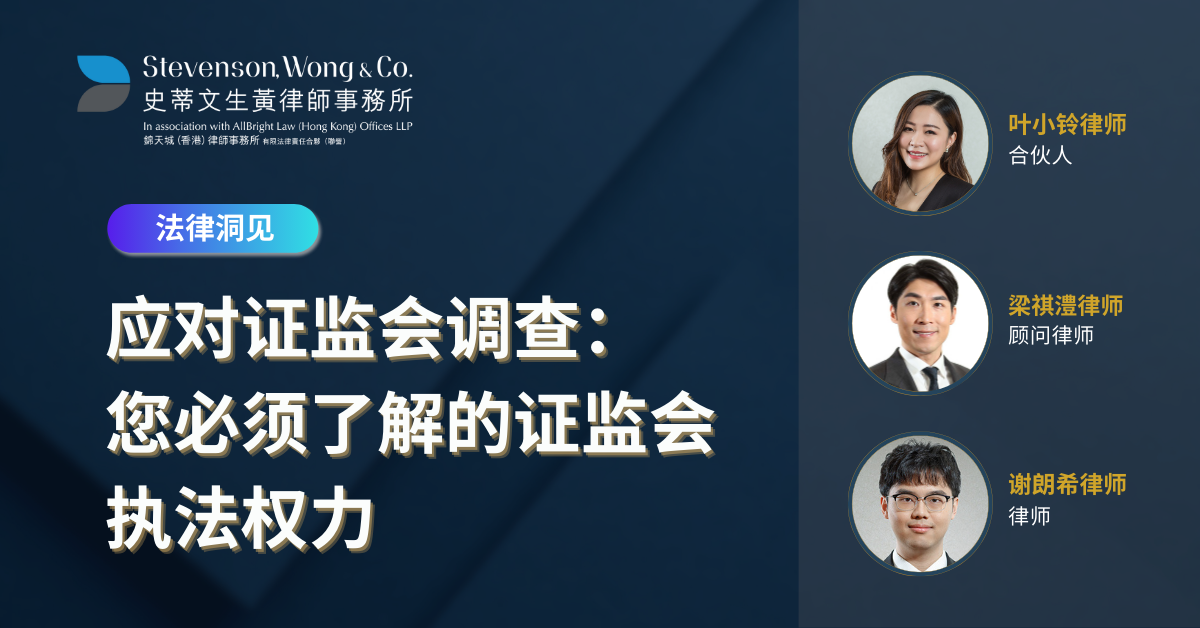
应对证监会调查:您必须了解的证监会执法权力
 …
…
在香港金融市场瞬息万变的环境中,证券及期货事务监察委员会(“证监会”)担当主要的监管角色。对于市场参与者,包括持牌法团、董事和投资经理而言,了解证监会的权力不仅是一项合规工作,更是风险管理的关键一环。对于一般大众而言,了解当收到证监会的查询或要求时可能涉及的法律责任和后果,对于保障自身的法律权益同样至关重要。
2025年下半年的执法趋势和法院判决传达了一个明确的信息:证监会拥有广泛的调查权力,对违规行为几乎零容忍,并且会毫不犹豫地动用其执法工具。
第183条:调查权力
证监会权力的基石在于《证券及期货条例》(香港法例第571章)第183条。该条文授权证监会在根据《证券及期货条例》第182条进行调查时,强迫任何人——不仅仅是受调查对象——提供资料。
与警方调查中您享有的缄默权不同,《证券及期货条例》在很大程度上废除了这项权利。如果您收到第183条通知,您在法律上有义务:
- 提供记录和文件;
- 就这些文件提供书面解释;及
- 出席会见以回答问题。
关键在于,您不能以“免使自己入罪”为由拒绝回答。虽然您可以主张特权以防止您的回答在刑事诉讼中被用作针对您的证据,但这些回答仍可用于民事或纪律处分程序,或引导调查人员寻找其他可接纳的证据。
保密的陷阱
受调查人士面临的一个常见陷阱是第378条的保密条文。一旦收到通知,您实际上即受到严格的法定“封口令”约束。未经证监会明确同意,您不得向任何人(包括您的同事、配偶或雇主)披露调查的存在或通知本身。
唯一的主要例外是向您的律师披露调查事宜以寻求法律意见。违反此保密规定本身即属刑事罪行,即使与相关的不当行为无关,您也可能因此面临独立的检控。
近期判例:不合规无借口
高等法院于2025年10月就SFC v. oOo Securities (HK) Group Limited [2025] HKCFI 4584 一案作出的判决,赤裸裸地提醒我们忽视这些义务的后果。
在该案中,一家持牌法团未能遵守第183条通知,理由是管理层变动及在搬迁至北京期间遗失记录。法院驳回了这些抗辩理由,并裁定:
- 所有权或管理层的变动并不能免除法团的监管责任。新所有者必须进行尽职调查并确保合规。
- 遗失记录并非充分的理由(特别是如果遗失发生在提交期限之后),除非能提供具体证据加以证实。
法院命令该行必须合规,并裁定其需承担罚款责任。这证实了证监会将利用第185条寻求法院命令,并惩处那些轻视监管通知的人士。
多重执法机制
一旦调查结束,证监会的“武器库”中有多种选择可供其进一步追究违规者的责任。证监会实行双重机制,可视乎案件的严重程度,通过民事、刑事或纪律处分途径处理失当行为。
- 纪律处分程序(《证券及期货条例》第IX部): 针对持牌人士最常用的工具。制裁范围包括公开谴责和罚款(最高可达1,000万港元或获取利润金额的3倍,以较高者为准),甚至撤销牌照。
- 市场失当行为审裁处(MMT): 处理内幕交易和操纵价格等市场失当行为案件的独立讯问机构。它可以施加各种命令,例如冷淡对待令(禁止买卖)和取消资格令(针对董事),但不能施加监禁等刑事制裁。
- 刑事检控: 对于严重罪行,证监会可进行简易程序检控,或(对于更复杂的案件)将案件转介律政司进行公诉程序检控,此途径经常会寻求判处监禁刑期。
- 民事补救(如根据《证券及期货条例》第213条和第214条提出的申请): 越来越多地用于申请强制令、冻结资产或寻求回复原状命令以向遭受损失的投资者进行赔偿。
加强对资产管理人的审查
证监会也加强了对资产管理行业的关注。继2024年10月发出一份通函后,证监会一直在严格视察私人基金管理人的“不达标情况”,特别是关于利益冲突和风险管理方面。
已发现的常见缺失包括利用基金资产为相关实体提供融资、在处理赎回时优先处理员工而非客户,以及采取不恰当的估值方法以掩饰投资亏损。核心职能主管及负责人员应意识到,他们需对这些失误承担主要责任。
结语
遵守《证券及期货条例》是必须的。正如 oOo Securities 案所示,内部行政障碍或人员变动并非违反法定义务的抗辩理由。
如果您或您的公司收到第183条通知或受到视察,立即寻求法律意见才可把握合作、特权和保密之间微妙的平衡。
史蒂文生黄律师事务所的监管及合规团队拥有丰富的经验,曾为众多上市公司、持牌法团及个人就证监会调查、纪律处分程序及合规策略提供法律咨询。我们可以协助您:
- 回应第183条通知及出席证监会会见;
- 进行内部调查及内部监控“健康检查”;及
- 就证监会发起的任何市场失当行为审裁处(MMT)或法庭程序提供法律意见及代表您出庭。
如欲讨论我们如何为您提供协助,请联系本所合伙人叶小铃律师、梁祺澧顾问律师或谢朗希律师。
本文仅供参考。其内容不构成亦不应视为法律咨询意见。史蒂文生黄律师事务所不会就任何因倚赖本处所载资料而作出的决定丶采取的行动或不采取的行动所引致的或与之有关的任何特别丶间接或相应而生的损失或损害向阁下承担法律责任。
最近文章/活动
- 2026 年 10 月
- 2026 年 9 月
- 2026 年 8 月
- 2026 年 7 月
- 2026 年 6 月
- 2026 年 5 月
- 2026 年 4 月
- 2026 年 3 月
- 2026 年 2 月
- 2026 年 1 月
- 2025 年 12 月
- 2025 年 11 月
- 2025 年 10 月
- 2025 年 9 月
- 2025 年 8 月
- 2025 年 7 月
- 2025 年 6 月
- 2025 年 5 月
- 2025 年 4 月
- 2025 年 3 月
- 2025 年 2 月
- 2025 年 1 月
- 2024 年 12 月
- 2024 年 11 月
- 2024 年 10 月
- 2024 年 9 月
- 2024 年 8 月
- 2024 年 7 月
- 2024 年 6 月
- 2024 年 5 月
- 2024 年 4 月
- 2024 年 3 月
- 2024 年 2 月
- 2024 年 1 月
- 2023 年 12 月
- 2023 年 11 月
- 2023 年 10 月
- 2023 年 9 月
- 2023 年 8 月
- 2023 年 7 月
- 2023 年 6 月
- 2023 年 5 月
- 2023 年 4 月
- 2023 年 3 月
- 2023 年 2 月
- 2023 年 1 月
- 2022 年 12 月
- 2022 年 11 月
- 2022 年 10 月
- 2022 年 9 月
- 2022 年 8 月
- 2022 年 7 月
- 2022 年 6 月
- 2022 年 5 月
- 2022 年 4 月
- 2022 年 3 月
- 2022 年 2 月
- 2022 年 1 月
- 2021 年 12 月
- 2021 年 11 月
- 2021 年 10 月
- 2021 年 9 月
- 2021 年 8 月
- 2021 年 7 月
- 2021 年 6 月
- 2021 年 5 月
- 2021 年 4 月
- 2021 年 3 月
- 2021 年 2 月
- 2021 年 1 月
- 2020 年 12 月
- 2020 年 11 月
- 2020 年 10 月
- 2020 年 9 月
- 2020 年 8 月
- 2020 年 7 月
- 2020 年 6 月
- 2020 年 5 月
- 2020 年 4 月
- 2020 年 3 月
- 2020 年 2 月
- 2020 年 1 月
- 2019 年 12 月
- 2019 年 11 月
- 2019 年 10 月
- 2019 年 9 月
- 2019 年 8 月
- 2019 年 7 月
- 2019 年 6 月
- 2019 年 5 月
- 2019 年 4 月
- 2019 年 3 月
- 2019 年 2 月
- 2019 年 1 月
- 2018 年 12 月
- 2018 年 11 月
- 2018 年 10 月
- 2018 年 9 月
- 2018 年 8 月
- 2018 年 7 月
- 2018 年 6 月
- 2018 年 5 月
- 2018 年 4 月
- 2018 年 3 月
- 2018 年 2 月
- 2018 年 1 月
- 2017 年 12 月
- 2017 年 11 月
- 2017 年 10 月
- 2017 年 9 月
- 2017 年 8 月
- 2017 年 7 月
- 2017 年 6 月
- 2017 年 5 月
- 2017 年 4 月
- 2017 年 3 月
- 2017 年 2 月
- 2017 年 1 月
- 2016 年 12 月
- 2016 年 11 月
- 2016 年 10 月
- 2016 年 9 月
- 2016 年 8 月
- 2016 年 7 月
- 2016 年 6 月
- 2016 年 5 月
- 2016 年 4 月
- 2016 年 3 月
- 2016 年 2 月
- 2016 年 1 月
- 2015 年 12 月
- 2015 年 11 月
- 2015 年 10 月
- 2015 年 9 月
- 2015 年 8 月
- 2015 年 7 月
- 2015 年 6 月
- 2015 年 5 月
- 2015 年 4 月
- 2015 年 3 月
- 2015 年 2 月
- 2015 年 1 月
- 2014 年 12 月
- 2014 年 11 月
- 2014 年 10 月
- 2014 年 9 月
- 2014 年 8 月
- 2014 年 7 月