 …
…
Institutional Upgrade for the “First Mile” of Cross-Border Litigation: New
Arrangement on Service of Judicial Documents in Civil and Commercial Matters
between the Mainland and Hong Kong
On 20 April 2026, the Supreme People’s Court of the People’s Republic of China and the Government of the Hong Kong Special Administrative Region signed the Arrangement on Mutual Service of Judicial Documents in Civil and Commercial Proceedings between the Mainland and the Hong Kong Special Administrative Region (the “New Arrangement”) in Beijing. The New Arrangement addresses a fundamental step in cross-border civil and commercial litigation that often determines whether a case can proceed: the effective service of judicial documents on parties located in the other jurisdiction.
- Major Practical Significance of the New Arrangement
In cross-border litigation, the valid service of judicial documents directly affects whether proceedings can commence, whether procedures are valid, whether a case can proceed, and whether subsequent judgments can be enforced. The New Arrangement will substantially improve the channels and methods for Hong Kong parties to serve judicial documents on addressees in the Mainland.
As background, the 1999 Arrangement for Mutual Service of Judicial Documents in Civil and Commercial Proceedings between the Mainland and Hong Kong Courts (the “Old Arrangement”) has been in force for more than two decades. Over this period, the number of cross-border cases between the two jurisdictions has risen markedly. As the Secretary for Justice of Hong Kong informed the Legislative Council on 27 April 2026, applications for mutual service of judicial documents increased from 359 in 1999 to 2,388 in 2024.
Under the Old Arrangement, Hong Kong judicial documents could only be served in the Mainland through entrusted service, giving rise to practical problems such as inaccurate service addresses, multiple layers of entrustment, and lengthy delays. A typical pain point was that even when a seemingly valid address was known, it could not be used in the entrusted procedure due to misalignment between entrusted documents, address details, and service rules, undermining litigation efficiency.
The New Arrangement therefore comprehensively upgrades the Old Arrangement to tackle these pain points. Its core objectives are to diversify service methods, shorten service pathways, raise success rates of service, and maintain judicial supervision and procedural safeguards for addressees while improving efficiency.
- The New Arrangement Adds Diverse Service Channels Beyond Entrusted Service
- The Old Arrangement Provided Only Entrusted Service
For service of Hong Kong judicial documents in the Mainland, the Old Arrangement offered only a single channel: entrusted service, which had clear limitations in efficiency and flexibility.
The New Arrangement retains entrusted service. In addition to the existing mechanism where higher people’s courts of the Mainland and the High Court of Hong Kong may mutually entrust service, and the Supreme People’s Court may directly entrust the High Court of Hong Kong, it adds a mechanism under which the Supreme People’s Court may authorize certain intermediate and primary people’s courts to mutually entrust service with the High Court of Hong Kong.
This means some cases will no longer need to be escalated to higher people’s courts before transmission to Hong Kong courts, shortening the procedural chain. For numerous contract, corporate, financial, and trade disputes heard by primary or intermediate people’s courts in the Mainland, service requests can connect more directly with Hong Kong courts once the relevant courts are authorized, reducing transmission time and information loss.
- The New Arrangement Establishes Diverse Service Methods
The New Arrangement keeps entrusted service and explicitly permits postal service, electronic service, and service by authorized entities as mutually recognized methods. If multiple methods are used simultaneously, service is deemed completed on the earliest effective date. These methods align better with commercial practice where legally required and court-approved.
(1) Postal Service
Article 13 provides that when a Mainland people’s court serves judicial documents on a Hong Kong addressee by post, it shall attach an acknowledgment of service. When a Hong Kong court serves documents on a Mainland addressee by post, it shall provide an original sealed judicial document and an acknowledgment or other proof for the addressee’s signature. Service is deemed complete on the date of signature on the proof; signature on the postal receipt without signing the proof also constitutes valid service.
Postal service becomes a formal cross-border channel with clear proof and timing rules, offering low cost, direct operation, and predictable timing—especially suitable for cases with confirmed addresses and low risk of evasion of service.
(2) Electronic Service
Article 14 allows electronic service via verifiable means where the addressee expressly consents, voluntarily provides an electronic address for service, or accepts service by responding or participating in proceedings. Eligible media include fax, email, mobile communication, and other instant-receipt systems. This is critical for cross-border commercial entities relying on digital communication, shifting the focus from physical delivery to verifiable receipt.
(3) Service by Authorized Entities
Article 15 states that a Mainland people’s court may, upon review, allow a party to arrange service via a Hong Kong law firm or registered foreign law firm if not prohibited by law. Conversely, Hong Kong parties may serve Mainland addressees through Mainland law firms or notary public institutions. Local legal and notary professionals are familiar with address verification, service documentation, and evidence preservation, boosting success rates and procedural compliance.
(4) Service by Public Notice
Article 17 permits service by public notice if other methods fail. Mainland courts shall publish notices on influential online platforms in both jurisdictions; Hong Kong courts may entrust Mainland courts to assist with public notice service in the Mainland when necessary. Service is deemed complete 60 days after publication, providing a fallback for missing or evasive addressees and preventing cases from stalling.
In sum, parties may design a tailored service strategy combining postal, electronic, authorized-entity, and other methods under the New Arrangement.
III. Practical Implications of the New Arrangement
- Preserve the counterparty’s physical address, electronic address, corporate registration details, and actual operating address before initiating cross-border disputes.
- Include clear service clauses in contracts: specify email, contact address, representative, confirmation methods, and notification obligations for address changes.
- Plaintiffs should select optimal channels early: use postal or electronic service for clear addresses and cooperative parties; engage lawyers or notaries for high-evasion cases, or preserve evidence for potential public notice.
- Defendants should recognize that refusal, delay, or evasion may not halt proceedings; verifiable receipt can still constitute valid service.
Notably, the New Arrangement has been signed but not yet entered into force. It will take effect following the issuance of relevant judicial interpretations by the Supreme People’s Court and completion of local legislative amendments in Hong Kong, with the effective date to be jointly announced. The Old Arrangement remains applicable in the interim.
Conclusion
The New Arrangement is a major procedural upgrade to cross-border judicial assistance between the Mainland and Hong Kong. It does not alter substantive laws or directly govern recognition and enforcement of judgments, but resolves the core bottleneck of difficulty in service—the most common and delay-prone step in cross-border litigation.
For enterprises and high-net-worth individuals, the revised service regime may accelerate cross-border litigation timelines and narrow procedural defenses, elevating the importance of evidence documentation and compliance. Once in force, parties should integrate service strategy into overall litigation planning at an early stage, rather than reacting passively after proceedings start. Parties in Hong Kong seeking to serve Mainland addressees may combine multiple service methods to improve success and gain procedural advantage.
This article was co-authored by Partner and Head of Litigation and Dispute Resolution, Heidi Chui, Cross-border Practice Director, Stephen Wong, Associate Victor Zhang. For further inquiries or more details, please contact our Heidi Chui.
This news update is for information purposes only. Its content does not constitute legal advice and should not be treated as such. Stevenson, Wong & Co. will not be liable to you in respect of any special, indirect or consequential loss or damage arising from or in connection with any decision made, action or inaction taken in reliance on the information set out herein.
The Hong Kong Fintech Promotion Blueprint – The Acceleration of Adopting Emerging Financial Technologies
 …
…
News Update:
The Hong Kong Fintech Promotion Blueprint – The Acceleration of Adopting Emerging Financial Technologies
28 April 2026
Introduction
The Hong Kong Monetary Authority (“HKMA”) has released a comprehensive Fintech Promotion Blueprint in February 2026 setting out concrete measures to push Hong Kong’s banking sector from broad, basic use of digital tools into deeply embedded, sophisticated financial technology across core operations.
From “All Banks Go Fintech” to Advanced Adoption
The Blueprint builds on the HKMA’s “Fintech 2030” strategy and the earlier Fintech Promotion Roadmap, which helped banks digitise front‑to‑back operations under the “All Banks Go Fintech” initiative. Comparing data from 2022 to 2025, 95% of surveyed banks – including all retail banks – had adopted fintech for end‑to‑end digitalisation, with particularly high uptake in Regtech (from 83% to 97%), Insurtech (28% to 57%), Greentech (26% to 45%) and Wealthtech (43% to 52%). Banks are also increasing investment: 36% have allocated more than 30% of their technology budgets to fintech, 95% have planned to maintain or increase these levels over the next three years, and half have expected budget growth of 10 – 20%.
Yet the HKMA notes that most institutions still deploy fintech as standalone tools which neither fundamentally re‑engineer processes nor integrate into core operating models, thereby limiting return on investment and slowing more ambitious adoption. The new Blueprint therefore shifts the emphasis from breadth to depth, aiming to move the industry towards “Advanced” maturity, where fintech is embedded in day‑to‑day operations and delivers tangible business value.
Five Pillars: A.I., DLT, HPC, Data and Cyber
The Blueprint is structured around five priority enablers and foundations: Artificial Intelligence (“A.I.”), Distributed Ledger Technology (“DLT”), High‑Performance Computing (“HPC”), Data Excellence, and Cyber Resilience.
Artificial Intelligence
Hong Kong’s financial sector is entering a new phase of A.I., progressing from traditional models used for fraud detection and credit scoring towards Generative A.I. (“GenA.I.”) and agentic A.I. GenA.I. is already powering applications such as anti‑money laundering systems that analyse transaction narratives and communications, and conversational agents that autonomously handle customer queries, supported by the HKMA’s GenA.I. Sandbox. Agentic A.I., emerging since 2025, enables autonomous monitoring, decision‑making and execution, for example real‑time fraud prevention that can freeze accounts or multi‑agent loan approval processes that coordinate risk assessment, identity verification and disbursement.
However, institutions report significant barriers: limited revenue‑generating use cases, concerns around accuracy and “hallucinations” (plausible yet factually incorrect outputs), integration with fragmented legacy systems, decentralised data, and acute talent shortages that combine technical, regulatory and business skills. Smaller banks lag behind their larger peers in adoption, with only 63% of small firms using A.I. compared with 83% of large firms. The Blueprint prioritises industry‑wide knowledge exchange, targeted upskilling, expanded sandbox use and shared infrastructure to enable safe, scalable and impactful A.I. adoption.
Distributed Ledger Technology
DLT is framed as a driver of tokenisation and next‑generation payments by providing shared, synchronised ledgers that support faster, more secure transactions and asset tokenisation. The Blueprint cites live examples including the HKSAR Government’s tokenised Green Bonds and the HKMA’s e‑HKD+ initiative, as well as Project Ensemble, a sandbox for cross‑boundary settlement in tokenised deposits, and the Supervisory Incubator for DLT.
Despite this progress, banks face heavy integration costs with legacy systems, interoperability and scalability constraints, smart‑contract and private‑key risks, difficulties in reversing fraudulent immutable transactions, and regulatory uncertainty over digital asset classification and smart‑contract enforceability. The HKMA therefore sets promotion priorities around sharing concrete integration strategies and commercially successful use cases, building production‑level skills (especially in smart contracts), and working towards clearer standards on asset classification, security baselines and preferred network architectures to support scalable and interoperable deployments.
High‑Performance Computing
HPC – including supercomputing and quantum computing – is positioned as critical infrastructure for advanced modelling, A.I. and risk analytics. Supercomputers can already support intensive risk simulations, portfolio stress‑testing and quantitative trading strategy optimisation, while also providing compute for GenA.I. workloads, for example via Cyberport’s A.I. Supercomputing Centre. Quantum computing is highlighted for its potential in portfolio optimisation, scenario analysis, product pricing and fraud detection, but also for the threat it poses to current cryptography.
Adoption is hampered by high cost, lack of supporting infrastructure, energy and cooling demands, and specialised talent gaps, with some smaller banks not exploring HPC at all. The Blueprint therefore calls for shared supercomputing facilities, broader literacy on supercomputing and quantum concepts, and early integration of post‑quantum cryptography (“PQC”) to address “harvest now, decrypt later” risks.
Data Excellence
Data Excellence is identified as a core foundation for A.I., DLT and advanced risk management, but many banks struggle with incomplete and inconsistent datasets locked in fragmented legacy systems. Batch‑oriented mainframes, non‑standard formats and isolated repositories prevent unified customer views, real‑time monitoring and high‑quality model training, while growing volumes of unstructured and cross‑border data add complexity.
The Blueprint calls for structured programmes to share best practices in managing structured and unstructured data, governance frameworks for internal and external data use, and sector‑wide standards on interoperability, formats and validation to improve availability, quality and sharing of risk data.
Cyber Resilience
As advanced fintech deployments demand large, granular datasets, cyber and privacy risks intensify. The Blueprint highlights adversarial A.I. attacks (such as poisoned training data, prompt‑injection, and deepfakes), smart‑contract bugs and oracle manipulation in DLT, and quantum‑enabled cryptographic threats, compounded by multi‑layered third‑party supply chains in cloud, data and platform services. HKMA’s priorities include stronger governance of third‑party risks, sector‑wide sharing of threat intelligence and defensive practices, and definition of baseline expectations for cyber standards in advanced fintech solutions.
Market Landscape: Adoption Progress and Pain Points
The Blueprint describes a rich fintech ecosystem in Hong Kong comprising fintech firms, financial institutions, regulators, investors, industry associations, academia and the public, all connected through platforms such as Fintech Connect, the FiNETech event series, the Commercial Data Interchange (“CDI”), GenA.I. Sandbox and the Supervisory Incubator for DLT. Government grants, the Digital Bond Grant Scheme, and Cyberport and HKSTP incubation programmes further de‑risk adoption and support solution development.
Despite this, the Tech Maturity Stock‑take identifies persistent barriers: 75% of banks cite high implementation costs, 73% highlight risks associated with new technologies, 71% struggle with integration into existing systems, 61% worry about data privacy and cybersecurity, and 59% report regulatory uncertainty and talent shortages. These challenges, especially for smaller institutions, reinforce the need for tactical and coordinated measures – the core focus of the new Blueprint.
Key Priorities: From Use Cases to Standards
Drawing on its research and engagement, the HKMA distils five priority directions that underpin the Blueprint’s design:
- For A.I., the priority is to move beyond internal pilots to advanced, customer‑facing use cases with measurable ROI, supported by proven case studies and connections to credible solution providers;
- For DLT, the focus is on embedding tokenisation, real‑time transactions and cross‑boundary settlements into business models, underpinned by clear standards for interoperability, asset classification and smart‑contract enforceability;
- For HPC, the Blueprint emphasises literacy, targeted education and clear integration pathways to prepare institutions for the post‑quantum era;
- For Data Excellence, the focus is to develop industry‑wide standards and guidance on managing diverse datasets and integrating external data sources for analytics, fraud prevention and risk modelling; and
- For Cyber Resilience, priorities include better governance of technology‑specific risks, especially third‑party risks, and collaborative programmes for sharing cyber risk intelligence and defensive practices.
These priorities feed into a Blueprint architecture with three strategic dimensions – (1) Ecosystem Collaboration, (2) Technological Advancement and (3) Talent & Outreach – each populated with concrete initiatives.
Blueprint Design 1: Ecosystem Collaboration
Beyond the flagship projects, the Blueprint sets out a series of ecosystem initiatives designed to increase connectivity and reduce search and coordination costs in the market:
- Fintech Cybersecurity Baseline: To streamline banks’ due diligence when onboarding fintech partners, HKMA will develop a standardised, industry‑led Fintech Cybersecurity Baseline for solution providers. This will define clear expectations on technological capabilities, operational readiness and security controls – with emphasis on emerging risks in A.I. and DLT – supported by guidance materials so providers can align their products. The baseline is designed to reduce misinterpretation of regulatory requirements, strengthen trust between banks and fintech firms, and lift cyber resilience across the ecosystem.
- Events and FiNETech: The HKMA will continue and expand conferences, FiNETech events and satellite activities to promote knowledge sharing on A.I., DLT, HPC, Data Excellence and Cyber Resilience, while showcasing global innovation and promoting Hong Kong as a leading international fintech hub;
- Hong Kong A.I. Fintech Map: A new publicly accessible directory will map A.I. and GenA.I. firms active in financial services, detailing their capabilities and use cases and integrating with Fintech Connect to make solution discovery more efficient; and
- Revamped Fintech Connect: The cross‑sectoral sourcing platform launched in 2024 will be enhanced with richer profiles of fintech providers and potential A.I.‑driven matching functionality, enabling banks to articulate problems and receive tailored solution recommendations. The HKMA will also explore linking platform registration to event participation to deepen engagement.
These measures are designed to transform current bilateral engagements into a more structured, data‑rich collaboration fabric that helps banks find credible partners and scale proven solutions more quickly.
Blueprint Design 2: Technological Advancement
Under the Technological Advancement dimension, the HKMA will deploy multiple content‑based and engagement‑based tools that translate complex technologies into implementable blueprints for banks:
- Quantum Preparedness Index: To help the sector prepare for quantum disruption, the HKMA will launch a Quantum Preparedness Index, starting with a baseline assessment of banks’ strategic awareness and operational readiness regarding quantum computing and PQC. This assessment will inform a “target index” and a transition roadmap, outlining concrete PQC and quantum computing projects and pilots to systematically raise quantum readiness, especially among small and medium‑sized banks.
- New Risk Data Strategy: Recognising that high‑quality risk data is essential to unlock the potential of A.I., DLT and HPC, the HKMA proposes a New Risk Data Strategy to foster collaboration, collect feedback and share best practices in data management. The strategy aims to enhance data infrastructure, enable smarter risk management and proactive insights, and broaden the scope of the HKMA’s Granular Data Reporting to cover more supervisory data, ultimately building a collaborative risk‑data ecosystem between banks, service providers and the HKMA.
- Publications: Building on prior guides and research, new in‑depth publications will cover A.I., DLT, HPC, Data Excellence and Cyber Resilience, drawing on surveys, interviews and case studies to highlight real‑world applications, risk management considerations and integration strategies;
- Industry Showcase Workshops: Hands‑on workshops will feature local experts and fintech firms demonstrating emerging technologies such as agentic A.I., tokenised assets and quantum computing, with follow‑up resources to support implementation and collaboration; and
- Digital Content: The HKMA will produce podcasts and video spotlights featuring expert discussions and case studies on topics such as A.I. bias mitigation, DLT–legacy interoperability and HPC’s impact on analytics and decision‑making.
These initiatives aim to turn abstract innovation narratives into practical, repeatable models that banks can adapt and deploy in their own environments.
Blueprint Design 3: Talent and Outreach
To ensure human capital keeps pace with the technology push, the Blueprint extends the HKMA’s talent and outreach agenda:
- Competency Development Support: To close A.I. and DLT skills gaps, the HKMA will explore the competency needs of fintech users in banks and develop practical tools that complement existing frameworks such as the Hong Kong Institute of Bankers’ Enhanced Competency Framework (“ECF”) – Fintech. With a strong focus on “human–machine interaction”, this initiative will support continuous learning via modular training resources, peer‑sharing platforms and skill‑progression guidance, building a more resilient, adaptable workforce ready to implement advanced fintech safely and effectively;
- Training Programme: Building on positive feedback from “All Banks Go Fintech”, the HKMA will roll out training modules across A.I., DLT, HPC, Data Excellence and Cyber Resilience, with a heavy emphasis on hands‑on exercises and real‑world scenarios, delivered via the Fintech Knowledge Hub;
- Competitions: New innovation competitions will focus on advanced use cases of GenA.I. and DLT, following the successful Green Fintech competitions of 2023 and 2025. They will encourage responsible innovation, attract global participation and help banks connect with leading solution providers; and
- Knowledge Repositories: A specialised repository within the Fintech Knowledge Hub will host technical artefacts such as GenA.I. prompt references and DLT smart‑contract designs tailored for finance, populated in collaboration with industry contributors.
These measures are intended to progressively raise the baseline of technical and practical competence across the industry, enabling institutions to adopt and govern sophisticated fintech safely.
Measuring Impact and Next Steps
To ensure the Blueprint translates into concrete results, the HKMA will monitor progress at both initiative and programme levels. Initiative‑level metrics will track engagement and behavioural changes, while programme‑level assessment will evaluate systemic progress across Ecosystem Collaboration, Technological Advancement and Talent & Outreach, allowing the HKMA to recalibrate actions as market conditions evolve.
The HKMA will kick off implementation with a FiNETech event on Data Excellence in the second quarter of 2026 and will continue to refine the initiatives through active engagement with banks, technology firms and other regulators. Ultimately, the Blueprint positions Hong Kong to move from foundational fintech adoption to strategic technological leadership, using targeted, tactical measures to accelerate the uptake of advanced, responsible financial technology across its financial industry.
Please contact our Partner Mr. Rodney Teoh for any enquiries or further information.
This news update is for information purposes only. Its content does not constitute legal advice and should not be treated as such. Stevenson, Wong & Co. will not be liable to you in respect of any special, indirect or consequential loss or damage arising from or in connection with any decision made, action or inaction taken in reliance on the information set out herein.
Stevenson, Wong & Co. Strengthens Partnership with the Promotion of Kenneth Leung
 …
…
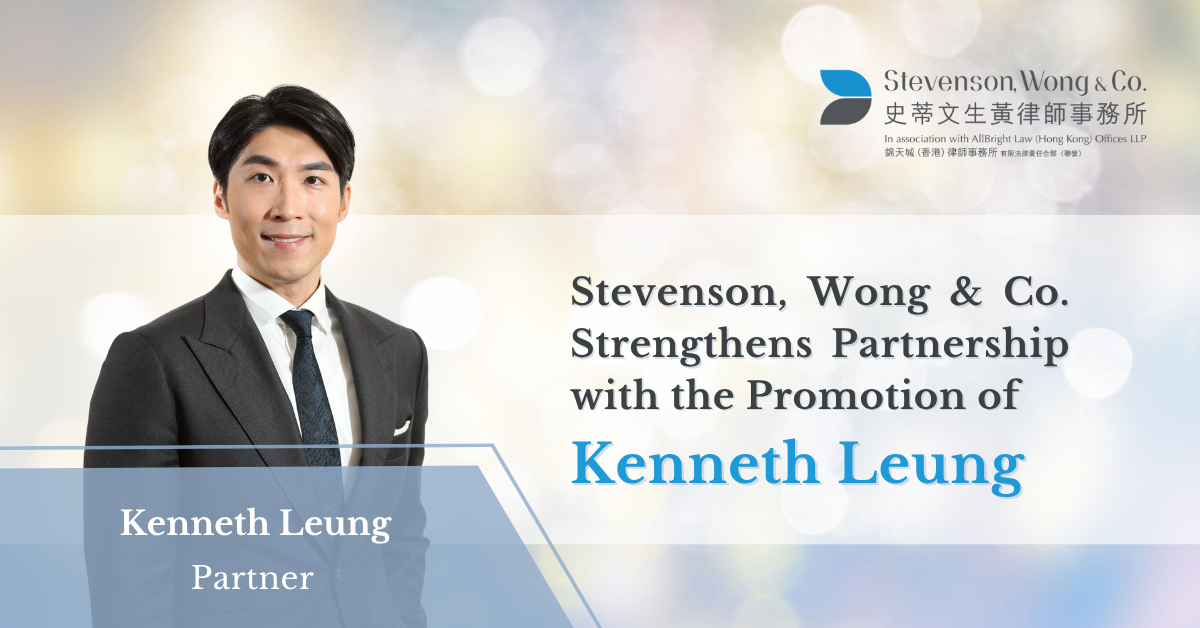
We are delighted to announce the promotion of Kenneth Leung to the Partnership, a move that significantly strengthens our firm’s senior capabilities in financial regulation and dispute resolution.
Mr. Leung is a Hong Kong-qualified solicitor with over a decade of experience at the forefront of the region’s most complex legal challenges. His practice is defined by a sophisticated mastery of corporate and securities laws, where he seamlessly bridges the gap between contentious regulatory enforcement and high-stakes commercial litigation.
Renowned for his strategic precision, Mr. Leung regularly advises on matters involving fiduciary duties and civil fraud, providing robust advocacy in proceedings before the SFC, HKEX, and the High Court. He serves as a pivotal advisor to listed companies and licensed corporations, navigating the intricate regulatory landscapes and shareholder disputes that define the Hong Kong market.
The promotion of Mr. Leung will strengthen our firm’s capacity to deliver exceptional legal services to our clients amidst Hong Kong’s evolving regulatory landscape. His elevation underscores our commitment to excellence and ensures we remain at the forefront of the legal sector.
Recent Articles/Events
- USM Countdown: Is Your Company Ready?
- Going Concern Disclaimers: Regulators Signal Greater Scrutiny and Potential Suspension Risk
- Korea FSC Unveils Three-Phase Roadmap for Tokenised Securities
- Hong Kong and Malaysia Launch Single-Submission Framework for Simultaneous Dual IPO Listings
- What Distressed Issuers Must Know in 2026: HKEx’s Refined Suspension Framework
- October 2026
- September 2026
- August 2026
- July 2026
- June 2026
- May 2026
- April 2026
- March 2026
- February 2026
- January 2026
- December 2025
- November 2025
- October 2025
- September 2025
- August 2025
- July 2025
- June 2025
- May 2025
- April 2025
- March 2025
- February 2025
- January 2025
- December 2024
- November 2024
- October 2024
- September 2024
- August 2024
- July 2024
- June 2024
- May 2024
- April 2024
- March 2024
- February 2024
- January 2024
- December 2023
- November 2023
- October 2023
- September 2023
- August 2023
- July 2023
- June 2023
- May 2023
- April 2023
- March 2023
- February 2023
- January 2023
- December 2022
- November 2022
- October 2022
- September 2022
- August 2022
- July 2022
- June 2022
- May 2022
- April 2022
- March 2022
- February 2022
- January 2022
- December 2021
- November 2021
- October 2021
- September 2021
- August 2021
- July 2021
- June 2021
- May 2021
- April 2021
- March 2021
- February 2021
- January 2021
- December 2020
- November 2020
- October 2020
- September 2020
- August 2020
- July 2020
- June 2020
- May 2020
- April 2020
- March 2020
- February 2020
- January 2020
- December 2019
- November 2019
- October 2019
- September 2019
- August 2019
- July 2019
- June 2019
- May 2019
- April 2019
- March 2019
- February 2019
- January 2019
- December 2018
- November 2018
- October 2018
- September 2018
- August 2018
- July 2018
- June 2018
- May 2018
- April 2018
- March 2018
- February 2018
- January 2018
- December 2017
- November 2017
- October 2017
- September 2017
- August 2017
- July 2017
- June 2017
- May 2017
- April 2017
- March 2017
- February 2017
- January 2017
- December 2016
- November 2016
- October 2016
- September 2016
- August 2016
- July 2016
- June 2016
- May 2016
- April 2016
- March 2016
- February 2016
- January 2016
- December 2015
- November 2015
- October 2015
- September 2015
- August 2015
- July 2015
- June 2015
- May 2015
- April 2015
- March 2015
- February 2015
- January 2015
- December 2014
- November 2014
- October 2014
- September 2014
- August 2014
- July 2014