8 Apr 2015

Stevenson, Wong & Co. attended “2015 International Dispute Resolution Forum” organized by AllBright Law Offices

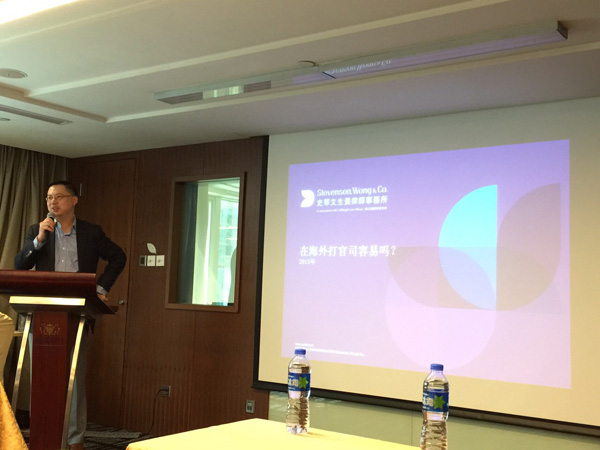
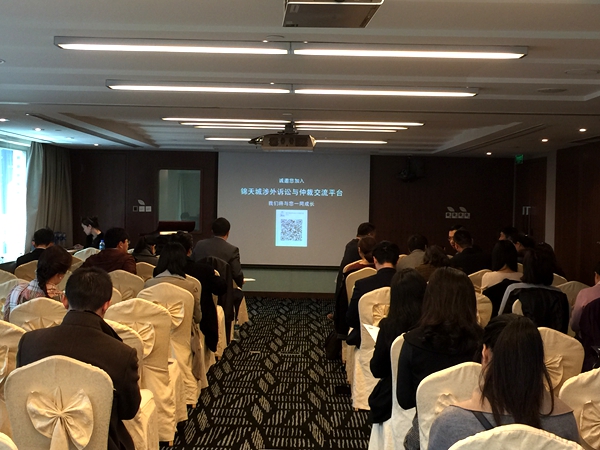
On 8 April 2015, SW partner Mr. Eric Lui and SW Head of Business Development (China) Ms. Connie Yeung attended “2015 International Dispute Resolution Forum” held in Shanghai by AllBright Law Offices. Topic of the forum was “How PRC enterprises resolve cross-border investment disputes by way of arbitration”.

Introduction was given at the forum on areas including cross-border disputes, overseas litigation as well as arbitration in Shanghai and Korea. In light of China’s economic growth, numerous PRC enterprises actively expand their business overseas and thus inevitably encounter cross-border disputes which have to be resolved by litigation or arbitration. In response to such needs, Mr. Eric Lui delivered a speech and his topic was “Is it easy to resolve disputes by litigation overseas?”. In addition, Eric gave in-depth exchange of ideas with attendees including entrepreneurs, legal personnel and investors.

Please contact our Eric Lui for any enquiries or further information about this event.
8 Apr 2015

Special Provisions in the new CIETAC Rules 2015 for Hong Kong Arbitration

The China International Economic and Trade Arbitration Commission (“CIETAC”) Arbitration Rules 2015 (“the 2015 Rules”) applies to CIETAC arbitrations commenced on or after 1 January 2015, or where the parties agree to apply the 2015 Rules for arbitrations commenced before 1 January 2015.  Given Hong Kong has a separate judicial and arbitration regime, certain special provisions are provided for in the 2015 Rules for CIETAC arbitrations.  This article will provide a brief summary on the special provisions for CIETAC arbitrations administered by CIETACHong   KongArbitrationCenter.

Article 74 – Place of Arbitration and Law Applicable to the Arbitral Proceedings

This Article provided that unless otherwise agreed by the parties, for an arbitration administered by the CIETACHong KongArbitrationCenter, the default place of arbitration shall be Hong Kong.  The arbitration law of Hong Kong is the applicable law to the arbitral proceedings and the arbitral award made in a CIETAC Hong Kong arbitration shall be a Hong Kong award.

Article 75 – Decision on Jurisdiction

Firstly, in Article 75, it provided that any objection to an arbitration agreement and/or the jurisdiction over an arbitration case must be raised in writing before the submission of the first substantive defense whereas in the general provisions (Article 6.4) of the 2015 Rules, any objections can be made before the first oral hearing.

Secondly, Article 75 stated that the arbitral tribunal shall have the power to determine the existence and validity of the arbitration agreement and its jurisdiction over the arbitration case. In the contrary, under the general provisions (Article 6.1), the arbitral tribunal can only make such determination when CIETAC delegates the relevant power to the tribunal.

This special provision has brought the 2015 Rules applicable to the CIETAC Hong Kong more consistent with the international arbitration rules in relation to any jurisdictional challenges.

Article 76 – Nomination or Appointment of Arbitrator

The CIETAC Panel of Arbitrators is to be recommended in arbitration cases administered by the CIETACHong KongArbitrationCenter.  However, this Article also provided the option to the parties to nominate their preferred arbitrators from outside the CIETAC’s Panel of Arbitrators.  Consensus between the parties on nomination is not necessary.

Clearly, this gave some flexibility to the parties as compared to the general provisions (Article 26.2) where agreement between all parties must be reached.  Nonetheless, one should also note that even consensus between the parties is not a prerequisite, the nominated arbitrator is subject to the confirmation of the Chairman of CIETAC before he/she can be appointed.

Article 77 – Interim Measures and Emergency Relief

This Article conferred the power on the arbitral tribunal to order appropriate interim measures when requested by one of the parties, or if the arbitral tribunal has not yet been formed, a party may apply for emergency relief pursuant to the CIETAC Emergency Arbitrator Procedures.  This provided a more extensive power to the arbitral tribunal as compared to the CIETAC tribunals in mainland arbitrations.

Although Article 23 in the general provisions allows the parties to apply for an emergency arbitrator to grant any urgent interim relief, under PRC law, the power to grant such measures is generally reserved to PRC courts.  Therefore, CIETAC does not have the power to actually grant such relief to the parties and will have to forward such application to the relevant PRC courts.

1 Apr 2015

The New CIETAC Arbitration Rules 2015

The China International Economic and Trade Arbitration Commission (“CIETAC”) Arbitration Rules 2015 (“the 2015 Rules”) has come into effect on 1 January 2015, which will apply to all CIETAC arbitrations commenced on or after 1 January 2015. For arbitration proceedings commenced before 1 January 2015, parties may also agree to adopt the 2015 Rules.

One of the highlights of the new 2015 Rules is the introduction of emergency arbitrators under Art.23, which is in line with s.22B of Hong Kong’s Arbitration Ordinance. S.22B provides that any emergency relief granted, whether in or outside Hong Kong, by an emergency arbitrator is enforceable in the same manner as a court order with leave of the court. Such emergency relief may include:-

  • Interim injunction to prevent actions which are likely to cause harm or prejudice to the arbitral process;
  • Relief for preservation of assets;
  • Security for costs of the arbitration, etc.

Another highlight of the 2015 Rules is that provisions which address multi-party disputes are introduced. Article 18 enables a party to file a request for joinder with CIETAC to join an additional party to the arbitration proceedings, and a decision shall be made by CIETAC after hearing submissions from all parties. CIETAC may also consolidate two or more arbitrations into a single arbitration under certain conditions stipulated in Article 19.

Please contact our Eric Lui or Heidi Chui for any enquiries or further information about this news.